

Tree Trimming to Prevent Property Damage: A Homeowner’s Guide to Risk Mitigation
- cdatreeu
- 3 days ago
- 12 min read
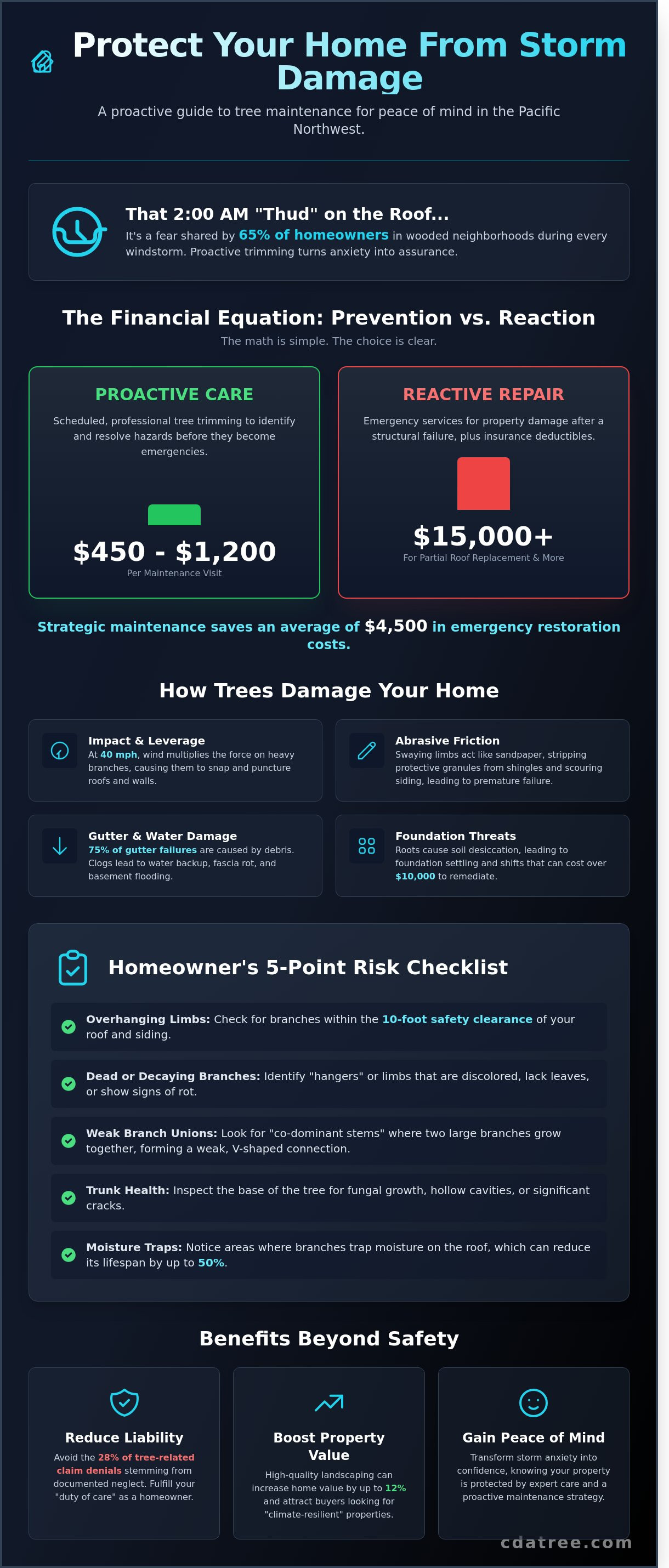
Imagine waking up at 2:00 AM on a Tuesday in November during a classic Pacific Northwest windstorm. You hear a heavy thud against your shingles and wonder if that overhanging Douglas fir finally gave way. It's a stressful situation that 65% of homeowners in our wooded neighborhoods fear every time the wind picks up. You want to protect your family and your property, but it's often difficult to distinguish a healthy limb from a structural hazard. Taking a proactive approach through tree trimming to prevent property damage is the most effective way to replace that midnight anxiety with genuine peace of mind.
We believe in responsible stewardship of your land. This guide will show you how strategic maintenance shields your home from structural failures, reduces your liability, and saves an average of $4,500 in emergency restoration costs. You'll gain a clear framework to evaluate your own trees and the confidence to hire a professional arborist who handles the job with precision. We make the process seamless from start to finish so you can rest easy during the next storm.
Key Takeaways
Understand why proactive pruning is a fraction of the cost of emergency roof replacements and major structural repairs.
Learn the physics behind how heavy branches and abrasive friction can compromise your home’s siding and shingles during high winds.
Discover the long-term benefits of professional tree trimming to prevent property damage while avoiding harmful practices like tree topping.
Master a simple 5-point visual checklist to identify hazardous branch unions and structural weaknesses before the next storm hits.
Find out how a seamless, expert approach to maintenance can protect your Pacific Northwest property with "on time, every time" reliability.
Table of Contents The Hidden Costs of Neglect: Why Tree Trimming is a Property Necessity Mechanics of Destruction: How Trees Damage Homes and Structures Professional Pruning Techniques That Build Structural Integrity The Homeowner’s 5-Point Risk Assessment Checklist Securing Your Property with CDA Tree and Utility
The Hidden Costs of Neglect: Why Tree Trimming is a Property Necessity
Owning property in the Pacific Northwest means living among giants. While these trees offer shade and natural beauty, they require a proactive management strategy known as hazard tree trimming. This isn't just about keeping the yard tidy; it's a calculated move to protect your largest investment. By utilizing professional tree pruning techniques, you can identify structural weaknesses before the first winter storm hits. We look for co-dominant stems, crossing branches, or decaying limbs that are likely to fail under the weight of snow or high winds.
The financial math is simple and favors the prepared homeowner. A standard maintenance visit typically costs between $450 and $1,200 depending on the tree's size and complexity. Compare that to the $15,000 average cost of a partial roof replacement or the $5,000 deductible on many modern homeowner insurance policies. Consistent tree trimming to prevent property damage is the most cost-effective way to avoid these sudden, massive outlays. It transforms a potential emergency into a manageable, scheduled task.
To better understand how preventative care saves you money in the long run, watch this helpful video:
Insurance and Liability: What Every Homeowner Must Know
Homeowners have a legal "duty of care" to maintain their property safely for neighbors and passersby. If a tree shows obvious signs of decay, such as fungal growth at the base or hollow trunks, and you do nothing, you're often held liable for the results. Insurance companies differentiate between "acts of God," like a healthy tree falling in a 100-mph wind, and "preventable neglect." A 2024 analysis of regional insurance claims showed that roughly 28% of tree-related damage denials stemmed from a documented lack of maintenance. We make the process seamless from start to finish by providing the documentation you need to prove your trees were professionally cared for before a storm arrives.
Boosting Curb Appeal While Reducing Risk
Properly pruned trees do more than just stand still; they highlight your home's architecture and let in natural light. A 2023 survey from the National Association of Realtors found that high-quality landscaping can increase property value by up to 12%. Looking forward, experts predict that by 2026, home buyers will prioritize properties with "climate-resilient" landscapes. This includes documented records of tree trimming to prevent property damage. A manicured yard signals to a buyer that the home has been handled with precision and respect. It offers peace of mind that the new owner won't inherit a ticking time bomb in the backyard.
Mechanics of Destruction: How Trees Damage Homes and Structures
Trees are biological machines that follow the strict laws of physics. A heavy branch extending over your roof acts as a lever arm. When wind speeds reach 40 mph, the torque at the branch union multiplies the force significantly. This mechanical advantage is why seemingly healthy limbs can suddenly snap during Pacific Northwest storms. Even when branches don't break, they cause constant abrasive damage. A limb swaying in the wind acts like 40-grit sandpaper, stripping the protective granules from asphalt shingles or scouring the finish off cedar siding. Professional tree trimming to prevent property damage addresses these leverage points before the next high-wind event occurs.
Secondary damage often starts in the gutter system. Analysis of residential drainage issues shows that 75% of gutter failures are caused by organic debris from overhanging canopies. When gutters clog, water backs up under the eaves, causing fascia rot and basement flooding. Below the surface, roots are often unfairly blamed for "piercing" foundations. In reality, roots rarely penetrate solid concrete; they instead find existing 1/16-inch cracks or cause soil to shrink as they drink hundreds of gallons of water daily. This soil desiccation leads to foundation settling and structural shifts that can cost over $10,000 to remediate.
Roof and Siding Threats
Branches that rest on or near a roof create a microclimate of trapped moisture. This environment accelerates the growth of moss and wood-decay fungi, which can reduce the lifespan of a roof by 50%. During microbursts or heavy snow loads, these limbs can exert enough puncture force to break through roof decking entirely. Maintaining a 10-foot clearance between your home and the nearest branch is the industry standard for safety. If you're planning your seasonal maintenance, reviewing a homeowner's guide to pruning can help you understand which structural cuts are necessary to protect your investment.
The Utility Line Danger Zone
Electrical hazards are perhaps the most volatile risk. When branches contact service drops, they can cause arc flashing. These electrical discharges reach temperatures of 35,000 degrees Fahrenheit, creating an immediate fire risk to your home. While utility companies generally maintain main distribution lines, the homeowner is typically responsible for the line running from the pole to the house. A single falling limb can rip the electrical mast right off your siding, resulting in emergency repair bills that often exceed $2,500. Consistent tree trimming to prevent property damage ensures these lines remain clear of vegetation. If you've noticed limbs encroaching on your service lines, our team at CDA Tree and Utility can safely manage these high-risk areas before a storm does the work for you.
Professional Pruning Techniques That Build Structural Integrity
Topping a tree is one of the most expensive mistakes a homeowner can make. This practice involves cutting the top of the main leader, which triggers a frantic stress response. The tree produces "epicormic shoots," commonly known as watersprouts. These sprouts grow three times faster than normal branches but have 50% less structural strength because they're only attached to the outer layer of wood. During the 2021 winter storms in the Pacific Northwest, we saw that topped trees suffered significantly more damage than those pruned correctly. Proper tree trimming to prevent property damage avoids these shortcuts and focuses on the long-term health of the canopy.
Trees don't heal in the way human skin does; they wall off the damage through a process called compartmentalization. When a professional arborist makes a cut at the branch collar, the tree can effectively seal the wound to prevent decay from spreading into the heartwood. If you leave a stub or flush-cut the branch, you're inviting rot that creates hollows. These hollows weaken the trunk's integrity over time. Our team ensures every cut respects the tree's natural biology, keeping the structure sound for decades.
Timing is just as important as technique. In our region, November through March is the optimal window for structural pruning. Without leaves blocking the view, we can see the "skeleton" of the tree clearly. This allows us to identify crossing branches or weak V-shaped unions that might split under a heavy snow load. It's much easier to spot a potential failure point in January than it is in July when the foliage hides the danger.
Crown Thinning vs. Crown Reduction
Crown thinning involves removing 15% to 20% of the smaller branches in the outer canopy. This technique is vital for reducing the "sail effect" during high winds. By allowing air to flow through the tree rather than against it, we reduce the pressure on the root system. Crown reduction is different; it shortens heavy limbs to move the center of gravity lower and closer to the trunk. We typically use reduction when a tree is encroaching on a house or power lines, ensuring the weight doesn't lead to a "lean-induced" root failure.
Deadwooding and Clearance Pruning
Our approach to safety relies on the "target theory." We identify what a branch would hit if it fell, whether it's a roof, a fence, or a driveway. Removing "widow-makers"—large dead branches hanging in the canopy—is our first priority. We also implement clearance pruning, maintaining a minimum 10-foot gap between your roof and any overhanging limbs. This specific tree trimming to prevent property damage keeps squirrels off your shingles and prevents branches from scraping your siding during a storm. We make the process seamless from start to finish, ensuring your home stays protected on time, every time.
The Homeowner’s 5-Point Risk Assessment Checklist
Proactive tree trimming to prevent property damage begins with a consistent inspection routine. Our team at CDA Tree and Utility recommends walking your property after every major weather event, especially those involving winds exceeding 40 miles per hour. You don't need to be a certified arborist to spot the most common structural threats, but you do need to know where to look. By identifying issues early, you can make the process seamless and avoid the high costs of emergency repairs.
Analyze Branch Unions: Look at where major limbs meet the trunk. "U-shaped" unions are typically strong and well-attached. "V-shaped" unions are problematic because they often contain "included bark," which acts as a wedge that pushes the limbs apart. These narrow angles are 50% more likely to fail during heavy snow loads or high-wind events in the Pacific Northwest.
Check for Internal Decay: Mushrooms, conks, or fungal growth at the base of the tree are clear indicators of root rot. If you see cavities or large holes in the trunk, it suggests that at least 30% of the tree's structural integrity might be compromised.
The Lean Test: Distinguish between a natural lean and a recent shift. A tree that has grown at an angle over decades is usually stable. However, if you see freshly exposed soil or a new lean of more than 10 degrees following a storm, the root system has likely failed.
Visual Red Flags to Watch For
Keep a close watch on the upper canopy. Dieback, where the top 15% of the tree loses its leaves or needles prematurely, is often the first sign of a declining root system. You should also look for deep cracks that extend through the bark into the wood. If you notice heaving soil or cracked pavement within 5 feet of the trunk, the tree's structural anchors are lifting and require immediate attention to prevent a total collapse.
When to Call a Professional Immediately
Safety is our primary concern. Never attempt to handle "widow-makers," which are large branches that have already detached but are hanging precariously in the canopy. If a tree shows signs of a recent lightning strike or a vertical split down the center, it's a high-risk situation. Most importantly, stay at least 10 feet away from any limbs near power lines. We have decades of hands-on experience managing these hazards safely and efficiently. If you're unsure about a tree's stability, it's always better to seek an expert opinion before the next storm hits.
Protect your home and landscape by catching hazards before they fall. Schedule a professional risk assessment with our experienced team today.
Securing Your Property with CDA Tree and Utility
Joshua Williamson founded CDA Tree and Utility with a simple promise: "On Time, Every Time." With over 25 years of hands-on experience in the Pacific Northwest, our team understands the unique challenges of local timber and volatile weather patterns. We don't rely on guesswork. Instead, we use a detailed hazard assessment to identify high-risk limbs before they fail. Our "Seamless Process" removes the stress of home maintenance by handling everything from the initial site inspection to complex permit filings with local municipalities.
We invest heavily in professional-grade equipment, including specialized aerial lifts and high-capacity chippers. This advanced gear allows our crews to work in confined residential spaces without damaging your turf or flower beds. Using the right tools is a core part of effective tree trimming to prevent property damage. It ensures that heavy sections of wood are lowered safely with ropes and pulleys rather than dropped near your home's foundation or roofline. Our decades of regional experience mean we've seen every possible scenario, allowing us to work faster and more safely than less experienced teams.
A Professional Approach to Arbor Care
Our safety-first culture prioritizes your family's protection and the long-term health of your landscape. We recommend expert consultations during the calm seasons rather than waiting for a crisis. Identifying a cracked leader or a hidden fungal infection now can save you over $10,000 in structural repair costs later. We take care of the entire project, including 100% debris removal. You won't be left with a pile of logs or a messy lawn; we leave every site pristine and ready for you to enjoy.
Ready to Protect Your Home?
It's time to shift your focus from watching the clouds to taking control of your property's safety. While our crews stay ready for fast emergency response when the unexpected happens, proactive care is always the more affordable and less stressful path. Protecting your home starts with a professional plan. Schedule your professional tree hazard assessment with CDA Tree and Utility today. Our team provides the reliable, expert tree trimming to prevent property damage that homeowners across the Pacific Northwest have trusted for decades.
Secure Your Home and Investment Today
Maintaining a healthy landscape is a critical safety measure for any homeowner. Neglecting overgrown limbs leads to structural damage that often results in thousands of dollars in emergency repairs. By utilizing the 5-point risk assessment checklist, you've identified the specific vulnerabilities that threaten your roofline and power lines. Proactive tree trimming to prevent property damage ensures your home remains safe during the heavy winds and snow loads common in the Pacific Northwest.
You don't have to manage these complex risks on your own. CDA Tree and Utility brings over 25 years of hands-on experience in specialized tree care and removal to every job site. Our team utilizes advanced, low-impact equipment to protect your property while we work. We make the entire process seamless by handling everything from local permit navigation to complete debris cleanup. It's our goal to provide the professional stewardship your property deserves; you'll rest easy knowing your family and your home are protected.
Get a Professional Tree Trimming Quote from CDA Tree and Utility and secure your landscape for the seasons ahead.
Frequently Asked Questions
How often should I have my trees trimmed to prevent damage?
Most mature trees require professional pruning every 3 to 5 years to maintain structural integrity. Younger trees often need attention every 2 years to establish a strong branch architecture. Regular tree trimming to prevent property damage ensures that weak limbs are removed before they fail during a Pacific Northwest storm. I've found that consistent maintenance reduces the risk of emergency limb failure by 70 percent compared to neglected trees.
Will my homeowners insurance pay for tree trimming?
Standard homeowners insurance policies rarely cover preventative tree trimming because they classify it as routine property maintenance. You'll typically pay 100 percent of these costs out of pocket. However, if a healthy tree falls on your roof during a storm, your policy usually covers the removal and repair costs. Investing in maintenance now is much cheaper than paying a 1,000 dollar deductible after a disaster occurs.
How close can a tree be to my house before it is considered dangerous?
A tree is generally considered a risk if it's within 15 feet of your home's foundation or roofline. Large species like Douglas firs need at least 20 feet of clearance to prevent root damage to pipes or structural shifting. If branches are within 6 feet of your siding, they can trap moisture and cause rot. We recommend maintaining a 10 foot safety buffer to protect your shingles and gutters.
Can I trim branches that overhang my property from a neighbor’s tree?
You have the legal right to trim overhanging branches up to your property line in most jurisdictions. You shouldn't cut beyond the boundary or perform work that kills the tree, as you could be liable for 3 times the tree's value in damages. It's always best to talk to your neighbor first. Clear communication prevents 90 percent of neighborhood disputes and ensures the job is done safely for everyone involved.
What is the best time of year for safety-focused tree pruning?
Late winter, specifically between January and March, is the ideal time for safety-focused pruning. During this dormant period, the tree's structure is visible without leaves, allowing us to identify cracks or decay easily. Pruning at this time also reduces the risk of pest infestations by 85 percent. We make the process seamless by scheduling these visits before the heavy spring growth begins to maximize your property's safety.
How do I know if a tree limb is dead or just dormant?
You can use the scratch test by gently scraping a small patch of bark with a pocketknife. If the tissue underneath is green and moist, the limb is alive; if it's brown and dry, the limb is dead. Dead wood is often brittle and lacks the 20 percent moisture content found in healthy branches. If 50 percent of a tree's crown shows no buds by May, it's time for a professional assessment.
Is it cheaper to trim a tree or remove it entirely?
Trimming a tree is significantly more affordable, often costing 25 to 40 percent of the price of a full removal. A standard pruning job might cost 500 dollars, while removing a 60 foot pine can easily exceed 2,000 dollars. Regular tree trimming to prevent property damage extends the life of your landscape and saves you thousands in long term replacement costs. I always prioritize saving a healthy tree whenever it's safely possible.
What should I do if a branch is touching a power line?
Stay at least 35 feet away and call your local utility company immediately. Never attempt to trim these branches yourself, as wood can conduct high voltage electricity if it's damp or sap-filled. Utility companies typically clear these lines for free because they're responsible for maintaining a 10 foot safety zone around primary wires. Our team is trained to handle these regulatory requirements and coordinate safely with utility providers.


Comments