

Professional Fallen Tree Cleanup: A Complete Safety and Removal Guide
- cdatreeu
- 1 day ago
- 13 min read
Updated: 19 hours ago
On November 15, 2023, a homeowner in Kootenai County woke up to find a 70-foot Douglas fir resting precariously against their primary bedroom. It's a terrifying sight that immediately sparks questions about structural integrity and the complexities of insurance coverage. When you're facing a massive trunk tangled in power lines or leaning over your roof, the pressure to act quickly often clashes with the need for extreme caution. Professional Post Falls fallen tree cleanup requires more than just a chainsaw; it demands a deep understanding of tensioned wood and Pacific Northwest soil conditions to prevent secondary damage during the clearing process.
We understand the fear of a simple cleanup turning into a costly disaster. You want your yard back to its beautiful, safe state without the headache of a rejected insurance claim or a compromised foundation. This guide outlines the exact steps our team at CDA Tree and Utility uses to manage these hazards efficiently. You'll learn how to document evidence for your adjuster, identify high-risk tension zones, and ensure the removal is seamless from start to finish. We're here to provide the calm competence you need to reclaim your property with confidence.
Key Takeaways
Identify critical hazards like downed power lines and unstable limbs to establish a secure "no-go" zone for your family and pets.
Master the professional techniques used in Post Falls fallen tree cleanup, including tension analysis to prevent dangerous "spring poles" from snapping during removal.
Learn when specialized heavy machinery is required and why specific personal protective equipment is essential for managing high-risk debris.
Navigate homeowner’s insurance complexities by understanding the "structure vs. yard" rule to potentially lower your out-of-pocket restoration costs.
Discover how a seamless, professional approach ensures your property is cleared efficiently and safely by seasoned arbor care experts.
Table of Contents Immediate Safety Assessment: Steps to Take Before Cleanup The Professional Fallen Tree Cleanup Process Essential Equipment and Professional Techniques Insurance, Documentation, and Cleanup Costs Why CDA Tree and Utility is the Premier Choice for Cleanup
Immediate Safety Assessment: Steps to Take Before Cleanup
Storm damage in North Idaho is often unpredictable and dangerous. When you face a Post Falls fallen tree cleanup situation, your first priority must be a cold, calculated safety assessment. A fallen trunk isn't just a pile of wood; it's a complex system of stored energy. Professional Arboriculture teaches us that tension and compression forces remain active long after the tree hits the ground. One wrong cut can release thousands of pounds of pressure in a fraction of a second.
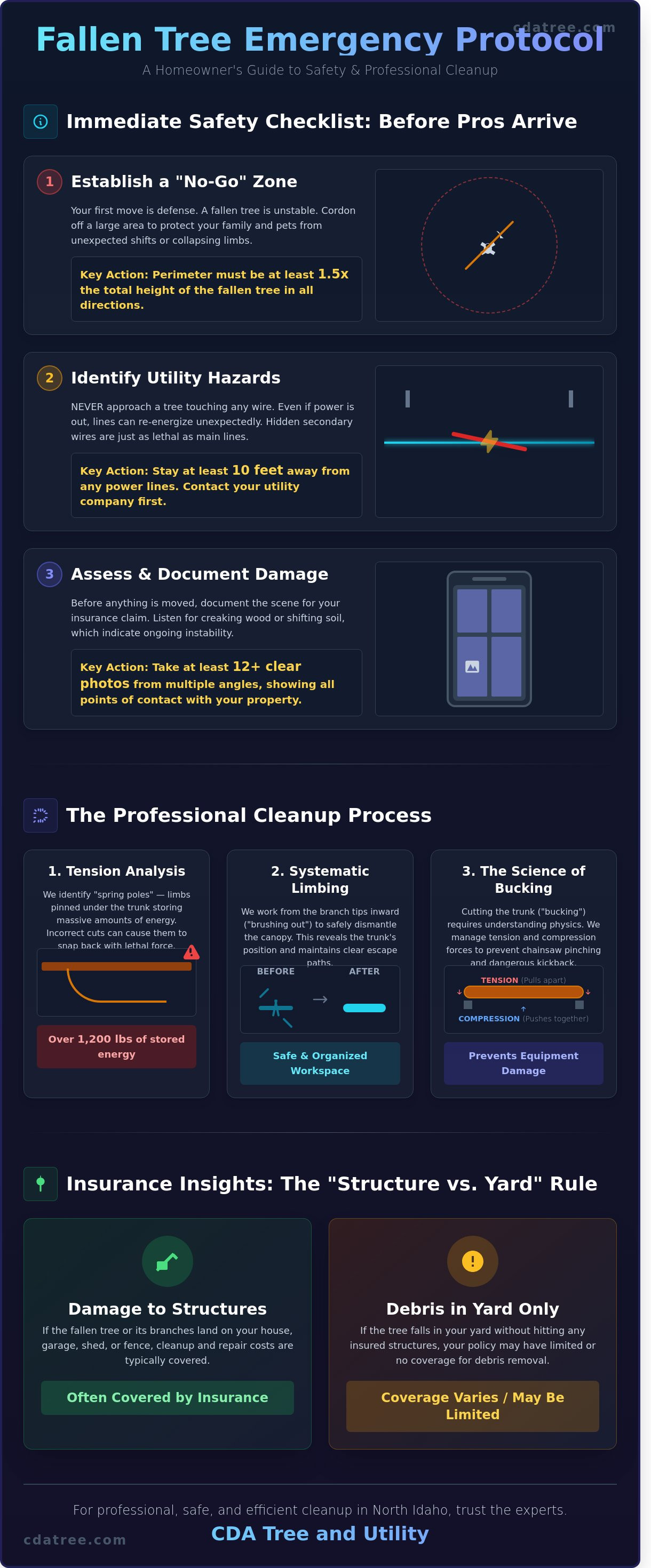
Establishing a strict "no-go" zone is your first defensive move. This perimeter should extend at least 1.5 times the total height of the tree in every direction. Keep family members and pets behind this line until a professional arrives. You must also watch the root plate carefully. During the high-wind events of January 2024, several local properties saw trees "stand back up" unexpectedly. This happens when the weight of the canopy is removed, allowing the root ball's natural tension to pull the trunk upright with lethal force.
To better understand this concept, watch this helpful video:
Utility and Power Line Hazards
Never approach a tree that's touching a wire. It doesn't matter if your neighborhood's power is out. Lines can be energized at any moment by automated grid switching or back-feed from a neighbor's portable generator. In our area, you should contact Avista or Kootenai Electric first if lines are involved. We follow the 10-foot rule: stay at least 10 feet away from any utility infrastructure, including the service drop to your home. Debris often hides "hidden" lines or secondary wires that are just as dangerous as high-voltage primary lines.
Assessing Structural Integrity
Before we begin a Post Falls fallen tree cleanup, we evaluate how the tree is resting. Check if the canopy is supported by your roof, a fence, or a vehicle. Take at least 12 clear photos from multiple angles for your insurance adjuster before anything is moved. Look for signs that the tree is still shifting. Creaking wood, snapping sounds, or fresh soil movement around the root ball are clear indicators of instability. If the trunk is suspended off the ground by its own branches, it's under extreme tension. This requires specialized rigging and decades of hands-on experience to dismantle without causing further property damage.
The Professional Fallen Tree Cleanup Process
Clearing a downed tree requires more than just a chainsaw; it is a calculated operation that ensures the safety of your property and our crew. For homeowners dealing with a Post Falls fallen tree cleanup after a windstorm, the process begins with a rigorous site evaluation. We first identify hazardous trees nearby that might still be standing but remain unstable. This initial assessment is vital because a secondary fall can occur during the removal of the primary debris.
A critical part of our safety protocol is tension analysis. We look for "spring poles," which are branches or smaller trees pinned under the weight of the main trunk. These limbs can hold over 1,200 pounds of stored kinetic energy. If a technician cuts these incorrectly, they snap back with lethal force. Our team uses specific release cuts to neutralize this tension safely before moving to the next stage of the removal.
Understanding Limbing and Brushing
Professional crews use a technique called "brushing out" the canopy. We start from the outer tips of the branches and work systematically toward the main trunk. This keeps the workspace organized and prevents the crew from getting tripped up by tangled limbs. By managing the debris pile as we go, we maintain clear escape paths at all times. In the Pacific Northwest, where Douglas firs and Ponderosa pines often have dense, heavy branch patterns, this systematic approach prevents the saw from getting pinned and ensures the tree doesn't shift unexpectedly. Our goal is to reveal the "skeleton" of the tree so we can see exactly how it's resting on the ground.
The Science of Bucking the Trunk
Bucking is the process of cutting the main trunk into manageable logs. This is where professional physics comes into play. Gravity creates two distinct zones in a downed log: compression, where wood fibers are pushed together, and tension, where they're pulled apart. Cutting into a compression zone will pinch a chainsaw bar in seconds, potentially damaging the equipment or causing a kickback. We use a "bore cut" or a "top-bottom" technique to manage these opposing forces.
We typically cut logs into specific lengths, such as 16-inch rounds for firewood or 8-foot sections if the wood is destined for a local mill. Once the trunk is bucked, the final step involves debris hauling and site restoration. We don't just leave a pile of wood; we ensure the ground is raked and the area is safe for your family to use again. Since 2004, we've refined this process to be as efficient as possible. If you're overwhelmed by storm damage, our team can provide a seamless cleanup solution that restores your landscape to its original beauty. This professional approach to Post Falls fallen tree cleanup ensures that no further damage occurs to your turf or nearby structures during the removal process.
Essential Equipment and Professional Techniques
Professional Post Falls fallen tree cleanup requires more than just a sharp blade and a willing hand. When a storm hits the Pacific Northwest, the resulting debris often involves thousands of pounds of unstable timber resting at precarious angles. Handling these situations safely demands a combination of heavy machinery and specialized rigging techniques that go far beyond standard landscaping. Our team approaches every job with a focus on precision, ensuring we protect your property while removing hazards efficiently.
Safety starts with the right gear. For high-risk cleanup, every crew member must utilize specific Personal Protective Equipment (PPE). This includes UL-certified chainsaw chaps, Class E hard hats for impact protection, and hearing protection with a minimum Noise Reduction Rating of 25dB. We don't just wear the gear; we follow strict protocols to ensure every cut is planned before the saw even starts. This meticulous approach is why we've been a trusted partner for local homeowners for decades.
Specialized Cleanup Machinery
We utilize grapple trucks to streamline the removal process. These machines feature hydraulic arms that can lift heavy logs directly over fences or landscaping, which reduces foot traffic and prevents lawn damage. When a 4,000-pound Ponderosa pine rests on a residential roof, a crane is often the only safe solution. The crane allows us to lift the tree vertically, removing the weight from the structure without causing secondary damage. Once the heavy lifting is done, we perform stump grinding to a depth of 6 to 12 inches below grade. This step is essential for site restoration and ensures your lawn is ready for replanting.
The Danger of DIY Chainsaw Work
Many homeowners own a chainsaw, but storm-damaged wood is notoriously unpredictable. According to CDC data, chainsaw-related accidents lead to approximately 36,000 emergency room visits every year. The primary cause of these injuries is a "bind," which occurs when the weight of the tree shifts and pinches the saw blade, often resulting in a violent kickback toward the operator. Storm-damaged wood fibers are under extreme tension, meaning a single cut can cause a branch to spring back with enough force to cause critical injury.
Compression wood is a high-density growth formed on the underside of leaning trunks that stores dangerous levels of energy, causing the wood to expand or shatter the moment a chainsaw breaks the surface tension. Because of these risks, Post Falls fallen tree cleanup should always be handled by professionals who understand wood physics. We make the process seamless from start to finish, providing the expert care your property deserves. Our commitment is to be on time, every time, delivering results that keep your home safe and beautiful.
Insurance, Documentation, and Cleanup Costs
Managing the aftermath of a storm is stressful, but understanding the financial side helps restore a sense of control. Most homeowners in the Pacific Northwest rely on their insurance policies to handle the heavy lifting. The "structure vs. yard" rule is the primary guideline adjusters use in 2026. If a tree hits your home, garage, or a permanent fence, your policy typically covers the removal costs. If the tree falls in an open area of your lawn without hitting anything, insurance companies often view the cleanup as a maintenance issue rather than a covered peril. One exception occurs when a fallen tree blocks a driveway or a handicap-accessible ramp, which often triggers coverage regardless of property damage.
Our team at CDA Tree and Utility focuses on making this process seamless. We know that clear communication with your insurance provider prevents out-of-pocket surprises. We provide the professional documentation required to prove the necessity of the service, ensuring you meet your policy's specific requirements for Post Falls fallen tree cleanup.
Navigating the Insurance Claim
Success with an insurance claim starts with the "look but don't touch" rule. Before our crew arrives, take at least 12 photos from various distances and angles. Capture the tree's base, the point of impact on the structure, and any secondary damage to landscaping. Insurance adjusters in 2026 prioritize claims backed by thorough visual evidence. We provide an itemized invoice that separates labor hours, equipment usage, and disposal fees. This level of detail is vital for reimbursement, especially during widespread storm events when adjusters are processing hundreds of local claims simultaneously.
Calculating Cleanup Expenses in 2026
Estimating the cost of tree services requires looking at the specific logistics of your property. Size and species are the first variables. A 60-foot Douglas fir requires more manpower and heavier machinery than a decorative maple. Accessibility is the second major factor. If our trucks can't get within 40 feet of the site due to steep hills or narrow gates, the manual labor involved increases the total. Finally, urgency dictates the price. Standard scheduled removals are more affordable than 2:00 AM emergency calls that require immediate mobilization of a full crew.
Standard Cleanup: $550 to $2,200 depending on tree volume.
Emergency Response: $2,800 to $6,500+ if cranes or specialized rigging are needed.
Accessibility Surcharge: 15% to 30% for difficult terrain or backyard-only access.
Hidden Costs: Budget $200 to $600 for stump grinding and $300 for basic landscape restoration.
Don't guess when it comes to the safety and value of your property. Our decades of hands-on experience ensure you get a fair, transparent price for every job. Contact us for an accurate cleanup quote and let our experts handle the dangerous work for you.
Why CDA Tree and Utility is the Premier Choice for Cleanup
When a storm rolls through the Pacific Northwest, the damage left behind requires more than just a chainsaw and a truck. CDA Tree and Utility brings over 20 years of specialized experience to every Post Falls fallen tree cleanup project. We've spent two decades mastering the complexities of arbor care in our specific regional climate. Our team understands how local soil saturation and wind patterns affect root stability, allowing us to provide solutions that go beyond simple debris removal.
We operate with a safety-first culture that protects your home and our crew. Our fleet includes advanced equipment such as high-capacity wood chippers and 75-foot aerial lifts. This machinery allows us to dismantle tangled limbs without risking further impact on your structures. We stand by our "On Time, Every Time" commitment. If we schedule your assessment for 8:00 AM, our experts will be there at 8:00 AM. Reliability is the foundation of our business.
A Seamless Process from Start to Finish
Dealing with a downed tree is stressful enough without worrying about red tape. We manage the entire project lifecycle, including securing necessary permits required by Kootenai County or local municipalities. You won't have to navigate regulatory paperwork alone. Our crew prioritizes your property's aesthetics, ensuring we leave your landscape better than we found it. Joshua Williamson, our owner, remains directly involved in every project. This direct line of communication ensures total accountability and a personal touch that larger corporations can't match.
Ready for Any Emergency
Hazardous trees don't wait for business hours. We provide a 24-hour rapid response for situations where a tree threatens power lines or structural integrity. Our experts perform a professional hazardous tree assessment on every site to identify 100 percent of potential risks before they cause another emergency. We look for hidden fractures and root rot that an untrained eye might miss. Contact us today for a fast, fair, and professional quote on your Post Falls fallen tree cleanup. Let us restore safety and beauty to your property with our proven, seamless approach.
Take Control of Your Property Recovery
Managing the aftermath of a storm requires a focus on immediate safety and long-term property health. You now understand the risks of unstable root balls and the necessity of professional equipment for complex removals. Handling Post Falls fallen tree cleanup isn't a DIY project; it's a task for seasoned experts who prioritize your safety. Since 1997, CDA Tree and Utility has provided the Pacific Northwest with reliable solutions for even the most precarious situations. We use advanced rigging and specialized crane capabilities to safely lift heavy timber away from structures, preventing further costly damage to your home.
Our team stands by an "on time, every time" guarantee, so you're never left waiting when a hazard is sitting in your yard. We've spent 27 years refining a seamless process that covers everything from the initial safety assessment to the final haul-away. You can trust our local expertise to handle the heavy lifting while you focus on getting life back to normal. It's time to clear the debris and move forward with confidence.
Get a Professional Cleanup Quote from CDA Tree and Utility today. We're here to make your landscape safe and beautiful again.
After the tree itself is handled, the recovery process may involve broader property maintenance to address any lingering damage to landscaping or structures. For these comprehensive needs, services from a company like JBM Custom Contracting can be a valuable next step in getting your home and yard fully back to normal.
Frequently Asked Questions
Does insurance cover the cost of fallen tree cleanup?
Homeowners insurance generally covers the removal costs if a tree hits a covered structure like your house, garage, or fence. Most standard policies in the Pacific Northwest provide $500 to $1,000 for debris removal following a storm. If the tree falls in an open yard without damaging property, insurance usually won't pay for the cleanup. Always take 5 or more photos of the damage before we start the Post Falls fallen tree cleanup process to assist with your claim.
What should I do first if a tree falls on my house?
Evacuate everyone from the building immediately and call 911 if you suspect any structural instability or fire risk. Once you're safe, contact your utility company to shut off power if lines are down. You should call a professional arborist within 60 minutes to stabilize the tree and prevent further damage. We offer 24/7 emergency response to secure your property and make the entire recovery process feel seamless and controlled.
Can I keep the wood from a fallen tree for firewood?
You can certainly keep the wood for your own use, and our team will buck it into 16 inch rounds for you. Choosing this option often saves you the 15 percent disposal fee that's typically included in a standard removal estimate. Remember that hardwood like oak needs 12 months to season, while softwoods like pine might be ready in 6 months. We'll stack the wood in a designated spot to keep your yard tidy and safe.
How long does it typically take to clear a large fallen tree?
A single 50 foot pine tree usually takes our crew between 3 and 5 hours to fully cut, chip, and haul away. If the tree is tangled in power lines or resting on a roof, the process can take 1 to 2 full workdays to complete safely. We use 72 horsepower stump grinders and high capacity chippers to move through the job efficiently. Our goal is to restore your property to its original state as quickly as possible.
Is a permit required for fallen tree removal?
In most cases, you don't need a permit to remove a tree that has already fallen due to natural causes or decay in Post Falls. However, if the tree is located within 25 feet of a shoreline or in a protected municipal zone, specific Kootenai County ordinances apply. We handle all the necessary regulatory research for you to ensure your project stays 100 percent compliant. Our team manages the paperwork so you don't have to worry about local fines.
What is a 'spring pole' and why is it dangerous during cleanup?
A spring pole is a sapling or branch that's bent under the weight of a fallen tree, creating immense mechanical tension. When these are cut incorrectly, they can snap back with over 500 pounds of force, causing severe injury to anyone nearby. Statistics show that roughly 30 percent of professional logging injuries involve these types of energy releases. Our experts use specialized techniques like the shave cut to neutralize this tension safely during your Post Falls fallen tree cleanup.
How much does professional fallen tree cleanup cost on average?
Most local homeowners spend between $450 and $2,000 for professional cleanup depending on the size and location of the tree. If we need to bring in a crane for a complex extraction from a roof, costs can increase to $3,500 or more. We provide a written, fixed price quote after a 15 minute on site assessment of the damage. This transparency ensures you know exactly what to expect without any hidden fees when the job is done.
Can a tree that has fallen over be replanted or saved?
It's rarely possible to save a mature tree once it has fully uprooted because at least 50 percent of the root system is usually destroyed during the fall. Small trees with a trunk diameter under 4 inches have a 70 percent survival rate if they're uprighted and staked within 24 hours. For larger specimens, the internal structural damage makes them a permanent safety hazard. We recommend replacing fallen trees with native species that are better adapted to our local climate.


Comments