

Coeur d'Alene Storm Damage Assessment: A Homeowner’s Safety Guide
- cdatreeu
- 3 days ago
- 12 min read
Updated: 2 days ago
After the 60-mile-per-hour gusts that swept through Kootenai County last Tuesday, Sarah Miller stepped into her backyard to find a 40-foot Ponderosa pine leaning precariously toward her roof. Like many of our neighbors, she needed an immediate Coeur d'Alene storm damage assessment but didn't know where to start safely. We know that the aftermath of a major weather event is overwhelming. You're likely worried about the structural integrity of your home, the tangle of downed power lines, or how to even begin documenting the mess for your insurance adjuster. It's a stressful position to be in, and your safety is the only thing that truly matters right now.
This guide provides a professional framework to help you safely identify high-risk tree hazards without putting yourself in harm's way. We've spent decades managing timber in the Pacific Northwest, and we want to share that expertise to give you peace of mind. You'll learn a clear safety checklist, discover exactly when it's time to call a certified arborist, and see how to capture the right photos for a successful insurance claim. We're here to make this process seamless so you can get back to normal as quickly as possible.
Key Takeaways
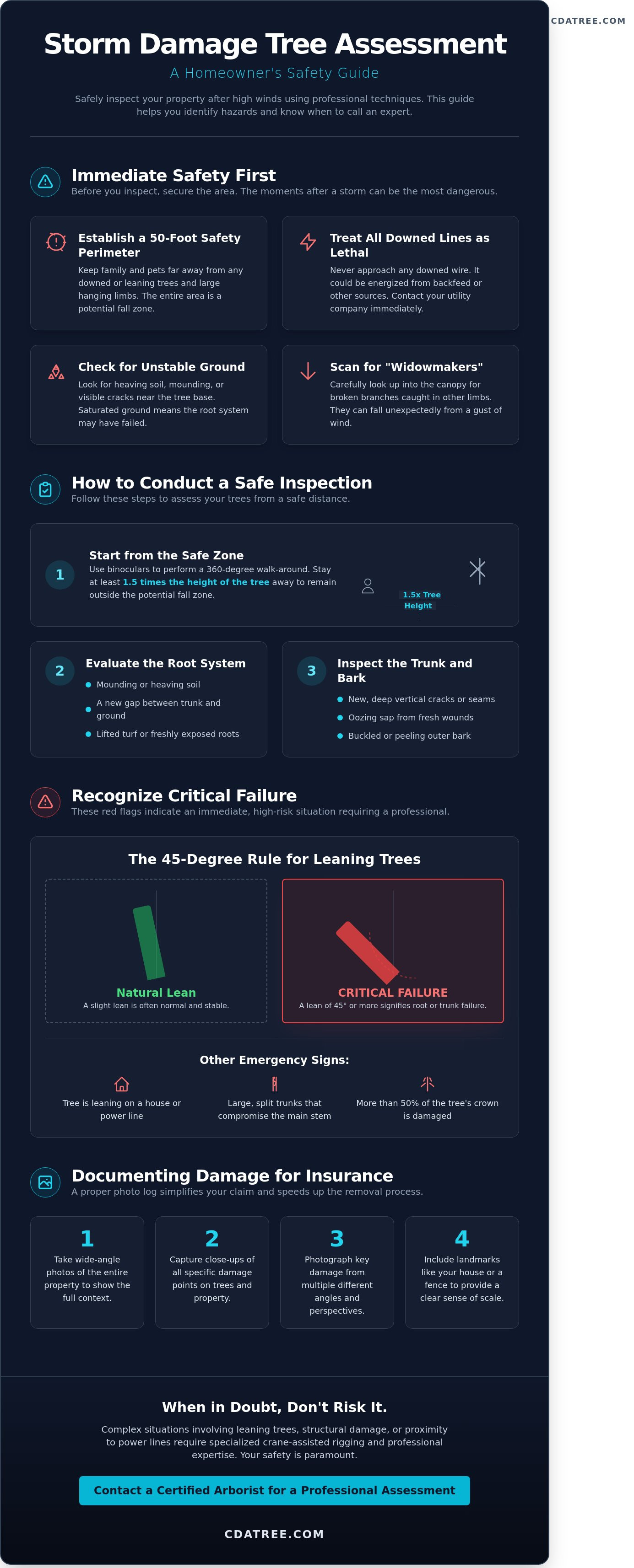
Establish a 50-foot safety perimeter and treat all downed lines as lethal to ensure your immediate protection after a major weather event.
Master professional techniques for a ground-level Coeur d'Alene storm damage assessment, including how to use binoculars to spot high-altitude hazards safely.
Learn the "45-degree rule" to distinguish between natural tree growth and critical structural failures that require emergency intervention.
Understand how to properly document property damage with a comprehensive photo log to simplify your insurance claims and ensure a seamless removal process.
Recognize the specific warning signs that signal a job is too dangerous for DIY and requires specialized crane-assisted rigging for safe resolution.
Table of Contents Immediate Safety Protocols: What to Do Before Your Storm Damage Assessment A Step-by-Step Guide to Conducting a Ground-Level Tree Inspection Identifying High-Risk Structural Damage After High Winds Documenting Damage for Insurance and Professional Removal When to Call a Professional Emergency Tree Service
Immediate Safety Protocols: What to Do Before Your Storm Damage Assessment
After a severe Pacific Northwest weather event, your first instinct is often to head outside and inspect your roof or garden. Stop. Before you begin a formal Coeur d'Alene storm damage assessment, you must secure the area. The 2021 windstorm that hit Kootenai County with 70 mph gusts proved that the most dangerous time isn't always during the storm, but the hours immediately following it. You need to establish a 50-foot safety perimeter around any downed trees or large hanging limbs. Keep all family members and pets inside until you've completed a full site sweep to identify hidden hazards.
To better understand the scale of local recovery efforts after these events, watch this video of regional authorities managing debris:
The ground itself can be a hidden hazard. Saturated soil from heavy rainfall often leads to windthrow and windsnap, where the entire root plate of a Douglas fir or Ponderosa pine lifts from the earth. If you see visible root heaving or cracked soil near the base of a tree, stay back. These trees are unstable and can finish falling without warning. Scan the upper canopy for "widowmakers." These are detached branches caught in the crown that can drop with a light breeze. Don't assume a tree is safe just because it's still standing; structural integrity can be compromised in seconds.
Identifying Electrical and Utility Hazards
Treat every downed wire as energized and lethal. In Coeur d'Alene, many homeowners use portable generators during outages. If these aren't installed with a proper transfer switch, they can cause "backfeed," sending high-voltage electricity back into downed lines you might assume are dead. Use the "Look Up and Look Down" rule. Check the ground for wires and the sky for entangled communication lines before moving. If a tree is touching a power line, call Avista or Kootenai Electric immediately. If the tree is clear of lines but poses a structural threat, contact a professional tree service.
The Danger of Tension and Compression
A downed tree isn't just a pile of wood; it's a loaded spring. When a trunk is pinned under its own weight or leaning against your home, it holds massive amounts of stored energy. Cutting a single branch can cause the entire structure to snap back or shift violently. Never walk under a tree leaning against a structure. Professional arborists identify "hangers" and tension points to prevent these sudden releases. A professional Coeur d'Alene storm damage assessment ensures these mechanical risks are neutralized before any cleanup begins.
A Step-by-Step Guide to Conducting a Ground-Level Tree Inspection
After the winds subside, your first priority is a visual check from a safe distance. Grab a pair of binoculars and perform a full 360-degree walk-around of every tree on your property. Stay at least 1.5 times the height of the tree away to ensure you stay outside the potential fall zone. This initial phase of your Coeur d'Alene storm damage assessment helps you spot hazards without putting yourself in immediate danger. Following established post-storm safety protocols is essential; never approach a tree that is entangled with utility lines or appears unstable.
Evaluating the Root System and Soil Stability
Look for signs of 'mounding' or 'heaving' near the base of the tree. If you see fresh soil exposed or a 2-inch gap between the trunk and the earth, the tree is actively uprooting. In North Idaho, our heavy rains often saturate the ground, making large evergreens like Ponderosa pines prone to root plate failure. You can distinguish these new movements from old surface roots by looking for cracked soil or lifted turf that wasn't there before the storm. Saturated soil loses its 'shear strength,' meaning a tree that stood for 30 years can suddenly lean during 50mph gusts if the root system isn't anchored in firm ground.
Trunk and Bark Inspection Techniques
Examine the main stem for new vertical seams or lightning scars. Freshly exposed white wood fibers or oozing sap suggests a recent structural split that requires immediate attention. If you notice a 'shell' failure, where the outer bark and wood layer have buckled or bucked, the tree's internal strength is likely compromised.
Seams: Look for deep cracks that run along the length of the trunk.
Fresh Sap: Note any amber or clear liquid weeping from new wounds.
Bark Shedding: Distinguish between natural shedding, like on a Cedar, and structural 'popping' where bark has been forced off by internal pressure.
Check major branch unions for 'V-shaped' splits. These narrow angles are naturally weaker than 'U-shaped' unions. If you can see daylight through the crotch of two major limbs, the risk of a secondary break is high. Finally, evaluate the canopy for shattered structural limbs hanging in the crown. These 'widow-makers' are a primary cause of property damage days after a storm has passed. If you're unsure about a specific crack or lean, a professional arborist evaluation can provide the peace of mind you need to keep your home safe.
Identifying High-Risk Structural Damage After High Winds
After a Pacific Northwest windstorm, the most dangerous threats to your property aren't always the branches lying on the lawn. Real danger often hides in the standing timber. A professional Coeur d'Alene storm damage assessment focuses on the physics of the tree to determine if it's still structurally sound. We look for subtle shifts in geometry that indicate a tree is losing its battle with gravity.
Analyzing a lean is your first priority. You must distinguish between a natural growth lean and a storm-induced lean. Trees that grow at an angle over 15 or 20 years develop "reaction wood" to compensate for the weight. However, if you see fresh soil cracks or mounded earth on the side opposite the lean, the root plate has likely detached. This is an active failure. We follow the 45-degree rule strictly; any tree that has shifted to a 45-degree angle or lower during a storm is a critical emergency. At this point, the structural integrity is gone, and the tree is held up only by friction or neighboring branches.
You should also inspect your trees for co-dominant stems. These are "V-shaped" unions where two main trunks grow from the same point. Unlike a single solid trunk, these unions often have "included bark" trapped between them, which prevents the wood from bonding. High winds act like a wedge, frequently splitting these trees right down the middle. This risk increases significantly if the tree has uneven end weight. If a 50 mph gust strips limbs from just one side of the canopy, the resulting imbalance creates a lethal leverage point that can pull the entire root system out of the saturated North Idaho soil.
The Mechanics of Tree Failure
Trees act like giant sails during a storm. This wind sail effect transfers thousands of pounds of pressure directly to the root plate. If a tree was "topped" or pruned poorly in 2022 or 2023, it likely produced weak "sucker" growth. These branches lack deep structural attachments and fail easily. We often find that internal decay, which can reduce wood strength by over 60%, acts as a hidden catalyst that turns a standard wind event into a total collapse.
Assessing Branch and Canopy Integrity
Check the upper canopy for fractured limbs that haven't fallen yet. These "widow-makers" can drop without warning days after the wind stops. Watch for bark inclusion at branch unions, as these areas often fail during the high-wind oscillations common in Coeur d'Alene. If you notice tip dieback or yellowing leaves 30 days after a storm, it's a sign of root trauma. We provide a seamless Coeur d'Alene storm damage assessment to identify these hidden triggers before they cause further property damage.
Documenting Damage for Insurance and Professional Removal
Before you move a single branch or clear a path to your driveway, you must document the scene. Insurance companies rely on visual evidence to process claims, and once debris is moved, the original "failure point" is often lost. A thorough Coeur d'Alene storm damage assessment requires a systematic approach to photography that proves how and why the damage occurred. Start by creating a digital folder on your phone to keep these files separate from your personal photos.
Wide-angle context: Stand 20 to 30 feet back to capture the entire tree. Ensure the photo clearly shows the tree's proximity to insured structures like your roof, garage, or fence.
Specific failure points: Take close-up shots of "root heaving," where the soil has lifted at the base. Document vertical cracks in the trunk or "hangers"—broken limbs still suspended in the canopy.
Property boundaries: If a neighbor's tree has fallen onto your lot, photograph the base of the tree on their property and the impact point on yours.
The timeline: Record the exact time you discovered the damage. For instance, if a microburst hit at 3:15 PM on January 13, note when the impact occurred versus when it was safe enough to step outside and inspect.
Working with Your Insurance Adjuster
When you speak with your agent, use the term "tree-to-structure contact" if the tree is physically touching your home. This phrase often triggers a higher priority response. Most standard policies have a $500 to $2,500 limit for "debris removal," but the cost to actually lift a 10,000-pound Ponderosa Pine off a kitchen rafters is often covered under the "dwelling" portion of the policy. You should request an Arborist Report if the storm destroyed mature landscape trees valued over $5,000. This report provides a professional valuation that a standard adjuster might overlook. It's also vital to distinguish between "removal" (getting the tree off the house) and "cleanup" (chipping and hauling), as these are often billed under different coverage categories.
Organizing Your Documentation
Modern smartphones automatically geo-tag photos with GPS coordinates. Use this to your advantage by walking the perimeter of your lot to create a digital map of the impact zones. If you must perform immediate mitigation, like hiring a crew to tarp a hole in the roof within the first 24 hours, keep every receipt. These "emergency repairs" are typically mandatory under your policy to prevent further water damage. When you file the initial claim, keep your summary brief and factual. A single sentence like, "A 60-foot Douglas Fir failed at the root ball during 70 mph winds and struck the northwest corner of the primary residence," is all the adjuster needs to start the file.
If you're feeling overwhelmed by the paperwork and the mess, we can help. Our team provides the expert documentation and professional storm damage removal services you need to restore your property safely and efficiently.
When to Call a Professional Emergency Tree Service
Homeowners often underestimate the tension stored in fallen timber. A tree leaning against a roof or tangled in power lines isn't just a cleanup task; it's a loaded spring waiting to release. Data from the Tree Care Industry Association suggests that DIY tree work leads to thousands of injuries annually, many involving "strike-by" incidents where wood moves in an unpredictable direction. Attempting a Coeur d'Alene storm damage assessment on a ladder with a chainsaw is statistically one of the most dangerous tasks a resident can perform. One wrong cut on a branch under tension can send hundreds of pounds of wood swinging with lethal force.
Professional crews identify jobs that require specialized rigging and crane-assisted removal immediately. When a tree is uprooted or resting on a structure, the weight distribution is compromised. We use heavy-duty cranes to lift sections of the tree vertically, preventing further structural collapse or damage to your landscape. Our arborists use a systematic hazard tree assessment to prioritize removals. We look for root plate heaving, internal decay, and loose hanging limbs, often called "widow-makers," to ensure the most immediate threats are neutralized first. We make the process seamless from start to finish, handling everything from the initial site evaluation to the final debris hauling.
The Benefits of Professional Arbor Care
ISA-certified expertise is required for any tree exceeding 15 feet in height. At this scale, the physics of a falling trunk change, and the margin for error disappears. Our team uses advanced equipment to minimize impact on your lawn and garden beds. Working with a fully insured and bonded tree company provides essential peace of mind. It ensures your property is protected against accidental damage while our experts handle the heavy lifting. We bring decades of hands-on experience in the Pacific Northwest to every job site.
Taking the Next Step for Your Property
When a regional storm hits, timing is critical for your recovery. You can schedule an emergency assessment to identify hidden risks before they become costly repairs. During a professional site visit, we coordinate all project logistics, including safety permits and utility line clearances. Our goal is to restore safety to your home on time, every time. Trust the experts at CDA Tree and Utility for your emergency assessment to ensure your landscape remains safe and beautiful after the clouds clear.
Secure Your Home and Restore Your Landscape
After a storm hits, your immediate priority is keeping your family safe. Start with a visual ground-level inspection and document every detail for your insurance provider to ensure a smooth claim process. While some small debris is manageable, identifying structural cracks or high-risk hanging limbs requires a specialized eye. Our team brings over 25 years of hands-on experience in the Pacific Northwest to every job site. We understand the specific challenges of North Idaho weather and handle all regulatory requirements on your behalf.
Navigating a Coeur d'Alene storm damage assessment shouldn't be a source of stress for your household. We make the entire process seamless by managing everything from complex local permits to the final cleanup. Our commitment is simple: we're on time, every time. You don't have to face the aftermath of high winds alone. Let us provide the professional clarity and expert care you need to restore your property to its beautiful, safe condition.
Get a Fast, Reassuring Assessment from CDA Tree and Utility
Frequently Asked Questions
Is a tree leaning after a storm always an emergency?
Yes, any tree that develops a new lean of 15 degrees or more after a storm is a critical emergency. This sudden shift indicates that the root system has failed or the soil has lost its structural integrity. Statistics show that 40% of trees with new leans fail completely within 72 hours of the initial storm impact. Don't wait for the next wind gust to see if it holds; clear the area and call for a professional inspection immediately.
Does homeowners insurance cover the cost of removing a fallen tree?
Homeowners insurance typically covers removal costs only if the tree falls on a covered structure like your house, garage, or fence. Most policies in the Pacific Northwest provide between $500 and $1,000 for debris removal in these specific cases. If the tree falls in your yard without hitting anything, you'll likely pay the full cost out of pocket. It's best to check your specific policy limits before a storm hits to avoid surprises.
What is the difference between a hazard assessment and a standard estimate?
A hazard assessment is a technical safety evaluation of a tree's health, while an estimate is simply a price quote for services. During a Coeur d'Alene storm damage assessment, our team uses a 12 point safety checklist to identify internal cracks and root instability. A standard estimate doesn't look for these hidden dangers. We focus on the structural integrity of the tree to ensure your property remains safe for years to come.
Can a tree survive if it loses more than 50% of its canopy in a storm?
Survival is highly unlikely for any tree that loses more than 50% of its crown during a storm. Trees rely on their leaves to produce energy; losing half the canopy often leads to starvation or fatal disease within 24 months. If the remaining limbs can't support at least 60% of the tree's original growth, the tree becomes a permanent safety risk. We usually recommend removal to prevent future property damage.
How quickly should I have a storm-damaged tree assessed?
You should have your trees assessed within 24 to 48 hours after a major weather event. Weakened branches can fall without warning even after the wind stops, and 1 in 5 damaged trees has hidden structural cracks that aren't visible from the ground. Our team provides fast response times because immediate action prevents secondary accidents. Quick intervention can also save a tree that only requires professional cabling or strategic pruning.
What are the signs that a tree is about to fall after a heavy rain?
Look for "heaving" soil or 2 inch wide cracks in the ground at the base of the trunk. Saturated soil loses 80% of its holding power, making it easy for large root balls to pull out of the earth. If you see roots lifting or the trunk swaying in a light breeze, the tree's stability is compromised. This is a vital observation during a Coeur d'Alene storm damage assessment to prevent a total collapse on your home.
Is it safe to clear small branches if the main tree is still standing?
It's only safe to clear debris that is already on the ground and not under tension from other limbs. You must stay at least 10 feet away from any hanging branches, which pros call "widow-makers," because they can drop at any second. Data shows that 30% of tree-related injuries occur when homeowners attempt to DIY their storm cleanup. Let our experienced team handle the overhead hazards with the proper safety gear and advanced equipment.


Comments