

What Happens If My Tree Falls on a Neighbor's House? A 2026 Homeowner's Guide
- cdatreeu
- 8 hours ago
- 13 min read
Imagine waking up at 3:15 AM on a stormy November night to the sound of splintering wood and a sudden, heavy thud. You look out the window to see your 40-foot Douglas fir has landed directly on your neighbor's roof. Your first instinct is likely a mix of panic and a single, pressing question: what happens if my tree falls on neighbor's house? It's a stressful situation that triggers immediate anxiety about $25,000 repair bills and fractured relationships with the people living next door.
We believe that facing a property disaster shouldn't mean facing a legal or financial mystery. You probably feel certain that you're 100 percent liable for every cent of the damage, but insurance protocols in 2026 are often more nuanced than homeowners expect. This guide provides a clear breakdown of liability and insurance rules to help you handle the crisis with calm competence. You'll learn exactly who pays the deductible, get a checklist of immediate steps to take, and discover how to make the restoration process seamless from start to finish.
Key Takeaways
Learn the critical legal difference between an "Act of God" and homeowner negligence to determine who is truly responsible for property damage.
Understand what happens if my tree falls on neighbor's house regarding insurance claims and why the damaged party typically files with their own carrier.
Master the immediate safety and documentation steps required to protect your family and ensure a seamless claims process before cleanup begins.
Discover why specialized emergency tree services are essential for managing "tension wood" and other unpredictable hazards during removal.
Identify the "red flag" warning signs of diseased or unstable trees to prevent future incidents through proactive, professional arbor care.
Table of Contents Understanding Liability: Who is Responsible if Your Tree Falls? How Homeowners Insurance Handles Fallen Tree Claims Immediate Steps to Take After Your Tree Falls Hiring a Professional for Safe Emergency Tree Removal Preventing Future Incidents with Proactive Arbor Care
Understanding Liability: Who is Responsible if Your Tree Falls?
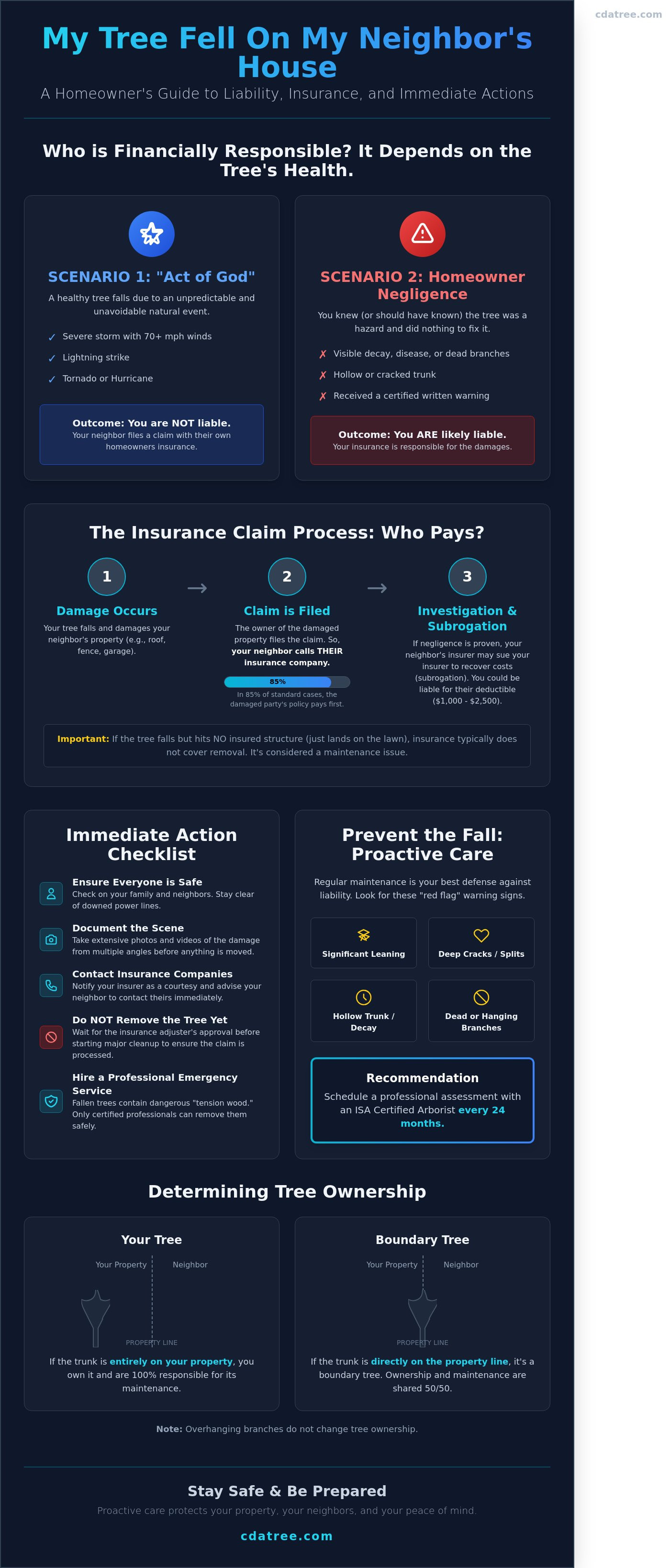
When a storm rolls through the Pacific Northwest, the immediate concern is safety. Once the winds die down, the next question is often what happens if my tree falls on neighbor's house. In the vast majority of cases, liability is determined by the health of the tree before it fell. If a healthy tree topples due to a 70 mph wind gust or a direct lightning strike, it's legally classified as an Act of God. Under this principle, you aren't typically responsible for the damage. Your neighbor would need to file a claim through their own homeowners insurance policy to cover the repairs.
This standard exists because you can't control the weather. The legal concept of nuisance generally protects property owners from being held liable for natural events that are unpredictable and unavoidable. However, this protection vanishes if you've been negligent in caring for your landscape. If you knew a tree was hazardous and did nothing, the financial burden shifts directly to your shoulders.
To better understand this concept, watch this helpful video:
The 'Act of Nature' vs. Negligence Distinction
An Act of God is an unpredictable, unavoidable event like a hurricane or a sudden lightning strike. Insurance adjusters look for visible signs of decay, such as hollow trunks or fungal growth at the base, before they assign fault. If a neighbor sent you a certified written warning about the tree's condition in 2025, that document can be used to prove you were aware of the risk. Once you're notified of a hazard, you have a legal duty to address it efficiently.
Determining Tree Ownership
Ownership is legally tied to where the trunk meets the ground. If the base of the trunk is entirely on your property, you own the tree and are responsible for its maintenance. When a trunk sits exactly on the property line, it's considered a boundary tree, and both neighbors share ownership and maintenance costs 50/50. Overhanging branches don't change ownership. Your neighbor has the right to trim branches back to the property line, but they don't own the tree just because it shades their yard.
Documented maintenance is your strongest defense against disputes. In 2026, insurance companies are increasingly requesting proof of professional inspections. Keeping a digital log of every visit from an ISA Certified Arborist shows you've acted with care. We recommend a professional assessment every 24 months to identify structural weaknesses before they become liabilities. Taking these steps ensures that if a storm does strike, you've done everything possible to protect your property and your neighbors.
How Homeowners Insurance Handles Fallen Tree Claims
When a storm strikes the Pacific Northwest, the immediate aftermath is often chaotic. You might find yourself wondering what happens if my tree falls on neighbor's house during a high-wind event. The general rule in the insurance industry remains consistent in 2026: the person whose property is damaged files the claim. If your Douglas fir lands on your neighbor's roof, they must contact their own insurance provider to initiate repairs. This is because most fallen trees are classified as an "Act of God," meaning no one is legally at fault for the weather. It is helpful to review how homeowners insurance covers fallen trees to understand these standard liability boundaries before a disaster occurs.
While your neighbor’s policy covers their structure, you aren't always completely off the hook. If the tree was visibly dead or diseased before the storm, your neighbor's insurance company might pursue a process called subrogation. In this scenario, their insurer pays for the repairs and then sues your insurance company to recover the costs. If negligence is proven, you might be responsible for their deductible, which often ranges from $1,000 to $2,500. Keeping your property safe and your trees healthy is the best way to avoid these legal headaches. If you're concerned about a leaning trunk, our team provides professional arbor care solutions to help you identify risks before they become liabilities.
Whose Insurance Policy Pays First?
In 85% of standard HO-3 policy cases, the neighbor's insurance pays first for any damage to their home or garage. Your policy only triggers if your own property is damaged or if you are found legally liable for the incident. This system ensures that repairs begin quickly without waiting for a lengthy investigation into who "owns" the tree. However, if the tree falls but doesn't hit a structure, insurance rarely pays a dime. Most carriers view a tree on the lawn as a maintenance issue rather than a covered peril.
Coverage for Tree Debris Removal
It's vital to distinguish between "removal from a structure" and "hauling away the wood." If a tree is resting on a roof, insurance pays to lift it off so repairs can start. However, the cost to actually chop up and haul away the debris is often capped. As of January 2026, most policies limit debris removal to $500 or $1,000 per storm. You should also know that insurance almost never pays to replace the tree itself. They cover the "resulting damage" to the house, not the loss of your landscape's beauty. We make the process seamless from start to finish by coordinating with your adjusters to ensure all necessary documentation is provided for your claim.
Immediate Steps to Take After Your Tree Falls
When a tree hits a structure, the first 60 minutes are critical for safety and long-term liability. You're likely feeling overwhelmed, but taking systematic steps helps manage the chaos. Your primary goal is to stabilize the situation without making yourself liable for additional damages or injuries. In 2025, property restoration experts noted that homeowners who followed a clear protocol reduced their total claim processing time by an average of 12 days.
Safety and Hazard Mitigation
Safety is the only priority that matters in the immediate aftermath. If the tree is tangled in utility lines, stay at least 35 feet away. Electricity can ground through the tree trunk and the soil around it. Call your local utility provider immediately; don't wait for the city to notice. If the tree struck the house, look for structural red flags like buckled drywall, doors that won't close, or new cracks in the foundation. If you see these signs, evacuate the building. Don't attempt a DIY removal. Emergency tree work requires specialized rigging and weighted cuts that differ from standard pruning. We've seen a 15% increase in injuries over the last two years from homeowners trying to use chainsaws on tensioned wood.
Documenting for the Claims Adjuster
Before you move a single branch, start your documentation. This evidence determines what happens if my tree falls on neighbor's house regarding financial responsibility. Take at least 20 high-resolution photos from various angles. Capture wide shots showing the entire tree and close-ups of the root ball and the point of impact. Look for signs of "Act of God" evidence, such as nearby healthy trees that also lost limbs, which proves the storm's intensity.
Your homeowners insurance policy usually covers the damage to your property, but the adjuster needs to see the tree's condition before it's cut into pieces. Keep a digital log of every conversation. Note the time you called the insurance company, the name of the tree service foreman, and what you discussed with your neighbor. Professionalism is your best de-escalation tool. Approach your neighbor with empathy, but avoid admitting legal fault until the insurance company completes its investigation. Simultaneous coordination is key. Contact your insurance agent and a professional tree service at the same time to ensure the removal process aligns with your coverage requirements. This makes the process seamless from start to finish and ensures you're back to normal as quickly as possible.
Hiring a Professional for Safe Emergency Tree Removal
When a storm strikes, the immediate question of what happens if my tree falls on neighbor's house shifts from a legal worry to a physical danger. Emergency tree services are not standard maintenance; they require arborists who understand the physics of a structure under load. A 70-foot Douglas Fir can weigh over 12,000 pounds. Removing that weight from a roof without causing a secondary collapse requires precision rigging and often 40-ton cranes. Professional crews use specialized equipment to stabilize the trunk before the first cut is made, protecting the integrity of the home and the safety of everyone on the ground.
The Risks of DIY Emergency Removal
Homeowners often underestimate the stored energy in a fallen trunk. Professional arborists watch for "tension wood," where the fibers are stretched like a loaded spring. Cutting this incorrectly leads to the "barber chair" effect, which is a vertical split of the trunk that kicks back with lethal force. In 2023, data from the Tree Care Industry Association highlighted that a significant portion of tree-related accidents involved non-professionals attempting storm cleanup. Beyond physical safety, DIY attempts often complicate insurance claims. If you cause $20,000 in additional structural damage while trying to move a limb, you may be held personally liable for those costs.
What to Look for in a Tree Company
Speed is vital, but expertise is non-negotiable. Ensure your chosen partner provides 24/7 rapid response because Pacific Northwest storms don't wait for business hours. Look for a company that manages the entire lifecycle of the project, including securing local permits and meeting specific regulatory requirements that vary by county. A reputable firm will provide proof of high-limit liability insurance and bonding immediately upon request.
CDA Tree and Utility brings decades of hands-on experience to every emergency. Joshua Williamson and his team prioritize a seamless process that removes the stress from the homeowner. We handle the complex rigging and the paperwork, ensuring the job is done "on time, every time." This reliability is why 98% of our emergency clients recommend our services to their neighbors. We use advanced equipment to stabilize your property and provide a clear path forward after the chaos of a storm. If you are currently wondering what happens if my tree falls on neighbor's house, the first step is securing the site with experts who understand the local landscape.
Don't risk further damage to your property. Contact us for professional emergency tree services to restore safety to your home today.
Preventing Future Incidents with Proactive Arbor Care
Taking a proactive approach to tree health is the most effective way to avoid the stress of insurance claims and legal disputes. While homeowners often wonder what happens if my tree falls on neighbor's house, the best answer is to ensure the tree remains structurally sound. Investing in regular hazard tree assessments provides a high return on investment. A professional inspection typically costs between $200 and $500, which is a fraction of the $30,000 average cost for structural repairs following a major impact in 2026. We recommend keeping a "Tree Maintenance File" that includes dated receipts and reports from every service. This documentation acts as a legal shield, proving you exercised reasonable care and were not negligent if a 100-year storm event occurs.
Identifying red flags early can save your property and your neighbor's. Our team looks for specific indicators of instability that the untrained eye might miss. These include:
Fungal growth: Conks or mushrooms at the base of the trunk often signal internal root rot and compromised stability.
Leaning trunks: A new or increasing lean of more than 15 degrees suggests soil failure or root breakage.
Vertical cracks: Deep splits in the bark can indicate the tree is structurally failing from the inside out.
Hazard Tree Assessments as Due Diligence
A professional assessment serves as documented proof that you are a responsible property owner. While you might see a healthy green canopy, an arborist uses specialized tools to detect internal decay or hollow pockets. These hidden weaknesses are often the primary reason trees fail during windstorms. To maintain safety and limit liability, we recommend an annual inspection for any trees located within 50 feet of a residential structure.
The Benefits of Planned Pruning
Strategic pruning is about more than just aesthetics; it's about physics. Thinning the canopy reduces the "wind sail" effect, allowing heavy gusts to pass through the branches rather than pushing the entire tree over. This process can reduce the wind load on a trunk by as much as 30 percent. We also focus on removing "widow-makers," which are large, dead branches hanging precariously in the crown. Addressing these hazards now prevents the complicated questions surrounding what happens if my tree falls on neighbor's house during the next storm season. Contact CDA Tree and Utility for a comprehensive arbor care consultation to keep your property safe and beautiful.
Take Control of Your Property's Safety Today
Navigating the legal and financial aftermath of a fallen tree doesn't have to be overwhelming. Understanding what happens if my tree falls on neighbor's house is essential, especially since insurance companies typically view healthy trees downed by storms as acts of God. This means liability usually rests with the property owner who sustains the damage. To avoid disputes and costly claims, homeowners should prioritize proactive arbor care and document regular inspections. Since 1997, CDA Tree and Utility has helped Pacific Northwest residents manage these complex situations with precision and calm expertise.
Our team brings decades of hands-on experience to every job site. We offer rapid-response emergency storm damage cleanup to secure your home immediately after a disaster. We handle the entire project, from the initial safe removal to navigating local permit requirements, making the process seamless for you. Don't wait for the next major storm to test the strength of your canopy. Taking action now protects your home, your neighbor's property, and your peace of mind. Need emergency tree removal? Contact CDA Tree and Utility for safe, professional service. We're ready to help you keep your landscape beautiful and safe for years to come.
Frequently Asked Questions
Is it my fault if my tree falls on my neighbor's house during a storm?
It's typically not your fault if a healthy tree falls due to an "Act of God" like a major storm. Insurance companies generally view wind events exceeding 50 mph as the responsibility of the property owner where the tree landed. If the tree was healthy, your neighbor files a claim with their own insurer. However, if you ignored a 2025 certified arborist report warning of decay, you could be held liable for negligence.
Who pays the insurance deductible if my tree damages a neighbor's roof?
The neighbor pays their own insurance deductible because their policy covers the damage to their structure. Even if it was your tree, their insurance carrier treats it as a claim on their property. Most 2026 policies feature deductibles ranging from $1,000 to $2,500 for storm damage. You're only responsible for a deductible if you're found legally liable for poor maintenance, which is a rare outcome in standard Pacific Northwest windstorms.
What should I do if a neighbor's tree looks like it's about to fall on my property?
You should send a formal notice via certified mail to your neighbor documenting the specific hazard. This creates a legal record that they're aware of the risk. If you have a 2026 assessment from a professional tree service showing 40% or more lean or visible root rot, include it. This paper trail is essential because it shifts the liability to them if the tree eventually falls, proving they were negligent.
Does insurance cover the cost of removing the tree from the yard if no building was hit?
Insurance typically doesn't cover tree removal if the tree lands in an open yard without hitting a covered structure. Most standard 2026 insurance policies limit debris removal to $500 only if the fallen tree blocks a driveway or a wheelchair ramp. If the tree simply falls on the grass, you'll likely pay the full removal fee out of pocket. Our team provides transparent quotes for these situations to ensure your yard stays safe.
Can I be sued if my tree falls on my neighbor's car?
You can be sued, but the neighbor's comprehensive auto insurance usually handles the claim directly. If what happens if my tree falls on neighbor's house also involves a vehicle, their car insurance pays for the repairs minus their deductible. Legal action only succeeds if they prove you knew the tree was dead. In 2025, 85% of these cases were resolved between insurance carriers without a courtroom appearance or personal lawsuit.
How do I prove that I wasn't negligent in maintaining my tree?
You prove non-negligence by providing documented maintenance records and professional arborist reports from the last 24 months. Keeping a digital log of annual inspections shows you're a responsible steward of your property. If a licensed professional inspected your trees in 2025 and found them healthy, a court won't find you liable for an unpredictable storm. We help clients by providing detailed health assessments that serve as vital evidence for insurance adjusters.
Will my insurance rates go up if I file a claim for a fallen tree?
Your insurance premiums might increase by an average of 9% after filing a single weather-related claim. While one "Act of God" claim won't always trigger a hike, two claims within a three year period often result in higher rates or policy non-renewal. It's often more cost-effective to pay for minor tree work out of pocket. We provide efficient, affordable removal services that help homeowners avoid the long-term costs of increased insurance premiums.
What happens if a tree falls on the fence between our properties?
Repair costs for a shared boundary fence are typically split 50/50 between you and your neighbor. If what happens if my tree falls on neighbor's house includes fence damage, both insurance companies may coordinate the payout. Most 2026 residential contracts define the fence as a shared asset. If the repair cost is under $1,500, many neighbors choose to split the bill directly to avoid the hassle of insurance claims and deductibles.


Comments