

Avoiding Tree Removal Scams: The Ultimate Homeowner’s Safety Checklist
- cdatreeu
- 1 day ago
- 13 min read
Updated: 4 hours ago
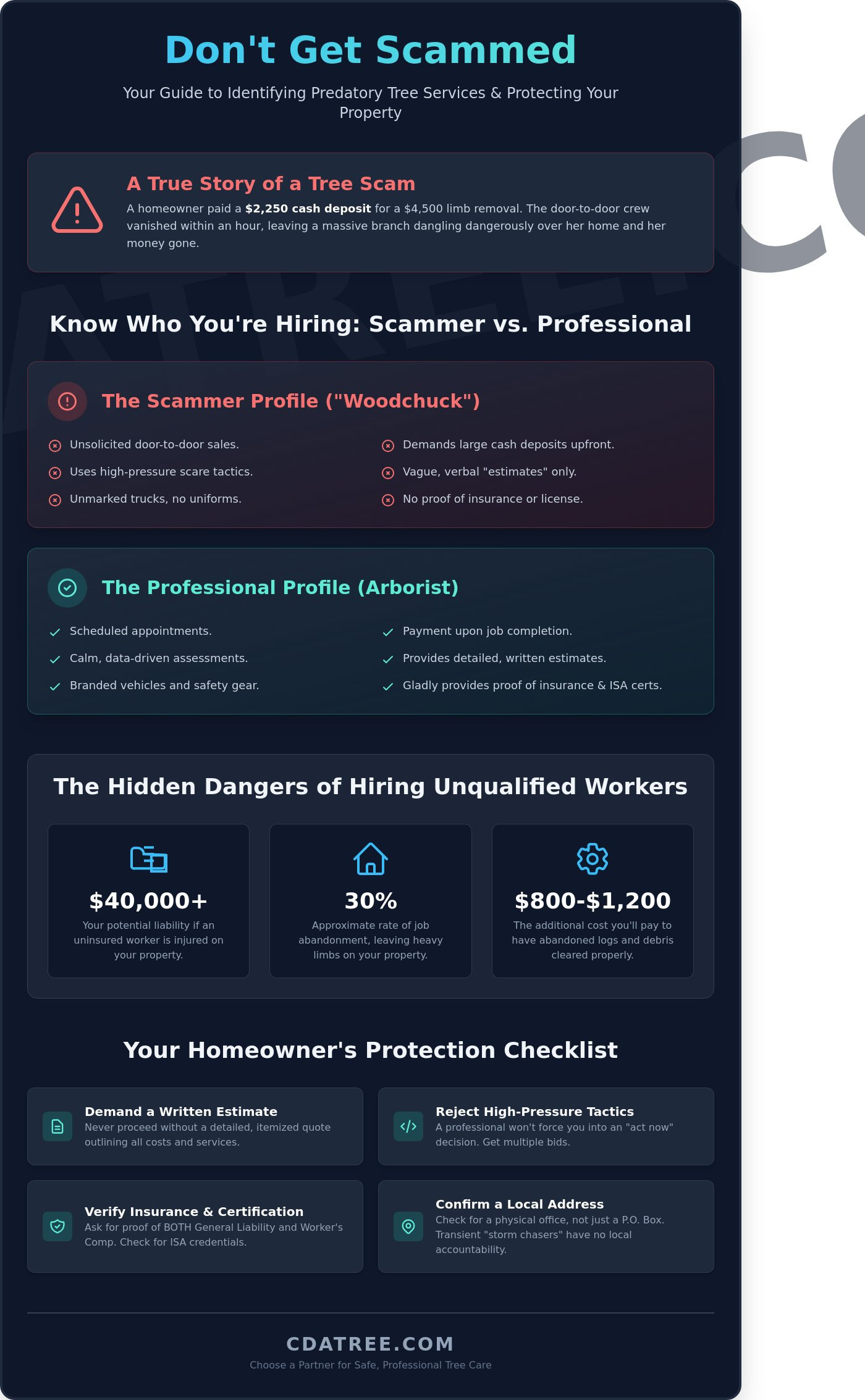
Last October, a homeowner named Sarah discovered how quickly a routine chore can turn into a nightmare when she was quoted $4,500 for an urgent limb removal. Within 45 minutes of her paying a $2,250 cash deposit to a door-to-door contractor, the crew vanished; they left a heavy branch dangling directly over her master bedroom. It's completely natural to feel anxious about property safety, especially when your priority is avoiding tree removal scams from unqualified workers. You deserve a tree service that is safe, professional, and transparent rather than predatory.
This guide is your ultimate resource for protecting your home and your financial investment. We'll provide a clear framework for verifying professional credentials and insurance requirements so you can reject high-pressure sales tactics with total confidence. You will learn how to spot 5 specific red flags that signal a fly-by-night operation before they ever step foot on your property. Our goal is to ensure your tree removal is a seamless, reliable process that leaves your home secure and your mind at ease.
Key Takeaways
Spot high-pressure red flags like door-to-door solicitation and unmarked vehicles before they compromise your property's safety.
Master the art of avoiding tree removal scams by verifying essential ISA certifications and the specific insurance coverage required for high-risk arbor care.
Learn how to validate a contractor's local reputation through physical address checks and the requirement of itemized, written estimates.
Discover the critical difference between general liability and specialized tree service insurance to shield yourself from potential legal and financial risks.
Identify the hallmarks of a professional partnership that ensures a seamless, safe, and transparent tree care experience from start to finish.
Table of Contents Understanding the High Stakes of Tree Removal Scams Identifying the Telltale Signs of a Tree Service Scam Verifying Professional Credentials and Safety Standards The Ultimate Homeowner’s Protection Checklist Choosing a Partner for Safe, Professional Tree Care
Understanding the High Stakes of Tree Removal Scams
A tree removal scam is a form of predatory solicitation where unqualified individuals pressure homeowners into unnecessary, overpriced, or dangerous work. These operations often rely on Understanding the High Stakes of Tree Removal Scams to exploit a homeowner's fear of property damage. While a professional arborist provides a calm, data-driven assessment of a tree's health, a scammer relies on artificial urgency. They might claim a branch is "seconds away from snapping" to bypass your better judgment and secure an immediate cash deposit. This tactic became particularly prevalent following the severe windstorms that hit the Pacific Northwest in late 2021, which brought a surge of out-of-state "storm chasers" to our local neighborhoods.
The tree care industry is a frequent target for fraud because it pairs high ticket prices with a low barrier to entry. A legitimate company like CDA Tree and Utility invests over $150,000 in specialized lifts, chippers, and comprehensive insurance. In contrast, a scammer only needs a used chainsaw and a borrowed pickup truck to look the part. By skipping the overhead of safety training and regulatory permits, they can offer "deals" that seem attractive but leave the homeowner vulnerable to massive legal and physical consequences. Avoiding tree removal scams starts with recognizing that true expertise cannot be found in a door-to-door sales pitch.
To better understand how these predatory operations function, watch this helpful report on industry warnings:
Why Scammers Target Your Trees
Tree removals often command prices between $2,000 and $6,000, which justifies long-distance travel for fraudulent crews. These "woodchucks" are transient workers with no local business license or physical office, meaning they have zero accountability once they leave your driveway. They exploit the "invisible" nature of tree biology, inventing hazards like "hidden heart rot" in perfectly healthy 70-foot pines to inflate their invoices. Since most homeowners aren't trained to spot these lies, the scammers successfully manufacture a crisis to extract quick payments.
The Financial and Physical Risks of Fraud
The dangers of avoiding tree removal scams involve more than just a lost deposit. If an uninsured worker is injured on your property, many state labor laws allow the liability to shift directly to you, the homeowner. This could result in a medical lien against your house for a $40,000 hospital bill. Physical risks are just as severe. Unqualified workers frequently drop heavy limbs on roofs or power lines because they lack the rigging knowledge required for safe removal. In approximately 30% of these cases, the crew abandons the job halfway through, leaving massive logs and debris in the yard that cost the homeowner an additional $800 to $1,200 to clear properly.
Identifying the Telltale Signs of a Tree Service Scam
Scammers often rely on the element of surprise to catch homeowners off guard. They typically show up unannounced, driving unmarked trucks without any company branding or specialized rigging equipment. One classic opening line is, "I just finished a job down the street and noticed your tree looks dangerous." This script is a calculated tactic designed to bypass your normal vetting process. Legitimate arborists in the Pacific Northwest usually have schedules booked 14 to 21 days in advance; they rarely need to solicit work door-to-door to fill their day.
Professional tree care requires precision, specialized tools, and a crew that follows strict safety protocols. When someone arrives without a business card or a formal uniform, it indicates a lack of professional investment. Avoiding tree removal scams is much easier when you insist on seeing a written bid before any equipment starts up. A 2023 report on consumer fraud highlighted that 68% of home service scams began with an unsolicited visit, often targeting neighborhoods with mature tree canopies.
Door-to-Door Solicitation and Pressure Tactics
Reputable arborists prioritize the health of your landscape and won't use scare tactics to get a signature. If a solicitor claims your tree will fall tonight unless you pay for immediate removal, they're likely using fear as a sales tool. This high-pressure approach prevents you from Verifying Professional Credentials and Safety Standards through official channels. You should decline these offers firmly. A real expert provides a detailed estimate and gives you time to review it. We believe in a seamless process where safety and transparency always come first.
The Upfront Payment Trap
Industry standards are clear: legitimate companies don't ask for money before the crew arrives and begins the work. The "phantom crew" scam is a common trick where a solicitor demands a 50% deposit for "equipment rentals" or "disposal fees" and then never returns. You should never pay for a tree project until the work is 100% complete and the cleanup is finished. If a contractor insists on a cash-only deal or a large upfront payment, it's a major red flag that they lack the financial stability or intent to finish the job.
Unmarked Vehicles: Professional teams use branded trucks that display a local address and phone number.
Today-Only Pricing: Scammers use artificial deadlines to stop you from getting a second opinion.
No Written Contract: Always demand a document that outlines the scope of work, total cost, and debris removal plan.
Lack of Insurance: If a worker gets hurt on your property without coverage, you could be held liable for their medical bills.
Protecting your property requires a skeptical eye toward anyone who promises a "special deal" that sounds too good to be true. Real professionals value their reputation and will always provide proof of their credentials without hesitation. By staying alert to these red flags, you can ensure your trees receive the expert care they deserve without falling victim to predatory practices.
The key is to find a partner who prioritizes professionalism and safety above all else. Reputable companies, such as We Love Trees, build their reputation on this foundation of trust, providing a clear example of what homeowners should seek in any region.
Verifying Professional Credentials and Safety Standards
A legitimate arborist doesn't just own a chainsaw; they hold credentials that prove their commitment to the craft. When you're focused on avoiding tree removal scams, the first thing you should look for is certification from the International Society of Arboriculture (ISA). This organization has set the benchmark for tree care since 1924. An ISA Certified Arborist has passed a rigorous exam covering everything from soil management to safe climbing techniques. If a contractor can't produce a certification number you can verify on the ISA website, they aren't the experts they claim to be.
Safety in this industry isn't a suggestion. It's governed by the ANSI Z133 standards, which were most recently updated in 2017. These guidelines dictate exactly how a crew should operate to prevent accidents. Professional companies invest heavily in advanced equipment like bucket trucks and 60-ton cranes to handle heavy limbs safely. If you see a crew relying solely on rickety ladders and frayed ropes, it's a red flag. Real pros prioritize a seamless, controlled removal process over reckless speed.
Insurance Verification Beyond the Paperwork
Never accept a photocopied insurance document as proof of coverage. Scammers often use expired or forged papers to trick homeowners. You must insist that a Certificate of Insurance (COI) is sent directly to your email from the insurance provider's agent. A standard professional policy should include at least $1,000,000 in General Liability to cover property damage. Workers' Compensation is the most critical protection for a homeowner because it ensures you aren't held legally or financially liable if a worker is injured on your property.
Safety Gear and Equipment Standards
A crew's appearance tells you a lot about their professionalism. Legitimate teams wear full Personal Protective Equipment (PPE) at all times. This includes hard hats, ear protection, safety glasses, and chainsaw chaps. According to OSHA data from 2022, 35% of tree-related injuries involve the head or face, making these items non-negotiable. Avoiding tree removal scams becomes easier when you inspect their gear for signs of neglect. Look for dull chains that produce fine dust instead of wood chips, or hydraulic lines that show visible leaks. Our team maintains every piece of machinery to ensure we deliver the highest level of service in the Pacific Northwest, keeping your property safe and beautiful. Professionalism means doing the job right, on time, every time.
The Ultimate Homeowner’s Protection Checklist
Protecting your property requires more than just a gut feeling about a contractor. You need a systematic approach to vetting every professional who steps onto your lawn. Following these five steps ensures you're hiring a legitimate team rather than a fly-by-night operation. Safety is non-negotiable when dealing with thousands of pounds of falling timber.
Step 1: Verify the physical address and local reputation. A legitimate business will have a local physical office, not just a PO Box. Check Google Reviews for at least 15 to 20 recent entries from the last 12 months. A business with zero local footprint is a major red flag.
Step 2: Demand a written, itemized estimate. This document should break down the costs for cutting, hauling, and stump grinding. Without a line-by-line breakdown, a scammer can easily claim that "cleanup" wasn't included in the original price.
Step 3: Confirm the debris removal plan. Don't get left with a 3,000-pound trunk section in your driveway. Ask specifically if they use a grapple truck or wood chipper and if those costs are included in the total.
Step 4: Check for professional affiliations. Look for members of the International Society of Arboriculture (ISA) or the Tree Care Industry Association (TCIA). An ISA Certified Arborist has documented at least three years of full-time experience and passed a comprehensive examination.
Step 5: Get three quotes to find the "market rate." Getting multiple bids helps you identify outliers. If two reputable companies quote $2,500 and a third quotes $800, the low bid is likely cutting corners on insurance or safety equipment.
Evaluating the Written Contract
A professional contract is your primary tool for avoiding tree removal scams. It must specify the exact start and end dates, the total cost, and a detailed description of the cleanup process. Verbal agreements or text messages aren't legally binding enough for hazardous work. Ensure the contract explicitly mentions "permit navigation" if your local municipality requires them. In the Pacific Northwest, specific permit requirements can change based on tree species or diameter; a responsible company handles this paperwork for you to ensure a seamless process.
The "Market Rate" Reality Check
An unbelievably low quote is often the most expensive choice you'll ever make. Professional companies like CDA Tree and Utility calculate competitive pricing based on the high costs of specialized equipment and comprehensive liability insurance. A single bucket truck can cost over $150,000, and worker's compensation for high-risk tree work is a significant investment. When a "discount" crew skips these costs, you become liable for any injuries or property damage that occurs on your site. We focus on fair, transparent pricing that reflects the true cost of doing the job right the first time.
Don't risk your property with unverified contractors. Contact us today for a professional tree removal estimate from a team you can trust.
Choosing a Partner for Safe, Professional Tree Care
Finding a reliable arborist shouldn't feel like a high-stakes gamble. Since 1997, CDA Tree and Utility has served as the gold standard for transparent, professional tree service in the Pacific Northwest. We've spent more than 27 years building a reputation for excellence, proving that experience is the best defense for homeowners. While avoiding tree removal scams often requires constant vigilance, our team provides the peace of mind that comes from decades of hands-on expertise.
We believe in a seamless process that respects your time and property. It starts with a clear, honest consultation and concludes with a thorough final cleanup. Our "on time, every time" promise isn't just a slogan; it's a core business value. We arrive when we say we will, equipped with the right tools to handle the job safely. This reliability sets us apart from transient workers who often disappear as soon as they receive a deposit.
The CDA Tree and Utility Standard
Our approach to comprehensive arbor care goes far beyond just cutting branches. We navigate the complex landscape of permits and local regulatory requirements so you don't have to. Whether you're dealing with protected species or municipal codes, we ensure every job is fully compliant. This meticulous attention to detail protects you from potential fines and legal headaches that scammers frequently ignore.
Safety is our primary driver, especially during urgent situations. Our rapid-response emergency services are designed for legitimate hazards, such as a tree leaning precariously after a storm. We don't use fear to sell; we use professional assessments to protect. Our philosophy centers on responsible stewardship, ensuring that every action we take contributes to the long-term health and safety of your landscape.
Full management of municipal permits and documentation.
Advanced equipment for high-precision removals in tight spaces.
24/7 emergency response for storm-damaged trees.
Environmentally conscious disposal and site restoration.
Your Next Steps for a Safer Landscape
The best time to evaluate a tree's health is before the next major storm arrives. Proactive hazard tree assessments allow you to make informed decisions without the pressure of an immediate crisis. Scammers thrive on the panic following a windstorm, but a baseline health check from a trusted professional gives you the facts you need to stay safe. We provide clear data on tree structural integrity, helping you prioritize work based on actual risk levels rather than guesswork.
Don't leave your property's safety to chance or to the first person who knocks on your door with a chainsaw. Take control of your landscape's future by choosing a partner with a proven track record. Contact CDA Tree and Utility for a professional, scam-free estimate today. Our team is ready to provide the expert care your trees deserve and the honest service you expect.
Protect Your Home with Trusted Tree Expertise
Protecting your property starts with recognizing red flags like high-pressure sales tactics or a lack of proper insurance documentation. By verifying credentials and using a formal checklist, avoiding tree removal scams becomes a straightforward part of your home maintenance routine. You should always demand written contracts and proof of worker's compensation so you aren't held liable for accidents on your land. Professionalism isn't just a preference; it's a safety requirement for any hazardous job.
Since 1997, CDA Tree and Utility has provided homeowners with safe, efficient workmanship across the Pacific Northwest. We are specialists in hazardous and emergency tree removal, bringing decades of hands-on experience to every project. Our team arrives on time, every time, and we focus on a seamless, professional process from the initial consultation to the final cleanup. You deserve a partner who respects your property and provides clear, honest communication throughout the entire job.
Get a professional, safe, and transparent tree removal quote from CDA Tree and Utility today.
Take the first step toward a safer landscape today; your trees and your peace of mind are in expert hands.
Frequently Asked Questions
Is it normal for a tree service to ask for a deposit upfront?
No, it's not standard practice for a reputable company to request a deposit before they begin work. At CDA Tree and Utility, we believe you should only pay once the job is finished to your satisfaction. Scammers often take a 20% or 30% deposit and never return. We've seen homeowners lose $500 or more to these hit and run operations. Always wait until the cleanup is complete before you provide any payment.
How can I tell if a tree service company is actually insured?
You must request a Certificate of Insurance sent directly from the provider's insurance agent to your email. Don't just look at a paper copy a worker hands you, as these are often forged or expired. A legitimate company carries at least $1,000,000 in general liability and full workers' compensation coverage. This protects you from being held liable if a crew member is injured on your property. It's a non-negotiable step for safety.
What should I do if a tree service worker knocks on my door after a storm?
Politely decline their services and ask for a written estimate and local business license number. Storm chasers often flood neighborhoods after high winds, sometimes marking up prices by 300% compared to local rates. Avoiding tree removal scams requires you to stay calm and vet the company through the Better Business Bureau. We recommend getting 3 different quotes from established local businesses before you commit to any emergency work after a storm.
Are all tree services required to have ISA-certified arborists?
No law requires a company to have an ISA-certified arborist, but it's a vital benchmark for quality. An ISA certification means the professional has at least 3 years of full-time experience and passed a rigorous 200-question exam on tree biology and safety. We maintain these high standards to ensure your trees stay healthy and your property remains safe. Hiring uncertified labor increases the risk of topping or other harmful cutting practices that kill trees.
What happens if a tree service damages my house and they aren’t insured?
You will likely be stuck paying the repair costs yourself or filing a claim through your own homeowner's policy. If a contractor lacks insurance, your insurance company might even deny the claim because you hired an unlicensed worker. This can lead to out-of-pocket expenses ranging from $5,000 for minor roof damage to over $20,000 for structural hits. Always verify coverage before any heavy equipment enters your yard to avoid these financial disasters.
How do I report a tree removal scam in my area?
You should contact your state's Attorney General and file a report with the Better Business Bureau Scam Tracker. Last year, the BBB tracked over 6,000 home improvement scams across the country. Reporting these incidents helps local police departments build cases against fraudulent contractors. If you've lost money, contact your local sheriff's office immediately to file a formal police report for fraud. This creates a paper trail that protects other homeowners in your community.
Does a low price always mean the tree service is a scam?
A low price isn't always a scam, but an estimate that's 50% lower than the market average usually indicates a lack of insurance or safety equipment. Professional tree removal for a medium tree typically costs between $750 and $2,000 depending on the complexity. If someone offers to do the same job for $300, they're likely cutting corners on safety. We provide fair, transparent pricing that reflects our decades of experience in the Pacific Northwest.
What equipment should a professional tree removal company always have?
A professional crew arrives with specialized gear like high-capacity wood chippers, rigging blocks, and chainsaws of various sizes. You should see every worker wearing ANSI Z133 compliant safety equipment, including hard hats, eye protection, and chainsaw chaps. Scammers often show up with just a single small saw and a pickup truck. We use advanced equipment to ensure every limb is lowered safely and your lawn remains undisturbed. It makes the process seamless from start to finish.


Comments