

Tree Service Safety Standards: A Comprehensive Guide to ANSI Z133 and Industry Compliance
- cdatreeu
- Mar 31
- 12 min read
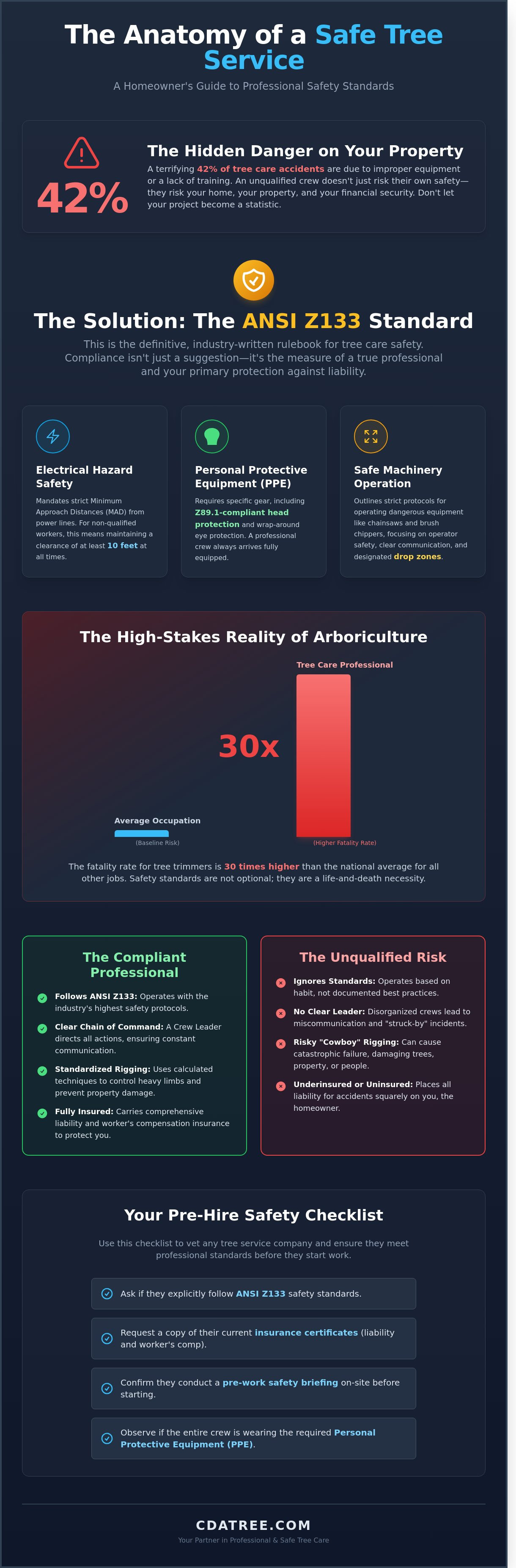
On a wet Tuesday morning in the Pacific Northwest, a homeowner watches a 3,500-pound Douglas fir limb hover inches above their roof, only to realize their hired "pro" isn't wearing a harness. It's a terrifying moment that happens more often than you think, especially when 42 percent of tree care accidents involve improper equipment or lack of training. You shouldn't have to hold your breath while a chainsaw runs on your property. It's natural to feel anxious about falling limbs or whether your provider follows modern tree service safety standards to prevent a $50,000 liability suit on your watch.
This guide simplifies the complex world of industry compliance so you can protect your home and your wallet. We'll break down the ANSI Z133 requirements and give you a clear framework to vet any contractor with professional-grade precision. You're going to learn how to ensure a seamless, accident-free experience from start to finish. By the end of this article, you'll have the peace of mind that comes from knowing exactly what a certified professional looks like when they step onto your land.
Key Takeaways
Understand why ANSI Z133 is the definitive gold standard for tree care safety and how it protects both workers and your property.
Discover how strict adherence to tree service safety standards mitigates high-stakes risks and ensures professional-grade precision on every job.
Learn to navigate the regulatory landscape by distinguishing between federal OSHA rules and industry-specific safety best practices.
Use our actionable client checklist to verify a company’s insurance and compliance before they begin work on your property.
Explore how CDA Tree and Utility leverages decades of experience and advanced equipment to provide a seamless, safety-first experience.
Table of Contents Understanding the ANSI Z133: The Gold Standard for Tree Care Safety Why Professional Tree Service Safety Standards Exist: Mitigating High-Stakes Risks ANSI Z133 vs. OSHA: Navigating the Regulatory Landscape How to Verify a Tree Service's Safety Compliance: A Client Checklist CDA Tree and Utility: Our Unwavering Commitment to Safety Standards
Understanding the ANSI Z133: The Gold Standard for Tree Care Safety
ANSI Z133 serves as the definitive safety framework for the tree care industry. While technically a voluntary consensus standard, it functions as the primary rulebook for protecting workers from the high-risk nature of Arboriculture. These tree service safety standards aren't just suggestions. They're established by the industry, for the industry. This ensures that every climber and ground technician operates under a unified safety protocol that accounts for real-world field conditions and biological hazards.
Choosing a company that follows these guidelines signals a deep commitment to professional excellence and client safety. In legal disputes or insurance audits, Z133 is the measuring stick used to determine if a company acted with due diligence. If an accident occurs on a job site, investigators check if these specific protocols were in place. It's the difference between a fly-by-night operation and a seasoned professional who respects the inherent danger of the work.
To better understand these safety protocols in action, watch this helpful video:
The History and Evolution of the Z133 Standard
The Tree Care Industry Association (TCIA) serves as the secretariat for the Z133 standard. They coordinate regular updates to ensure the rules keep pace with technological shifts. The standard has evolved significantly since its first iteration in 1968. The last major revision arrived in 2017, introducing stricter language around specialized rigging and modern aerial lifts. Staying current is vital because safety habits from a decade ago don't always translate to today's high-tension winch lines or high-capacity battery saws.
Key Areas Covered by ANSI Z133
The standard addresses three critical danger zones. First, it defines Minimum Approach Distances (MAD) for electrical hazards. This is crucial for any work near utility lines where 10 feet of clearance is often the baseline for non-qualified workers. Second, it mandates specific Personal Protective Equipment (PPE), requiring head protection meeting Z89.1 standards and wrap-around eye protection. Finally, it outlines safe operation for machinery like brush chippers. Adhering to these tree service safety standards keeps our teams safe and your property protected from avoidable accidents.
Why Professional Tree Service Safety Standards Exist: Mitigating High-Stakes Risks
Arboriculture is one of the most dangerous professions in the United States. Workers handle high-tension equipment while suspended 80 feet in the air, often maneuvering heavy limbs that weigh thousands of pounds. Without strict tree service safety standards, these variables create a recipe for disaster. Data from the Tree Care Industry Association (TCIA) shows that tree trimmers face a fatality rate 30 times higher than the national average for all other occupations. These protocols exist to bridge the gap between extreme risk and a successful, uneventful job.
A professional job site relies on a rigid "Chain of Command" to maintain order. The Crew Leader or Certified Arborist directs every movement, ensuring ground crews and climbers remain in constant communication. This hierarchy prevents "struck-by" incidents, which are the leading cause of injury in the field. When a team follows these standards, it doesn't just protect the workers. It ensures your home and landscape remain untouched by falling debris or equipment failure. If you're planning a project, it's wise to consult with an experienced local team that prioritizes these protocols.
Preventing Property Damage Through Standardized Rigging
Rigging is where physics meets forestry. Standardized rigging practices prevent "shock loading," a dangerous event where a falling limb generates sudden, massive force that can snap ropes or cause catastrophic tree failure. Professional crews use calculated load-limitations and designated "drop zones" to control every descent. Ground-crew communication protocols, often involving hand signals or two-way headsets, ensure that no piece of wood moves until the landing area is clear and secure.
The Reality of Liability: Who Pays if an Accident Occurs?
Many homeowners don't realize they can be held liable for injuries that occur on their property if a contractor lacks proper coverage. If a worker is injured while ignoring basic tree service safety standards, the financial burden may fall on your homeowner's insurance. Workers' Compensation is the primary defense here, as it covers medical costs and lost wages for the crew. An insured tree service acts as a financial shield that absorbs the risk of property damage and medical costs, protecting your personal assets from litigation.
ANSI Z133 vs. OSHA: Navigating the Regulatory Landscape
Understanding the difference between federal law and industry best practices is vital for any property owner. OSHA provides the legal framework for workplace safety, but it doesn't currently have a dedicated manual for arboriculture. Instead, the agency relies on a patchwork of regulations borrowed from other industries. While ANSI Z133 represents the gold standard for tree service safety standards, OSHA acts as the enforcement arm that ensures these practices are followed on every job site.
When an accident occurs, OSHA uses the General Duty Clause, found in Section 5(a)(1) of the Occupational Safety and Health Act. This clause requires employers to provide a workplace free from recognized hazards. Since ANSI Z133 is the recognized industry standard, OSHA frequently references it to issue citations, even if a specific OSHA rule doesn't exist for a particular climbing technique. A company that integrates both sets of rules demonstrates a level of reliability that goes beyond simple legal compliance.
The OSHA 'Patchwork' Explained
OSHA currently applies three primary sets of standards to tree work: Logging (1910.266), Telecommunications (1910.268), and Electric Power Generation (1910.269). These rules often fall short because they weren't designed for residential tree care. For example, logging standards focus on clear-cutting in forests, not removing a 100-foot Ponderosa pine next to a house. To fix this gap, the industry is pushing for a dedicated OSHA Tree Care Standard, which is currently slated for a potential release in 2026. This new rule will finally provide a single, cohesive legal requirement for our trade.
Why Industry Certification Complements Safety Standards
Safety isn't just about following a checklist; it's about expert interpretation. ISA-certified arborists play a critical role in applying tree service safety standards to real-world scenarios. A licensed business might have the right paperwork, but a safety-certified team understands the physics of rope rigging and the biological structural integrity of a decaying limb.
Precision: Certified arborists ensure that "Arbor Care Solutions" protect the tree's health while maintaining a zero-incident work zone.
Accountability: Certification requires ongoing education, keeping crews updated on the latest 2024 equipment ratings.
Risk Mitigation: Expert teams identify hazards, like hidden rot or tension wood, that general laborers often miss.
Choosing a team that prioritizes these dual layers of protection makes the process seamless. It transforms a high-risk project into a controlled, professional operation. Joshua Williamson and the team at CDA Tree and Utility have spent decades refining this balance in the Pacific Northwest, ensuring every cut is backed by both law and science.
How to Verify a Tree Service's Safety Compliance: A Client Checklist
Hiring a tree care company shouldn't feel like a gamble. You deserve a team that respects your property and the lives of their crew. To ensure you're hiring a professional outfit that follows modern tree service safety standards, follow this five-step verification process before any work begins on your landscape.
Step 1: Request a current Certificate of Insurance (COI) that shows both General Liability and Workers' Compensation coverage.
Step 2: Ask the estimator directly how their crew implements ANSI Z133 standards during daily operations. A professional will answer this without hesitation.
Step 3: Look for the three essentials of personal protective equipment (PPE): high-visibility vests, helmets rated for impact, and ear protection.
Step 4: Inspect the gear. Professional teams use commercial-grade chainsaws and specialized rigging ropes, not the hardware-store variety meant for weekend gardening.
Step 5: Confirm they handle the "seamless" part of the job. A high-quality provider manages local permits and utility line clearances so you don't have to.
What an Insured Tree Service Looks Like on Paper
A legitimate COI lists the insurance agency's contact info, the policy numbers, and the expiration dates. Don't just glance at the paper; call the agent to confirm the policy is active for 2024. This protects you from "Ghost Policies," a deceptive practice where a business owner is the only person covered. If a crew member gets hurt on your property and isn't listed on the policy, the financial liability could fall directly on your shoulders. We prioritize transparency because we believe every homeowner deserves 100% peace of mind.
Red Flags to Watch for on the Job Site
Safety isn't just about paperwork; it's about what happens in the canopy and on the ground. Watch for these three critical warning signs once the crew arrives:
No Drop Zone: If there are no cones, signs, or bright tape marking where branches will fall, the site is unsafe for bystanders.
Single-Point Climbing: Modern tree service safety standards require climbers to use a secondary tie-in point. If a climber relies on a single rope without a backup, they are at extreme risk.
Unsafe Chipper Use: Crews should never "bulk feed" a chipper or stand directly behind the feed table without a designated safety observer nearby.
I've spent decades in the Pacific Northwest ensuring that every cut we make is backed by rigorous training and top-tier equipment. We make the process seamless from start to finish so you can enjoy a beautiful, safe property without the stress of "what ifs."
Ready to work with a team that puts your safety first? Contact CDA Tree and Utility for a professional consultation today.
CDA Tree and Utility: Our Unwavering Commitment to Safety Standards
Since 1997, CDA Tree and Utility has built its reputation on the core philosophy of safe, efficient workmanship. We recognize that every property in the Pacific Northwest presents unique challenges, from towering Douglas firs to tight urban spaces. Our crews strictly follow modern tree service safety standards to protect your home and our workers. We utilize advanced equipment, including low-impact aerial lifts and precision rigging systems, to minimize property disruption. This technical approach allows us to remove large, hazardous limbs without damaging your lawn or surrounding structures.
Professional discipline defines our operation. Our "on time, every time" promise reflects the respect we have for your schedule and your property. This reliability is especially vital during emergency services. High winds or heavy snow often create volatile situations where safety is frequently overlooked by less experienced contractors. We maintain a calm, methodical approach during these high-pressure scenarios. We ensure every cut is calculated and every worker is secured before the work begins, preventing secondary damage during the recovery process.
Decades of Experience in High-Stakes Environments
Joshua Williamson leads our team with a commitment to personal accountability and meticulous care. With over 27 years of hands-on experience, we've mastered the art of managing complex environments. We understand the stress of dealing with local regulations and environmental codes. Our team navigates these complex requirements on your behalf, ensuring every job meets or exceeds legal expectations. We provide a seamless experience that covers the entire project lifecycle. This includes the initial site assessment, strategic planning, execution, and the final, thorough debris removal.
Ready to Secure Your Property?
Experience a professional arbor care solution that puts your safety first. We provide competitive pricing without compromising on the rigorous tree service safety standards that define our brand. Protecting your property requires proactive care from experts who understand the local ecosystem and the physics of tree failure. Contact CDA Tree and Utility today for a hazardous tree assessment to ensure your trees remain a beautiful asset rather than a liability.
Protect Your Property with Industry-Leading Safety Standards
Maintaining a safe landscape requires more than just a chainsaw and a truck. It demands a rigorous commitment to tree service safety standards like ANSI Z133 and OSHA regulations. These essential protocols ensure that high-stakes risks are managed with precision. When you hire a professional team, you're investing in the specialized knowledge that prevents property damage and keeps workers safe on your property. Understanding these requirements helps you distinguish between a casual worker and a seasoned expert who respects the environment.
Since 1997, CDA Tree and Utility has specialized in hazardous and emergency tree removal across the Pacific Northwest. We don't just follow the rules; we build our entire operation around ANSI Z133 and OSHA-compliant practices to make the process seamless for you. Joshua Williamson and his team bring decades of hands-on experience to every job site. We handle the complex permits and high-risk removals so you don't have to worry about the details. Our goal is to provide peace of mind through reliable, professional stewardship of your land.
Your trees deserve the highest level of care from experts who prioritize safety and precision on every single project.
Frequently Asked Questions
Is ANSI Z133 a law that tree services must follow?
ANSI Z133 isn't a federal law, but it's the industry standard that OSHA uses to enforce safety regulations. While the standard itself is voluntary, failing to follow it can lead to OSHA citations under the General Duty Clause. We've adhered to these guidelines for decades in the Pacific Northwest to ensure every job is handled with precision. It's the benchmark for tree service safety standards across the United States.
What happens if a tree service worker gets injured on my property?
You could be held liable for medical bills and lost wages if an uninsured worker is injured on your property. Most standard homeowner insurance policies exclude coverage for hired contractors or business activities. This means a single accident could cost you $50,000 or more in legal fees and settlements. We carry full workers' compensation to protect our clients from these life-altering financial risks and ensure a seamless experience.
Does every tree service need to have an ISA-certified arborist on staff?
No law requires every company to have an ISA-certified arborist, but hiring one ensures your trees receive expert care. The International Society of Arboriculture has set professional benchmarks since 1924 to improve industry reliability. We believe having certified experts on staff is essential for responsible stewardship of your property. It guarantees that the person evaluating your oaks or pines has passed a rigorous 200-question exam on tree biology and safety.
What is the most common safety violation in the tree care industry?
Struck-by accidents are the most frequent safety violation and cause of injury in the industry today. According to OSHA data, being hit by falling branches or equipment accounts for 42% of tree care fatalities. We prevent these incidents by establishing clear drop zones and using advanced communication headsets. Our crews follow strict tree service safety standards to keep both our team and your home out of harm's way during every project.
How much more does an insured tree service cost compared to an uninsured one?
You'll typically pay 15% to 30% more for an insured tree service because of the high cost of workers' compensation premiums. While a lower bid from an uninsured worker is tempting, it leaves you exposed to massive personal liability. We provide fair, affordable pricing that includes the cost of protecting your assets. Paying a bit more upfront ensures a professional and safe experience that won't result in a lawsuit.
Can I ask a tree service to show me their safety manual?
You absolutely have the right to ask for a safety manual and proof of insurance before any work begins. A reputable company will have a written safety program that covers everything from chainsaw handling to electrical hazard awareness. We're proud to share our safety protocols with clients. It shows we're committed to doing the job right and have nothing to hide about our meticulous operational standards.
What should I do if I see a tree crew working unsafely near my house?
You should tell the crew leader to stop work immediately if you see dangerous behavior like climbing without a harness. If they're working within 10 feet of power lines without proper utility certification, it's a life-threatening situation. Don't hesitate to voice your concerns to the owner. We make the process seamless by maintaining a clean, organized job site where safety is the top priority from start to finish.
Are there specific safety standards for emergency storm damage cleanup?
Safety standards like ANSI Z133 still apply during emergencies, but crews must also follow specific protocols for tension and compression wood. Storm-damaged trees are unpredictable and increase job site risk by 50% over routine pruning. We offer fast emergency response in the Pacific Northwest using specialized equipment to stabilize fallen trees safely. Our team is trained to handle these high-pressure situations without compromising on industry regulations.


Comments