


The Life-Threatening Risks of Cutting Down Your Own Tree: Why DIY is Never Worth It
- cdatreeu
- 4 hours ago
- 14 min read
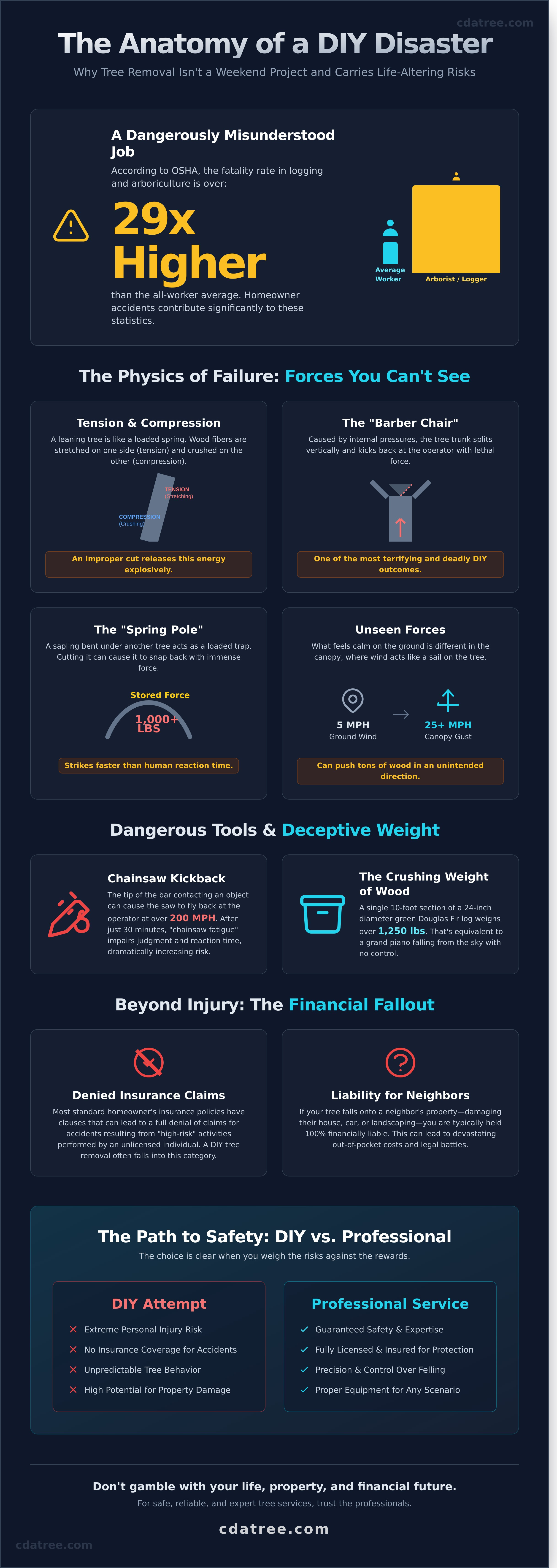
The decision to cut down your own tree is one of the single most dangerous choices a homeowner in the Pacific Northwest can make. According to a 2023 analysis by the Occupational Safety and Health Administration (OSHA), logging and arboriculture have a fatality rate over 29 times higher than the all-worker average, and a significant percentage of civilian injuries involve homeowners underestimating the power of a falling tree.
It’s completely understandable to look at that leaning fir, think about the potential cost, and figure your chainsaw and a free Saturday are all you need. We get it. You're capable, and saving several hundred, or even thousands, of dollars is a powerful motivator. But the hidden physical, financial, and even legal risks of cutting down your own tree are simply not worth the gamble. This guide will provide a clear, direct look at the specific dangers involved and show you why professional arborist expertise is the only safe and reliable choice for your property.
We’ll break down the complex physics that can send a multi-ton tree in an unexpected direction, explore the insurance clauses that could leave you financially ruined after an accident, and explain how to find a trustworthy professional to handle the job safely and efficiently from start to finish.
Key Takeaways
Discover the invisible physics of a leaning tree, including the critical difference between tension and compression that professionals must master.
Pinpoint the most common DIY errors, such as chainsaw kickback and ladder misuse, to understand the severe physical risks of cutting down your own tree.
Protect yourself by learning how a DIY tree removal accident can lead to denied insurance claims and significant liability for your neighbor's property.
Recognize why Pacific Northwest trees, from towering Douglas Firs to those in rain-saturated soil, present unique challenges that demand local expertise.
Table of Contents The Gravity of the Situation: Why Tree Physics Defy DIY Logic Life-Altering Hazards: The Most Dangerous DIY Tree Removal Mistakes Beyond the Injury: Financial and Legal Risks of DIY Failures The Pacific Northwest Factor: Why Our Trees Are Different The Seamless Path to Safety: When to Call CDA Tree and Utility
The Gravity of the Situation: Why Tree Physics Defy DIY Logic
Most homeowners see a tree and think of it as a simple, vertical structure. They believe that with a powerful chainsaw and a clear line of sight, felling it is a straightforward task. This assumption is the first and most dangerous mistake. A standing tree is a complex system of immense weight, stored energy, and competing physical forces. In arboriculture, professionals have a chilling term for a loose, broken branch caught high in a tree's canopy: the 'Widow-maker'. It's a name earned because the slightest vibration from a chainsaw below can send it plummeting without warning. This single hazard represents one of the many hidden risks of cutting down your own tree.
A tree isn't just sitting on the ground; it's a dynamic structure under constant strain. Understanding the forces at play is the difference between a controlled felling and a catastrophic accident. Gravity is only one of at least five major forces acting on the trunk, which also include tension, compression, torsion (twisting), and the dynamic force of wind. Ignoring even one of these can lead to disaster.
Understanding Tension and Compression
The internal pressures within wood are immense. A leaning tree, for example, has its wood fibers stretched on the outer side of the lean (tension) and crushed on the inner side (compression). If you make the wrong cut, you can release this stored energy explosively. A common and lethal trap for amateurs is the 'spring-pole', where a smaller sapling is bent under the weight of a larger tree. Cutting this sapling to clear a path can cause it to snap back with over 1,000 pounds of force, striking an operator before they can react. Even a tree that appears perfectly straight has an unpredictable center of gravity due to uneven limb growth or unseen internal decay, making a precise directional fall nearly impossible without expert assessment.
The Unpredictable Nature of a Falling Tree
What feels like a calm day on the ground can be entirely different 50 feet up in the canopy. A 5-mph breeze at ground level can easily be a 25-mph gust at the top of a tree, acting like a sail and pushing tons of wood in an unintended direction. The key to controlling this fall is the hinge, a specific amount of wood left uncut between the notch and the back cut. DIYers almost always fail to create a proper hinge; they either cut it off entirely, removing all control, or make it improperly. Professional arborists are trained in the physics of tree felling, allowing them to create a precise hinge that guides the tree safely to its target landing zone. The dreaded 'barber-chair' is a vertical split that occurs before the felling cut is complete, causing the base of the trunk to kick back violently at the operator. This terrifying event, often caused by internal pressures and improper cutting technique, is one of the most lethal outcomes of a failed DIY removal.
Life-Altering Hazards: The Most Dangerous DIY Tree Removal Mistakes
When homeowners consider removing a tree, they often focus on the visible task: cutting the trunk. But the most catastrophic accidents stem from forces they don't see coming. These aren't simple mistakes; they are split-second events with permanent consequences, turning a weekend project into a life-changing emergency. The true risks of cutting down your own tree involve a dangerous combination of powerful equipment, immense weight, and unpredictable physics.
Chainsaw Safety and Kickback Risks
The number one cause of severe injury for DIY arborists is chainsaw kickback. This violent, upward jerking of the saw happens when the upper tip of the guide bar, an area known as the 'kickback zone', contacts a solid object. The chain can fly back toward the operator at over 200 miles per hour. While personal protective equipment (PPE) like chaps and a helmet are essential, they are rated to resist, not stop, a chain at full throttle. The University of Illinois Extension highlights the dangers of improper equipment, but even the best gear has limits. Physical exhaustion dramatically increases this danger. After just 30 minutes of continuous work, 'chainsaw fatigue' sets in, impairing judgment and slowing reaction time. This fatigue is a key factor in accidents involving even modern, 2026-era chainsaws with advanced safety features.
Given these life-threatening risks, being prepared for a worst-case scenario is just as important as prevention. Having professional-grade trauma supplies on hand can be the difference between a manageable injury and a tragedy. For those interested in comprehensive emergency preparedness, you can learn more about MED-TAC International Corp. and their specialization in tactical medical gear.
Gravity and Falling Objects
Most people severely underestimate the weight of wood. A single 10-foot section of a green Douglas Fir log, just 24 inches in diameter, can weigh over 1,250 pounds. That's the weight of a grand piano falling from the sky. Attempting to 'rope' a tree or large limb without a professional rigging system creates a dangerous pulley. Instead of guiding the limb down, the rope can easily pull the operator off their ladder or, if tied to a vehicle, pull the entire tree onto your home or truck. The initial vibration from the first cut also poses a significant threat. It can shake loose 'widowmakers'-large, dead branches in the upper canopy that can fall silently and strike anyone below.
These falling objects are a primary reason why the ground is the most dangerous place to be. OSHA data consistently shows that 'struck-by' incidents are a leading cause of fatalities in professional logging. For a DIY project, the 'ground crew' is often an unprepared family member who has no concept of escape routes or the unpredictable bounce of a falling limb. Compounding these issues in the Pacific Northwest is the constant threat of electrocution. Homeowners don't realize that high-voltage electricity can 'arc' several feet from a utility line to a metal ladder or a wet branch, causing a fatal shock without any direct contact. These invisible dangers represent the most serious risks of cutting down your own tree.
The forces at play during a tree removal are immense and unforgiving. A deep respect for the power of chainsaws, the physics of gravity, and the unseen electrical hazards is non-negotiable. Understanding these complex variables is central to our work, which is why a professional assessment of your tree removal project is the first step toward a safe, seamless outcome for your property.
Beyond the Injury: Financial and Legal Risks of DIY Failures
The most immediate danger of handling a chainsaw is physical harm, but the financial fallout from a mistake can be just as devastating. Many homeowners assume they are saving a few hundred dollars, but they fail to calculate the enormous financial and legal exposure they take on. The hidden risks of cutting down your own tree can quickly transform a weekend project into a decade-long financial burden, turning a perceived savings of $1,500 into a catastrophic loss exceeding $150,000 for a new roof and structural repairs.
Insurance and Liability Nightmares
Your homeowner's insurance policy feels like a safety net, but it's not designed to catch you from acts of gross negligence. When you, an unlicensed and untrained individual, decide to perform a highly dangerous task, many insurers can view a resulting accident as a preventable, 'intentional act' that went wrong. Most standard homeowner policies exclude damage caused by unlicensed 'contractor' work performed by the owner. A denied claim leaves you personally responsible for every penny of the damage, whether it's to your own home, a neighbor's property, or public infrastructure. If that tree falls the wrong way and damages the house next door, you aren't just facing repair bills; you're facing a lawsuit from your neighbor and their insurance company. In the Pacific Northwest, accidentally severing a public utility line can result in fines from the Washington Utilities and Transportation Commission (UTC) that can reach thousands of dollars, on top of the utility company's bill for emergency repairs.
The True Cost of 'Saving' Money
The price quoted by a professional arborist isn't just for labor; it's the cost of safety and certainty. A DIY approach ignores the very real expenses that professionals bundle into their service. These hidden costs add up quickly:
Equipment Rental: A commercial-grade chainsaw rental costs around $90 per day, a wood chipper can be over $350, and a boom lift can exceed $500.
Debris Disposal: Your local waste management won't haul away a 2-ton tree trunk. Expect to pay landfill or transfer station fees of $60-$120 per ton.
Medical Bills: Even a "minor" injury can result in thousands of dollars in emergency room co-pays, stitches, and follow-up care.
Should an accident occur and you file a claim, your financial troubles are just beginning. A single claim can cause your insurance premiums to skyrocket by an average of 9% to 20% for years. A professional's quote includes comprehensive liability insurance, workers' compensation, and the use of specialized, maintained equipment. You're not just paying for removal; you're paying for peace of mind that you simply can't buy at a rental shop.
The Pacific Northwest Factor: Why Our Trees Are Different
Tree removal here isn't like anywhere else in the country. In the Pacific Northwest, we live among giants. The unique combination of our regional tree species, persistently saturated soil, and challenging terrain creates a set of variables that dramatically elevates the risks of cutting down your own tree. What might be a straightforward project in a drier, flatter state becomes a complex calculation of physics and biology here in Washington and Oregon.
Our landscape is defined by trees that can reach staggering heights. A mature Douglas Fir often towers over 200 feet, and Western Red Cedars can grow even taller. The sheer scale of these trees means the potential energy involved in a removal is immense. A small miscalculation doesn't just damage a fence; it can level a home. Compounding this is the prevalence of diseases like Laminated Root Rot, a silent destroyer common in our region. This fungus can hollow out the lower trunk and root system of a Douglas Fir, leaving a dangerously weak base on a tree that otherwise appears healthy. An amateur might never spot the subtle signs before it's too late.
Regional Tree Species and Their Challenges
Not all trees are created equal, especially when it comes to removal. Douglas Firs are notoriously top-heavy, and their upper limbs can fail and fall without warning, creating deadly "widowmakers." Cottonwoods, often found near our rivers and wetlands, are even more treacherous. Their wood is incredibly brittle and prone to rot, making them one of the most unpredictable and hazardous trees for any DIY removal attempt. Identifying a hazardous tree in the PNW requires decades of hands-on experience with these specific species.
Terrain and Weather Complications
Our region's topography and weather add another layer of serious risk. Felling a 150-foot tree on a 15-degree slope doesn't create a simple 150-foot drop zone; the angle, ground composition, and potential for the trunk to roll or slide can extend that danger zone unpredictably. After our long rainy season, which can last over 9 months, the soil becomes deeply saturated. This leads to a phenomenon called "root heave," where the entire root plate can become unstable. Attempting a removal in these conditions can cause the entire tree to pivot unexpectedly from the base.
Looking ahead, the need for professional oversight is only growing. Climate projections from the University of Washington's Climate Impacts Group forecast an increase in the intensity of our winter storm systems. This means that by 2026, the baseline for what constitutes a "high-risk" tree will have shifted, demanding an even higher standard of professional-grade hazard assessment to keep properties safe.
These regional factors transform a difficult job into a highly technical and dangerous one. The immense size of our trees, the instability of our soil, and the hidden threat of decay are why the risks of cutting down your own tree are so magnified in the Pacific Northwest. Understanding these complex, overlapping variables is our commitment. Before you attempt to tackle a PNW giant, let our certified arborists provide a professional and safe tree risk assessment for your property.
The Seamless Path to Safety: When to Call CDA Tree and Utility
Understanding the dangers of DIY tree removal is the first step toward protecting your property and family. The next is choosing a trusted professional to manage the job with precision and care. For homeowners across the Pacific Northwest, CDA Tree and Utility is that choice. We are built on a simple promise: ‘On Time, Every Time.’ This commitment to reliability is backed by owner Joshua Williamson’s over 20 years of hands-on experience, navigating the unique challenges of our region’s landscape.
We believe that safety shouldn't be complicated. That’s why we developed our ‘Seamless Process,’ a comprehensive approach that removes the burden from your shoulders. From the moment you call us, we manage every detail. This includes conducting a thorough initial hazard assessment, securing all necessary city or county permits, and coordinating every phase of the removal. Our meticulous planning and execution are designed to completely eliminate the well-documented risks of cutting down your own tree, giving you total peace of mind.
Our Professional Safety Protocol
Our commitment to safety is absolute, which is why we invest in industry-leading equipment and expertise. We utilize a fleet of advanced machinery, including 75-foot aerial lifts for precise access and powerful cranes for zero-impact removal over homes and delicate landscaping. An ISA-Certified Arborist oversees every project, ensuring that each cut is strategic and protects the health of your property. It’s this level of professionalism that makes us the first call for emergency response when powerful PNW windstorms strike.
Get a Fast, Fair, and Safe Estimate
Taking the next step is simple. You can schedule a no-obligation hazard assessment with our expert team to get a clear, transparent quote for your project. The peace of mind that comes from hiring a fully insured professional is invaluable. We carry a comprehensive $2 million liability policy, so you are completely protected from the financial and legal consequences that can arise from the risks of cutting down your own tree. Don't leave your safety to chance. Protect your home and family-request a professional tree removal quote from CDA Tree and Utility today.
Make the Safe Choice for Your Pacific Northwest Property
The immense weight of a falling tree, the unpredictable nature of cuts, and the potential for catastrophic property damage all point to one clear truth. Attempting a DIY tree removal isn't a weekend project; it's a life-altering gamble. Understanding the full spectrum of risks of cutting down your own tree, from physical injury to significant financial liability, is the first step toward making a responsible decision for your home and family.
You don't have to face these dangers alone. Since 1997, CDA Tree and Utility has provided safe, reliable arbor care solutions across the Pacific Northwest. Our owner, Joshua Williamson, stands behind every job with his personal guarantee of quality and safety. We manage the entire process for you, from the initial assessment to securing all necessary permits and regulatory approvals, ensuring a seamless and worry-free experience.
Don't risk your home or health-Contact CDA Tree and Utility for a professional hazard assessment. Let our team provide the professional care your property deserves and the peace of mind you need.
Frequently Asked Questions About Tree Removal
Is it ever safe to cut down a tree yourself?
Yes, it can be relatively safe to remove a small, healthy sapling that is under 15 feet tall and has a trunk diameter of less than 6 inches. The tree must also be in a wide-open area, clear of any homes, fences, or power lines. However, the inherent risks of cutting down your own tree multiply if it is leaning, diseased, or near any obstacle. For any tree outside these specific conditions, a professional assessment is essential for safety.
What size tree is safe for a homeowner to cut down?
A tree with a trunk diameter of 6 inches or less and a height under 15 feet is generally the maximum size a homeowner should consider felling. This size can typically be managed with basic equipment. Once a tree's trunk exceeds 8 inches in diameter, its weight and the forces involved require advanced felling techniques, like a proper hinge cut, and professional-grade saws to ensure the fall is controlled and predictable.
Will my insurance cover me if I damage my house while cutting a tree?
No, your standard homeowner's insurance policy, such as an HO-3 policy, will almost certainly not cover damage you cause to your own property during a DIY tree removal. These policies include negligence clauses that exclude coverage for damage resulting from high-risk activities you perform yourself. While a storm dropping a branch on your roof is a covered event, you will likely be responsible for 100% of the repair costs if you drop the tree on it yourself.
What is the most dangerous part of cutting down a tree?
The felling process, specifically making the final back cut, is the most dangerous part of cutting down a tree. An improper cut can cause the tree to kick back off the stump, split vertically, or fall in an unintended direction. The Tree Care Industry Association (TCIA) reports that over 60% of felling accidents are due to this loss of control. Unseen decay, wind, and the tree's natural lean can all lead to a catastrophic failure during this critical moment.
Do I need a permit to cut down a tree on my property in the PNW?
Yes, in many Pacific Northwest cities and counties, you do need a permit. The rules are highly localized; for example, Seattle requires a permit to remove any "exceptional tree," often defined by a trunk diameter of 30 inches or more. In Coeur d'Alene, specific rules apply to trees in shoreline protection zones. You must check with your local city or county planning department before any work begins to avoid fines, which can exceed $1,000 per violation.
How do I tell if a tree is too dangerous for DIY removal?
A tree is too dangerous for DIY removal if it is within 10 feet of power lines, leans at an angle greater than 15 degrees, or has visible signs of severe decay like large fungal growths, deep cracks, or major dead limbs. These factors introduce unpredictable variables that dramatically increase the risks of cutting down your own tree. If the tree cannot fall freely without hitting a structure, it requires professional sectional dismantling.
What equipment do professionals use that homeowners don't have?
Professionals use specialized gear designed for safety and efficiency that isn't available at a hardware store. This includes industrial-grade rigging systems with ropes and pulleys rated for over 10,000 pounds, aerial lifts or bucket trucks for safe access, and commercial wood chippers that can process a 12-inch log in under a minute. For complex jobs near homes, we often use a crane to lift heavy sections away, guaranteeing zero impact to your property.
What happens if a DIY tree removal hits a power line?
If a tree hits a power line, it creates an immediate and deadly risk of electrocution and will likely cause a power outage for your entire neighborhood. You can be held financially liable by the utility provider for all repair costs, which frequently exceed $10,000 for replacing a damaged transformer or utility pole. You must call 911 immediately and stay at least 35 feet away, as the ground itself can be energized and lethal.
Comments