


DIY Tree Removal vs. Professional Service: Is the Risk Worth the Savings in 2026?
- cdatreeu
- 4 hours ago
- 14 min read
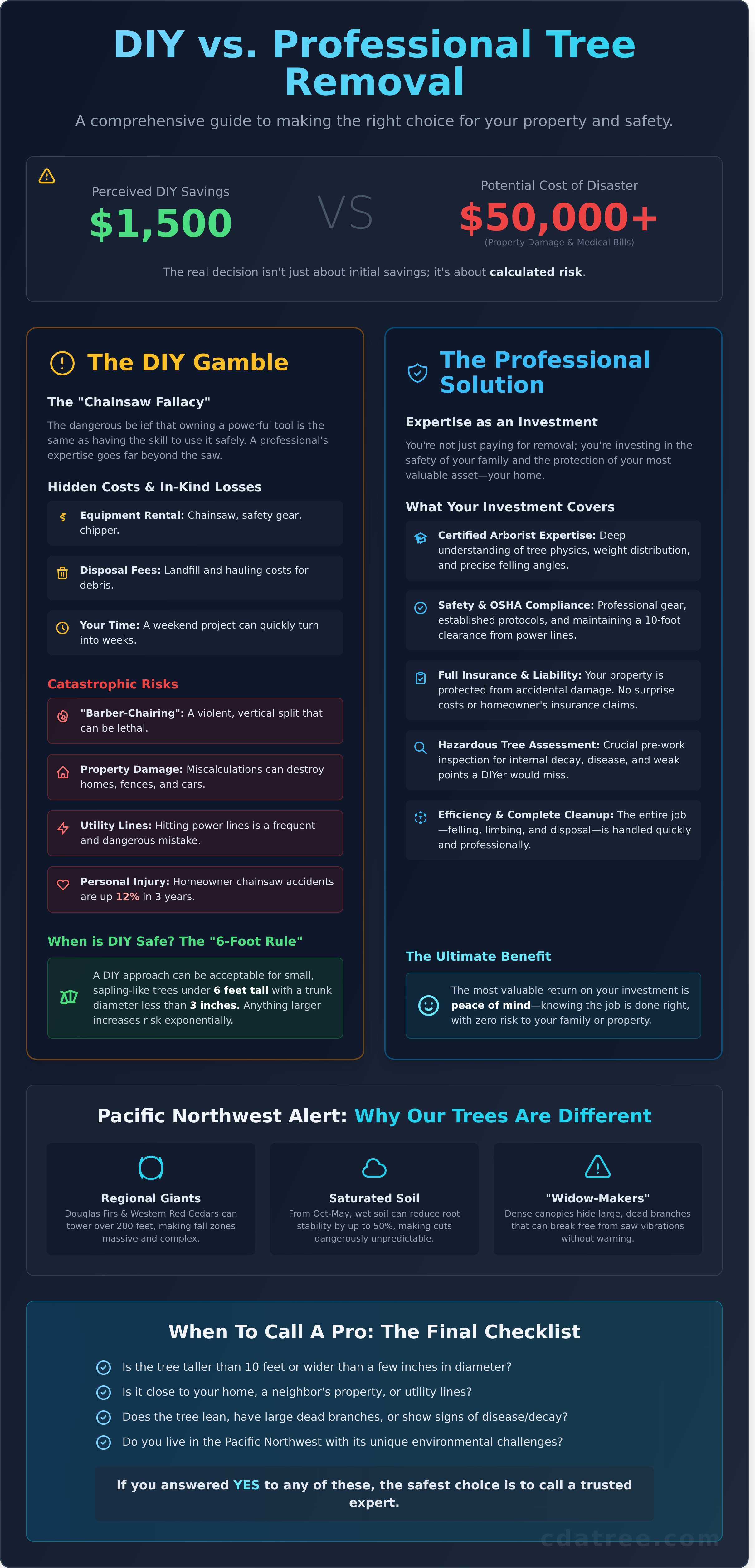
What if that weekend tree removal project, the one you think will save you $1,500, ends up costing you $50,000 in property damage and emergency room visits? It's a sobering thought, but according to a 2025 Tree Care Industry Association report, homeowner injuries from chainsaw accidents have risen by 12% in the last three years. We get it. The temptation to handle a problem tree yourself is powerful, and the debate over DIY tree removal vs professional service often starts with the bottom line.
However, the real decision isn't just about initial savings; it's about calculated risk, especially here in the Pacific Northwest with our massive firs and unpredictable weather. This article provides a comprehensive breakdown of the critical factors you must consider: the true financial costs, the confusing web of local permits, and the essential safety protocols that separate a successful job from a disaster. By the end, you'll have a clear framework to confidently decide which trees are truly "DIY-able" and when it's time to call a trusted expert.
Key Takeaways
Understand the critical cutting mistakes, such as those leading to "barber-chairing," to avoid catastrophic property damage or personal injury.
Calculate the true cost of DIY by factoring in hidden expenses like equipment rental, disposal fees, and the high value of your own safety.
Use our decision-making guide to confidently determine if your specific tree is a safe DIY project or one that demands an expert.
Weigh the pros and cons of DIY tree removal vs professional service by looking at the crucial insurance and liability implications most homeowners overlook.
Table of Contents The Reality of DIY Tree Removal: Can You Really Do It Yourself? The Hidden Risks of DIY Tree Removal: What Tutorials Don’t Show Professional Tree Removal vs. DIY: A Cost-Benefit Analysis When is DIY Actually Safe? (And When is it a Disaster?) Why CDA Tree and Utility is the PNW’s Choice for Safe Removal
The Reality of DIY Tree Removal: Can You Really Do It Yourself?
Taking on a tree removal project yourself means managing the entire job without professional help: the felling, the limbing, and the final disposal of all debris. The desire to save money is understandable, and for many homeowners, it's the primary motivation. However, this often leads to the "Chainsaw Fallacy"-the dangerous belief that owning a powerful tool is the same as having the skill to use it safely and effectively. In reality, a chainsaw is just one small part of a complex and high-stakes operation.
The skills required go far beyond simply starting a motor. A certified arborist understands tree physics, weight distribution, and the precise angles needed for a controlled fall. The tree felling process is a science that involves a series of calculated cuts, including the notch and the back cut, to direct a multi-ton object to a specific spot on the ground. A miscalculation of just a few degrees can send a trunk crashing into your home, your neighbor's property, or nearby power lines. This is the central question in the DIY tree removal vs professional debate: are you prepared to manage that level of risk?
Before any reputable service makes a single cut, they perform a Hazardous Tree Assessment. This professional evaluation goes beyond what's visible from the ground. We inspect for signs of disease, internal decay, weak branch unions, and soil erosion around the root plate. These are critical factors that dramatically change how a tree will behave when cut. A DIY approach misses this essential diagnostic step, meaning you could be attempting to fell a tree that is far more unstable and dangerous than it appears.
Here in the Pacific Northwest, the stakes are rising along with our property values. With real estate values in North Idaho and the greater Spokane area projected to appreciate by over 12% between 2024 and 2026, your home is an increasingly valuable asset. A tree removal accident doesn't just result in a costly cleanup; it can cause structural damage that significantly devalues your property and leads to complex, expensive insurance claims. Protecting your investment requires a professional, zero-mistake approach.
The "6-Foot Rule" for Homeowners
For small, sapling-like trees under six feet tall with a trunk diameter of less than three inches, a DIY approach can be safe. The risk is minimal. Once a tree surpasses 10 feet, however, its weight and the force it generates increase exponentially. A 40-foot pine, for example, can easily weigh over 1,000 pounds. The potential fall zone is a circle with a radius of at least 1.5 times the height of the tree.
PNW Specifics: Why Our Trees are Different
Our region is home to giants like the Douglas Fir and Western Red Cedar, which can tower over 200 feet. The challenges they present are unique. From October through May, our notoriously saturated soil can reduce root stability by up to 50%, making a tree's reaction to being cut dangerously unpredictable. Their dense canopies also often hide "widow-makers"-large, dead branches that can break free from the vibration of a saw and fall without warning.
Ultimately, the choice between DIY tree removal vs professional service comes down to a clear-eyed assessment of the tree and your capabilities. For anything larger than a shrub, especially given the unique challenges of our Pacific Northwest environment, the risks to your safety and property are simply too great. It's about more than just getting the job done; it's about getting it done safely and without incident.
The Hidden Risks of DIY Tree Removal: What Tutorials Don’t Show
Online tutorials make felling a tree look deceptively simple. A few quick cuts, a shout of "timber," and the problem is solved. What these videos fail to capture is the immense and unforgiving power of physics. Gravity doesn't care about your intentions. When a 2,000-pound tree trunk begins to shift mid-cut, you have zero room for error and only a fraction of a second to react. This is the critical difference in the DIY tree removal vs professional debate: a professional plans for physics, while a DIYer is often surprised by it.
The most common amateur mistakes are catastrophic. A slight miscalculation in your back-cut, for instance, can lead to "barber-chairing." This is a terrifying event where the tree trunk splits vertically up from the back-cut, violently kicking the base back at the cutter with lethal force. It happens in an instant. Then there are the overhead hazards. The Occupational Safety and Health Administration (OSHA) mandates that workers maintain a minimum 10-foot clearance from power lines. Are you certain you can identify every utility cable hidden in the canopy? The reality is that tree work is one of the most dangerous jobs in America; according to 2022 data, logging and tree service workers have a fatal injury rate over 20 times the national average for all professions.
Structural Instability and Decay
A tree that looks solid on the outside can be a ticking time bomb internally. Internal rot, or "hollow heart," compromises the tree's structural integrity, making its fall path completely unpredictable. Signs of this hidden danger can be subtle:
Fungus or mushrooms growing on the trunk or at the base.
Deep cracks or splits in the bark.
An unusual number of dead branches in the upper canopy.
Sawdust (frass) near the base, indicating insect infestation.
Cutting a diseased tree without the proper rigging and support equipment is a gamble. Ironically, dead trees are often even more dangerous than living ones. Their wood is brittle, causing branches to snap unexpectedly under the vibration of a chainsaw.
The Property Damage Domino Effect
Even a "successful" DIY removal can end in financial disaster. A single 200-pound oak limb falling just 40 feet strikes your roof with over 8,000 foot-pounds of energy, an impact comparable to a small sedan being dropped on your house. The potential repair bill for shattered rafters and damaged shingles can easily eclipse the highest estimates for professional tree trimming costs, turning a money-saving project into a mortgage-level expense. This doesn't even account for the "oops" factor; when your careful notch fails and the tree twists, falling the wrong way onto a neighbor's fence, your garage, or underground septic lines. The true cost of DIY tree removal isn't just the price of a chainsaw rental. It includes the risk to your home, your property, and your safety. Before you start the engine, it's wise to get a professional risk assessment to understand precisely what you're up against.
Professional Tree Removal vs. DIY: A Cost-Benefit Analysis
At first glance, the math seems simple. A quote from a professional tree service has a clear dollar amount, while doing it yourself appears to save that entire cost. But this surface-level comparison misses the bigger picture. The true financial debate of DIY tree removal vs professional services isn't about one price tag; it's about weighing a guaranteed, insured cost against a long list of potential expenses, risks, and hidden fees.
A homeowner's initial investment for a single medium-sized tree removal can be surprisingly steep. You don't just need a chainsaw. You need a safe and effective toolkit.
Chainsaw Purchase/Rental: A reliable, safe chainsaw like a Stihl or Husqvarna costs upwards of $400. A daily rental might be $75, but it won't be the professional-grade tool needed for larger jobs.
Personal Protective Equipment (PPE): This isn't optional. A complete kit with a helmet system, safety glasses, hearing protection, and chainsaw chaps will cost at least $250.
Disposal Fees: Your local landfill or transfer station doesn't accept yard waste for free. Expect to pay between $60 and $150 per ton for disposal, and that's after you've spent hours cutting and hauling the debris.
Suddenly, your "free" project has a real-world cost of over $700 before you've even started the engine. This doesn't account for the "invisible costs": the 8 to 16 hours of a weekend you'll never get back, the physical exhaustion, or the immense risk of an accident. The Centers for Disease Control and Prevention (CDC) reports that over 36,000 people are treated for chainsaw injuries in U.S. emergency rooms each year.
The Insurance Nightmare
This is the single greatest financial risk in the DIY tree removal vs professional debate. If you drop a tree on your own roof, your homeowner's insurance may deny the claim, citing the incident as a "preventable accident" due to negligence. A professional arborist carries at least $1 million in general liability insurance specifically to cover these events. If a friend gets hurt helping you, you could be personally liable for their medical bills, as they aren't covered by workers' compensation.
Equipment: The Pro Advantage
By 2026, the gap between consumer and professional equipment has widened significantly. We utilize advanced tools that ensure a safe, clean, and seamless job. This includes aerial lifts to precisely dismantle trees near structures and high-capacity wood chippers that process 18-inch diameter limbs in seconds. Our stump grinding services eliminate the tripping hazard and permanent eyesore a DIY removal almost always leaves behind. Through proper rigging, we can "float" massive limbs safely to the ground, guaranteeing no damage to your lawn or landscaping.
A professional quote isn't just for labor. It's an all-inclusive price that covers expertise, specialized equipment worth tens of thousands of dollars, comprehensive insurance, and guaranteed debris removal. A job that exhausts your entire weekend is often completed by our crew in just 3-4 hours. Our commitment to being on time, every time means your project is completed efficiently, preventing costly delays and giving you back your valuable time. It's the difference between a risky weekend project and a seamless, professional solution.
When is DIY Actually Safe? (And When is it a Disaster?)
For Pacific Northwest homeowners, the decision to tackle a tree removal project yourself can feel empowering. You save some money and get a weekend project. But the line between a manageable task and a life-altering accident is dangerously thin. The debate over DIY tree removal vs professional services isn't just about cost; it's a serious risk assessment. Before you even think about starting a chainsaw, you need to evaluate the three critical factors: the tree’s size, its location, and your equipment.
A 15-foot ornamental maple in your front yard is a different species of problem than a 120-foot Douglas Fir towering over your roof. The former might weigh a few hundred pounds, while a single 20-foot section from the fir can easily exceed 2,000 pounds. That’s the weight of a small car, and gravity doesn't care about your weekend plans. Your first step should always be to conduct a simple "Proximity Test." Is the tree's total height greater than the distance to any structure? If that fir is 120 feet tall and your house is only 50 feet away, you've failed the test. It's a job for a professional, period.
Next, take an honest look at your gear. That 16-inch chainsaw from the hardware store is designed for light pruning and cutting firewood, not for felling a tree with a 30-inch diameter trunk. Professional arborists use saws with longer bars (24 inches or more) and powerful engines, but more importantly, they use a complex system of ropes, pulleys, and rigging to control the descent of every single piece. Without this equipment, you have zero control. You're simply gambling on where a multi-ton object will fall.
The Green Light: When You Can DIY
You can safely handle a few specific scenarios with basic hand tools and proper safety glasses. These jobs don't involve felling or significant climbing:
Small Saplings: Young trees with a trunk diameter of less than 4 inches at chest height.
Isolated Brush: Clearing small trees or shrubs in a wide-open area, far from any fences, sheds, or power lines.
Ground-Level Pruning: Trimming small, low-hanging branches you can reach easily from the ground with a pole saw.
The Red Light: When DIY is a Disaster
Attempting removal in these situations is not cost-saving; it's a reckless gamble with your property and your life. The tree care industry has a fatality rate over 10 times higher than the average for all industries, and these scenarios are why:
Near Power Lines: If any part of the tree is within 10 feet of a utility line, stop. It's illegal and incredibly dangerous to work this close. Utility line repair is not a service we offer, because the power company must be involved.
Leaning or Unstable Trees: A tree leaning toward your home, your neighbor’s garage, or the street has a compromised center of gravity. It will not fall where you expect.
Damaged or Diseased Trees: Look for large, dead branches hung up in the canopy (known as “widow-makers”), deep cracks in the trunk, or signs of rot. These trees are structurally unsound and unpredictable.
When the risks are this high, the choice becomes clear. Your safety and the integrity of your home are not worth the gamble. If your tree falls into any 'Red Light' category, don't risk it. Get a professional safety assessment from CDA Tree today.
Why CDA Tree and Utility is the PNW’s Choice for Safe Removal
After weighing the options, the choice between DIY tree removal vs professional service becomes a matter of trust, safety, and guaranteed results. At CDA Tree and Utility, we’ve built that trust with homeowners and businesses across the Pacific Northwest since 1997. For over 25 years, our founder, Joshua Williamson, has personally committed to providing a service that isn't just effective, but completely seamless for our clients. We understand the unique challenges of our region, from the towering Douglas Firs to the unpredictable winter storms that can turn a problem tree into an immediate hazard.
Our reputation is built on a simple promise: On time, every time. We respect your schedule and your property. This commitment to reliability means you aren't left waiting, wondering, or worrying. From initial assessment to the final rake of debris, our team manages every detail with precision. This includes navigating the complex web of local permits and regulatory requirements that can easily trip up a DIY project, potentially leading to fines. We handle the paperwork, we execute the removal safely, and we leave your property cleaner than we found it. It’s a comprehensive approach that removes all the stress from your shoulders.
Our Emergency Response Advantage
When a storm hits, there’s no time for a learning curve. Our rapid-response team is equipped to handle emergency situations where DIY is simply not an option. We utilize advanced equipment, including specialized cranes and rigging systems, specifically chosen for the challenging terrain of the Pacific Northwest. Our first priority is to safely secure your property, prevent further damage, and clear the hazard with unmatched efficiency and care.
The CDA "Seamless Process"
We've refined our process to eliminate the headaches often associated with property services. It begins with a clear, honest consultation and ends with a perfectly clean site. Our competitive pricing is transparent, accounting for the entire job from start to finish. This approach consistently proves more cost-effective than a DIY attempt, which often comes with hidden costs like equipment rental, waste disposal fees, and the immense financial risk of property damage. Let us show you the difference true professionalism makes. Schedule your professional tree assessment with Joshua today.
Make the Safe, Professional Choice for Your Property
When weighing DIY tree removal vs professional service, the final verdict is clear: the risks far outweigh the perceived savings. A single miscalculation with a chainsaw or a falling limb can result in thousands of dollars in property damage or a life-altering injury, completely negating any money you hoped to save. For any tree that requires a ladder, is near power lines, or shows signs of disease, the expertise, specialized equipment, and full insurance coverage of a certified arborist are non-negotiable for a safe outcome.
You don't have to take on that risk. Since 1997, CDA Tree and Utility has proudly served the Pacific Northwest, specializing in the hazardous and emergency tree removals that demand precision and experience. Our commitment is to provide a seamless process from start to finish, backed by our "on time, every time" service guarantee. We bring decades of hands-on experience to ensure your property is treated with respect and the job is done safely and efficiently.
Choose certainty over chance. Get a Fast, Professional Tree Removal Quote from CDA Tree and let our team provide the professional peace of mind you deserve.
Frequently Asked Questions
Is it cheaper to cut down a tree yourself in 2026?
Initially, it might seem cheaper to cut down a tree yourself, but hidden costs can quickly add up. Equipment rental for a chainsaw, safety gear, and a wood chipper can exceed $300 per day. When considering DIY tree removal vs professional services, you must also factor in the financial risk. A single mistake could cause thousands in property damage, far exceeding the cost of hiring an insured arborist who guarantees a safe, efficient job from start to finish.
What is the most dangerous part of removing a tree DIY?
The single most dangerous part of a DIY tree removal is the final felling cut. This is the moment the tree begins to fall, and its path can be dangerously unpredictable. An improper cut can cause the trunk to split vertically in a "barber chair" event or kick back at the operator. According to OSHA, being struck by falling objects accounts for over 25% of all fatalities in the tree care industry, a risk that untrained individuals face directly.
Does homeowners insurance cover damage if I cut down a tree myself?
Your homeowners insurance policy will almost certainly not cover damage if you cut down a tree yourself. Most policies contain liability exclusions for activities deemed negligent or work that requires a licensed professional. If your DIY removal damages your home, your neighbor's property, or a vehicle, you will likely be personally responsible for 100% of the repair costs, which can easily exceed $10,000 for a tree falling on a roof.
How do I know if a tree is too big for me to remove safely?
A tree is too big for a DIY project if its trunk is more than 8 inches in diameter, it's taller than your house, or any part of it is leaning over a structure or power line. You should also call a professional if the tree is within a distance of 1.5 times its height from your home. Any of these factors dramatically increases the risk of an uncontrolled fall and requires specialized equipment and expertise to manage safely.
What equipment do professionals use that I can’t rent?
Professionals use specialized, high-powered equipment that isn't available for public rental due to safety and training requirements. This includes aerial lifts (bucket trucks) for precise canopy work, cranes for lifting large sections of wood over obstacles, and industrial-grade stump grinders that can remove root systems over 3 feet wide. Our advanced rigging systems allow us to safely lower massive limbs with zero impact to your property, a capability you can't replicate with rental gear.
Do I need a permit for tree removal in the Pacific Northwest?
Yes, obtaining a permit is often a requirement for tree removal in the Pacific Northwest. Many cities, including Seattle and Portland, have regulations to protect significant or "heritage" trees. For instance, removing a tree with a trunk diameter over 6 inches in certain zones may require city approval. Failing to get a permit can result in fines of up to $1,000 per tree. We handle the entire permitting process to ensure your project is fully compliant.
What happens if a DIY tree removal hits a power line?
If a tree hits a power line, it creates an immediate and life-threatening emergency. The primary risks are electrocution and fire. You must stay at least 35 feet away and call 911 and your utility provider immediately. Do not touch the tree or anything it's in contact with. You could be held financially liable by the utility company for repairs, which often cost over $15,000, in addition to facing potential fines for causing an outage.
Can I just leave the stump after a DIY removal?
You can leave the stump, but it's not a good idea for the long-term health and safety of your property. A decaying stump is an ideal habitat for pests like termites, carpenter ants, and fungi, which can then spread to your home. It also presents a serious tripping hazard and can continue to sprout new growth for years. Professional stump grinding removes the stump 8-12 inches below grade, eliminating these risks and reclaiming your yard space.
Comments