


15 Essential Questions to Ask a Tree Removal Service Before Hiring (2026 Guide)
- cdatreeu
- 4 hours ago
- 14 min read
Imagine this: you hire a crew to remove the massive pine leaning over your roof. A few hours later, you aren't admiring your newly sunny yard; you're staring at a crushed fence and a surprise bill for "debris hauling" that doubles the original quote. It’s a nightmare scenario, but it’s an all-too-common reality for homeowners who don't know what to look for. Choosing a contractor can feel overwhelming when you're worried about property damage, confused by different prices, and unsure who is truly qualified to handle such a dangerous job safely.
This guide is built to give you complete confidence in your decision. We've compiled the 15 essential questions to ask a tree removal service before you ever sign a contract. Armed with this knowledge, you’ll be able to vet any company like a pro, verify their professional credentials, avoid hidden costs, and protect yourself from liability. You'll learn how to ensure the entire process is safe, clean, and completely seamless from start to finish.
Key Takeaways
Learn the two critical insurance questions that protect you from financial liability if an accident occurs on your property.
Discover the most important questions to ask a tree removal service about their local experience to ensure they can safely handle your specific trees.
Understand how to spot hidden costs and red flags in an estimate so the price you are quoted is the price you actually pay.
Confidently evaluate any tree care professional using a proven vetting process for a safe, efficient, and seamless project from start to finish.
Table of Contents Beyond the Chainsaw: Why Your Choice of Tree Service Matters The "Must-Ask" Legal and Safety Questions Technical Expertise and Local PNW Experience Evaluating the Estimate: Pricing, Cleanup, and Red Flags Choosing Your Partner: The CDA Tree and Utility Approach
Beyond the Chainsaw: Why Your Choice of Tree Service Matters
Removing a tree, especially a large one near your home, is more complex than simply firing up a chainsaw. It’s a high-stakes operation involving physics, biology, and immense risk. A single miscalculation can send tons of wood crashing down, jeopardizing your home, nearby power lines, and the safety of everyone in the vicinity. This is why the first and most critical step in the process isn’t getting a quote; it’s understanding that your choice of tree service professional will dictate the safety and success of the entire project.
The right team protects your property and enhances your landscape's long-term health. The wrong one can lead to financial disaster. Knowing the right questions to ask a tree removal service is your best defense against turning a tree problem into a catastrophe.
The High Cost of Cheap Tree Removal
A surprisingly low bid from "the guy with a truck" might seem like a great deal, but it's often the most expensive choice you can make. These operators frequently cut costs by skipping essential safeguards, like insurance. If an uninsured worker is injured on your property, you could be held liable for their medical bills, which can easily exceed $100,000 for a serious injury. Furthermore, without proper general liability insurance, any damage to your property, from a crushed fence to a 2-ton oak limb destroying your roof, comes directly out of your pocket. Many homeowners have also fallen victim to the "disappearing contractor," who takes a hefty 50% deposit and is never seen again, leaving you with a lighter wallet and the same tree problem.
The Role of an ISA Certified Arborist
There is a fundamental difference between a "tree cutter" and a professional arborist. A cutter simply removes wood. An arborist, particularly one certified by the International Society of Arboriculture (ISA), manages the health and safety of your entire landscape. To become certified, an individual must demonstrate a high level of knowledge in arboriculture through years of experience and by passing a comprehensive examination. To learn more about their qualifications, you can explore the answer to What is a Certified Arborist? and understand the deep expertise they bring to every job.
ISA Certified Arborists are also bound by a strict code of ethics, ensuring they provide recommendations based on the tree's health and your property's safety, not just on making a quick sale. They will never recommend a harmful practice like "topping," which is the indiscriminate cutting of tree branches to stubs. This practice severely weakens a tree's structure and often leads to decay and hazardous regrowth. Instead, a professional provides expert pruning or a strategic removal plan that protects your property and promotes the vitality of your surrounding landscape, ultimately increasing your property value.
The "Must-Ask" Legal and Safety Questions
Choosing a tree service based on price alone is a significant risk. The tree care industry, according to 2022 data from the Bureau of Labor Statistics, has a fatal injury rate more than 20 times the national average for all professions. This isn't just a concern for the crew; it's a critical liability issue for you, the homeowner. Asking the right legal and safety questions protects your property, your finances, and ensures the job is done by true professionals. These are some of the most important questions to ask a tree removal service before they ever start their chainsaw.
A reputable company will welcome these inquiries and have the answers ready. Here’s what you need to confirm:
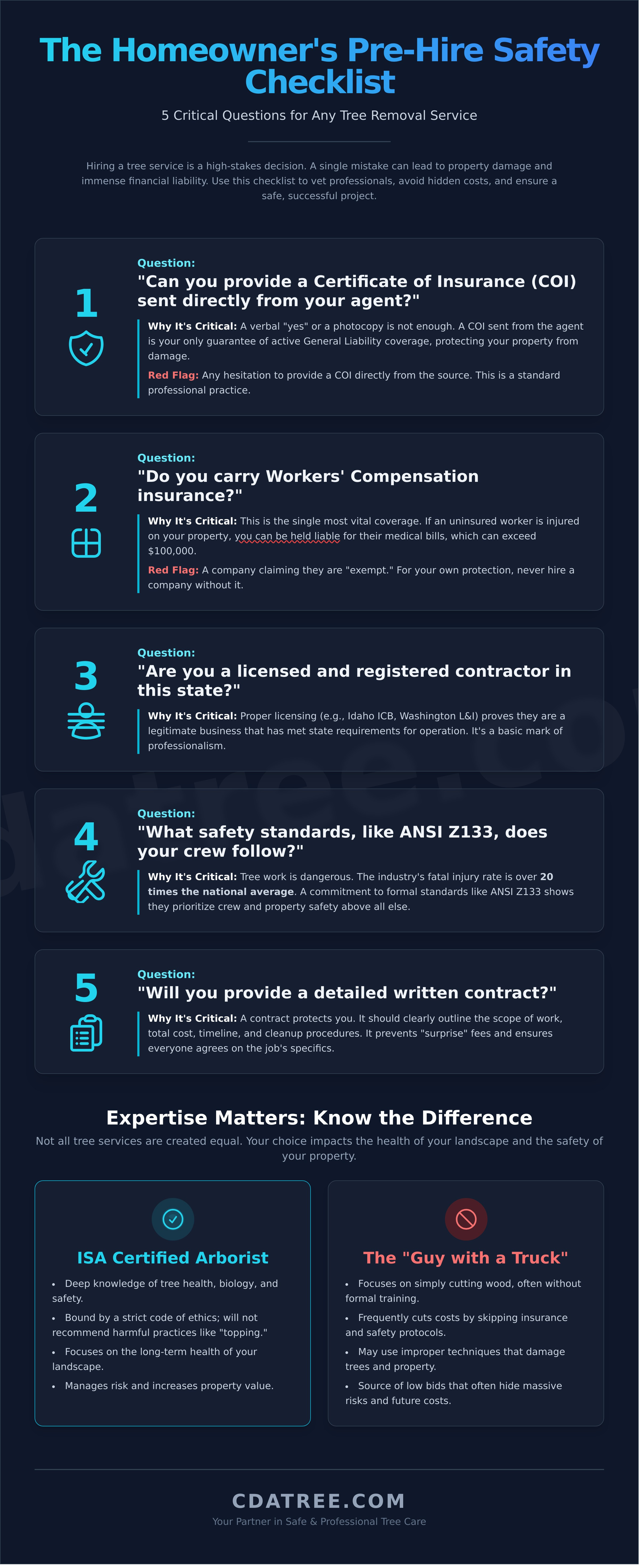
Can you provide a current certificate of insurance (COI) sent directly from your agent?
Do you carry both General Liability and Workers' Compensation insurance?
Are you a licensed and registered contractor in Idaho (ICB) and/or Washington (L&I)?
What safety standards, specifically ANSI Z133, does your crew follow on every job site?
Will you provide a detailed written contract outlining all responsibilities and costs?
Verifying Insurance: Don’t Just Take Their Word For It
A company telling you they're insured isn't enough. A photocopy of an insurance card is also insufficient, as the policy could have lapsed a week ago. You need direct confirmation. The only acceptable method is to request a Certificate of Insurance (COI) sent to you directly from their insurance agent’s office. The City of Portland’s official guide for homeowners strongly recommends requesting proof of liability insurance as a key step in hiring a qualified arborist. Also, understand that being "bonded" is different from being "insured." A bond protects you if the contractor fails to complete the job or commits theft, while insurance covers accidents and property damage.
Workers' Compensation: Protecting Your Personal Assets
This is the single most critical piece of coverage. Some small crews may claim they are "exempt" from carrying workers' compensation. This is a massive red flag. If an uninsured worker is injured on your property, you could be held personally liable for their medical bills, lost wages, and other damages, potentially costing you tens of thousands of dollars. Your homeowner's policy will likely not cover it. At CDA Tree and Utility, we eliminate this risk entirely. We carry full workers' compensation for every team member on every project, a non-negotiable part of our commitment to safety that you can learn more about by reviewing our professional standards.
Finally, a professional company's commitment to safety is demonstrated by their adherence to established industry protocols. Ask if they follow the ANSI Z133 safety standards, the nationally recognized standard for arboricultural operations. This governs everything from proper cutting techniques to aerial lift operation. Combine this with a written contract that details the exact scope of work, specifies who is responsible for cleanup, and locks in the final price. This document prevents misunderstandings and ensures the process is seamless from start to finish.
Technical Expertise and Local PNW Experience
Removing a tree in the Pacific Northwest isn't like anywhere else. The sheer scale of our native trees, combined with unique soil and weather conditions, demands a level of expertise that goes far beyond basic chainsaw work. A company's technical skill and deep-rooted local experience are what separate a seamless project from a potential disaster. These are some of the most vital questions to ask a tree removal service to gauge their true capability.
Any arborist can claim to have experience, but experience in this region is different. You should ask, "How many years have you specifically worked with the trees and conditions here in the Pacific Northwest?" With decades of hands-on experience serving North Idaho and the surrounding areas, our team at CDA Tree and Utility understands the unique challenges posed by our environment. We've managed complex removals through every season, from dry summer conditions to the challenging soil saturation of a wet spring.
PNW Specifics: Soil, Storms, and Species
Our region's heavy winter rains, often exceeding 27 inches annually in Coeur d'Alene, saturate the soil and can compromise the stability of a tree's root system. This makes trees, especially those over 100 feet tall, highly susceptible to windthrow during storms that produce gusts over 50 mph. Understanding this interplay between soil, weather, and native species like Douglas fir is critical for safe and effective tree removal.
When you have a 150-foot Douglas fir leaning precariously over your home, the approach must be meticulous. We're often asked how we handle these giants, and the answer lies in a combination of precision rigging and advanced equipment. It's not just about felling the tree; it's about systematically deconstructing it in a controlled environment. This leads to another crucial question for any service: "What is your detailed plan for protecting my property?"
Our standard procedure involves more than just a vague promise to be careful. We protect your property with specific, proven methods:
Ground Protection Mats: We lay down heavy-duty ground protection mats to create a temporary roadway, distributing the weight of an 8-ton bucket truck and preventing deep ruts in your lawn.
Strategic Rigging: Large limbs are never simply dropped. We use specialized ropes and lowering devices to guide each section safely to a designated drop zone, avoiding damage to underlying landscaping, fences, or patios.
Site Cleanup: Our commitment to a seamless process means we leave your property looking better than when we arrived, with all debris chipped and hauled away.
For the most dangerous and inaccessible removals, standard equipment won't suffice. That’s why you must ask, "Do you use specialized equipment like cranes for hazardous removals?" For trees that are structurally compromised or located in tight quarters, we coordinate with a 40-ton crane. This allows us to lift entire sections of the tree vertically, moving them up and over your home to a safe processing area. This method completely eliminates the risk of impact to your property.
Hazardous Tree Assessment Protocols
A professional assessment is the foundation of a safe removal. You should always ask the arborist, "What specific signs of decay or structural failure did you find?" At CDA Tree and Utility, our certified arborists conduct a thorough evaluation before any work begins. We identify fungal conks at the base indicating root rot from pathogens like Armillaria and check for internal hollows or cracks that signal a critical failure risk.
Evaluating the Estimate: Pricing, Cleanup, and Red Flags
Once you’ve confirmed a company is insured and qualified, the next step is scrutinizing their estimate. A written quote is more than just a number; it’s a commitment that outlines the entire scope of work. A vague or verbal-only price is a significant warning sign. You need a detailed document that protects you from surprise costs and ensures the job is completed to your satisfaction. The quality of the estimate often reflects the quality of the work to come, making these some of the most critical questions to ask a tree removal service.
First, clarify if the price is a fixed quote or a "ballpark" estimate. A professional arborist provides a firm, fixed price that won't change unless the scope of the project is formally amended by you. A loose estimate can easily inflate by 20% or more, leaving you with an unexpected bill. Also, ask directly what is included. Does the price cover cutting the tree flush to the ground, or does it also include grinding the stump 6-8 inches below grade? Does "debris removal" mean hauling all logs and chipping all branches, or will you be left with a pile of wood on your curb? A professional service defines these terms explicitly.
Be cautious about payment terms. A reputable company will never demand full payment upfront. A small deposit, typically no more than 10-15% of the total cost, might be required to secure your spot on the schedule, but the final balance should only be due upon satisfactory completion of the job. Finally, get a clear timeline. Ask how long the removal itself will take and when they anticipate finishing the cleanup and any stump grinding, which is sometimes scheduled for a different day.
What Should Be Included in a "Seamless" Quote?
A truly professional, "seamless" quote is an itemized project plan. It leaves no room for interpretation and clearly outlines every step. Your estimate should be a written document detailing:
A line-by-line breakdown of services: Felling the tree, chipping brush, hauling logs, and stump grinding listed as separate items.
Coordination of logistics: Confirmation that they will handle the "Call 811" process to mark underground utility lines before any digging.
Specific completion criteria: A clear definition of "cleanup," such as "all debris hauled, property raked, and hard surfaces blown clear of sawdust."
Spotting Estimator Red Flags
Your property's safety depends on hiring a true professional, not an opportunist. Be wary of estimators who show up unannounced, especially after a major storm. These "door-to-door" solicitors often use high-pressure tactics and may lack proper insurance. Another major red flag is a significant discount for paying in cash. This often means the company is attempting to evade taxes and, more importantly, may not have the workers' compensation or liability insurance needed to protect you. A professional business will always provide a formal invoice and accept multiple forms of payment.
Finally, never accept a quote from someone who doesn't perform a thorough, on-foot inspection of the property. An estimate given from the street is a guess, not a professional assessment. A certified arborist needs to walk the entire area to identify potential hazards like nearby power lines, septic tank locations, and the tree's precise lean. These are essential details for planning a safe and efficient removal. Vague answers and rushed assessments are not just poor customer service; they are safety risks.
Tired of ambiguous quotes and the risk of hidden fees? Request a free, transparent, and fully itemized estimate from our certified arborists today and see the difference that professionalism makes.
Choosing Your Partner: The CDA Tree and Utility Approach
You've done your research and understand the critical factors that separate a professional arborist from a risk. After reviewing the essential questions to ask a tree removal service, you'll find that our answers are built on a foundation of reliability, safety, and deep local expertise. At CDA Tree and Utility, we don't just remove trees; we provide comprehensive solutions with a commitment to your peace of mind.
Our promise begins with our "On Time, Every Time" commitment. We understand that your time is valuable, and waiting for a crew is a major frustration. This isn't just a slogan; it's a core operational principle that respects your schedule and ensures your project starts and finishes as planned. This reliability extends to our entire operation, which we’ve refined since our founding in 1997. For over 25 years, we have proudly served the Pacific Northwest, developing an unmatched understanding of the region's native species, climate challenges, and local regulations.
We make the entire project a seamless process from start to finish. This means we manage every detail, from the initial hazard assessment to securing necessary municipal permits in communities like Coeur d'Alene or Spokane Valley. Once the work is done, our job isn't finished until a final, meticulous cleanup leaves your property looking pristine. We handle the complexity so you can enjoy the results.
When emergencies strike, our rapid response is a hallmark of our service. A storm-damaged tree leaning over your home requires immediate action. Our crews are trained to mobilize quickly, but our speed never compromises our stringent safety standards, which adhere to ANSI Z133 guidelines. Our efficiency comes from decades of experience, not from taking shortcuts. We encourage you to use this guide's questions to ask a tree removal service when you contact us; we're confident our answers will demonstrate our unwavering commitment to professional, safe, and reliable care.
The Personal Touch of Joshua Williamson
When you hire CDA Tree and Utility, you're not just another job number. As a locally owned business, owner Joshua Williamson is directly accountable for every project. This personal investment ensures a higher level of care and a commitment to stewardship. We treat your property as if it were our own, protecting your home, landscape, and surrounding environment with meticulous attention to detail. Learn more about our team and values and discover the difference accountability makes.
How to Get Started Today
Getting a professional assessment is straightforward. Our process is designed for your convenience:
Step 1: Contact Us. Give our team a call to describe your tree care needs.
Step 2: Get Your Free Estimate. We'll schedule a time to assess the situation and provide a detailed, transparent quote with no hidden fees.
Step 3: Schedule the Work. We find a time that works for your schedule to complete the job safely and efficiently.
For an emergency removal, please have your exact address, a description of the immediate hazard (e.g., "a large fir tree has split and is resting on our garage"), and information on any nearby risks like power lines ready when you call. This allows us to dispatch the right team and equipment immediately. Don't wait for a potential hazard to become a costly disaster. Schedule your hazard tree assessment with CDA Tree and Utility today.
Make the Confident Choice for Your Property's Safety
Hiring a tree service is a significant decision for your property's safety and value. By focusing on critical details like full insurance coverage and the presence of ISA Certified Arborists on staff, you can avoid costly mistakes and ensure expert care. These essential questions to ask a tree removal service are your best tool for vetting potential partners and finding a company you can trust.
At CDA Tree and Utility, we welcome your questions. Since 1997, we have provided Pacific Northwest homeowners with transparent answers and exceptional work. Our commitment is backed by our team of ISA Certified Arborists and our "on time, every time" guarantee, ensuring a professional and reliable experience from the moment you call.
When you're ready for a seamless process managed by seasoned experts, we're here to help. Get Your Free, Seamless Tree Removal Estimate and let our team provide the safe, efficient solution your property deserves.
You're now equipped to make a great decision. We look forward to earning your business.
Frequently Asked Questions
Do I need a permit for tree removal in the Pacific Northwest?
Yes, you often need a permit, but requirements are set by your specific city or county. For example, the City of Seattle requires a permit to remove any "exceptional tree" over 6 inches in diameter, while regulations in unincorporated King County may differ. A professional service will investigate the local municipal code as part of their process to ensure your project is 100% compliant, making the process seamless for you.
What is the most common mistake people make when hiring a tree service?
The single most common mistake is hiring a company based only on the lowest price. A bid that is 40-50% cheaper than the competition often signifies a lack of critical components like general liability or workers' compensation insurance. This choice exposes you to massive financial risk if an accident damages property or injures someone. Always verify a company's insurance coverage before work begins; a reputable service will provide it without hesitation.
Will my homeowners insurance cover the cost of tree removal?
Your homeowners insurance will likely not cover the cost of proactively removing a living tree. Coverage typically applies only after a tree has fallen from a covered event, like a windstorm, and damaged an insured structure. Even in that case, most standard HO-3 policies cap the debris removal payout at $500 to $1,000. It's always best to call your insurance agent to confirm the specific details of your policy before an issue arises.
How do I know if a tree is actually dead or just dormant?
You can tell if a tree is dead with a simple "scratch test." Use a knife to carefully scrape a small section of bark off a young twig. If the tissue underneath is green and feels moist, the tree is alive. If it's brown, dry, and brittle, that section of the tree is dead. Another clear sign is a complete lack of leaf buds in the spring, well after other trees of the same species have begun to grow their new leaves.
Is it cheaper to have a tree removed in the winter?
Yes, scheduling a non-emergency tree removal in the winter can be 10-20% cheaper. Winter is the off-season for most arborists, leading to better crew availability and more competitive pricing. The lack of leaves makes the tree's structure easier to assess, and frozen ground helps minimize any lawn damage from heavy equipment. This makes it an efficient and cost-effective time for proactive tree care.
What equipment should a professional tree service bring to my home?
A professional crew should arrive with specialized equipment for a safe and efficient job. This includes an aerial lift or bucket truck for accessing tall canopies, a commercial-grade wood chipper, multiple professional chainsaws, and advanced rigging equipment like ropes and pulleys. This is one of the most important questions to ask a tree removal service, as having the right tools is non-negotiable for protecting your property and completing the work correctly.
Can I keep the wood for firewood to lower the price?
Absolutely. You can typically reduce your final cost by $100 to $300 by keeping the wood from your tree. This saves our company significant labor, fuel, and disposal costs, as tipping fees at recycling facilities can exceed $100 per ton. We can cut the trunk and larger limbs into manageable, firewood-length rounds for you. Just be sure to mention you want to keep the wood when you request your initial estimate.
How do you protect my neighbor’s property during a removal?
We protect your neighbor’s property through a combination of meticulous planning and proven techniques. Our climbers use advanced rigging systems to safely lower every branch into a designated drop zone, preventing any part of the tree from falling uncontrolled. If our equipment must cross a lawn, we lay down 1/2-inch thick ground protection mats to prevent ruts. We also believe in clear communication and will inform your neighbor of our work plan as a professional courtesy.
Comments