


Commercial Property Tree Removal: The Complete Guide for Business Owners
- cdatreeu
- 4 hours ago
- 14 min read
Last winter, a Coeur d'Alene property manager watched a heavy branch, weighed down by snow, snap and crush a tenant's new car. The incident didn't just cause thousands in damages; it triggered a complex insurance claim and raised serious questions about liability. It’s a scenario that keeps business owners up at night, and for good reason.
As a property manager in the Pacific Northwest, you know our majestic trees are both a blessing and a significant responsibility. The thought of navigating city ordinances, potential downtime, and property damage is overwhelming. This guide is designed to change that, providing a clear path for managing tree removal for commercial property. You'll learn how to assess risk, ensure full legal compliance with PNW regulations, and implement a strategy that protects your assets, minimizes disruption, and leaves you with a safe, professional-looking landscape.
Key Takeaways
Learn how a professional tree risk assessment can protect your business from liability and prevent insurance claim denials.
Discover the specific permits required in the Pacific Northwest to ensure your project is fully compliant and avoids costly fines.
Develop a logistics plan for your tree removal for commercial property that minimizes disruption to tenants, customers, and daily operations.
Recognize when tree removal is a strategic investment that not only mitigates risk but also enhances your property's value and safety.
Table of Contents Understanding the Strategic Importance of Tree Removal for Commercial Property Navigating Permits and Regulations in the Pacific Northwest Mitigating Liability: The Commercial Tree Risk Assessment Minimizing Business Disruption During Large-Scale Removal CDA Tree and Utility: Your PNW Commercial Partner Since 1997
Understanding the Strategic Importance of Tree Removal for Commercial Property
For a property manager, trees can be both a significant asset and a substantial liability. Commercial tree removal is not merely about cutting down a tree; it's the planned, strategic extraction of hazardous, obstructive, or unhealthy trees to protect business assets, ensure public safety, and maximize property use. This process differs fundamentally from residential jobs. The stakes are higher, with commercial general liability policies often requiring specific endorsements for tree work due to the increased risk to the public and property. Regulations from municipalities are stricter, and the scale of the work frequently demands heavy-duty equipment like industrial cranes and chippers that are simply unnecessary for a typical backyard.
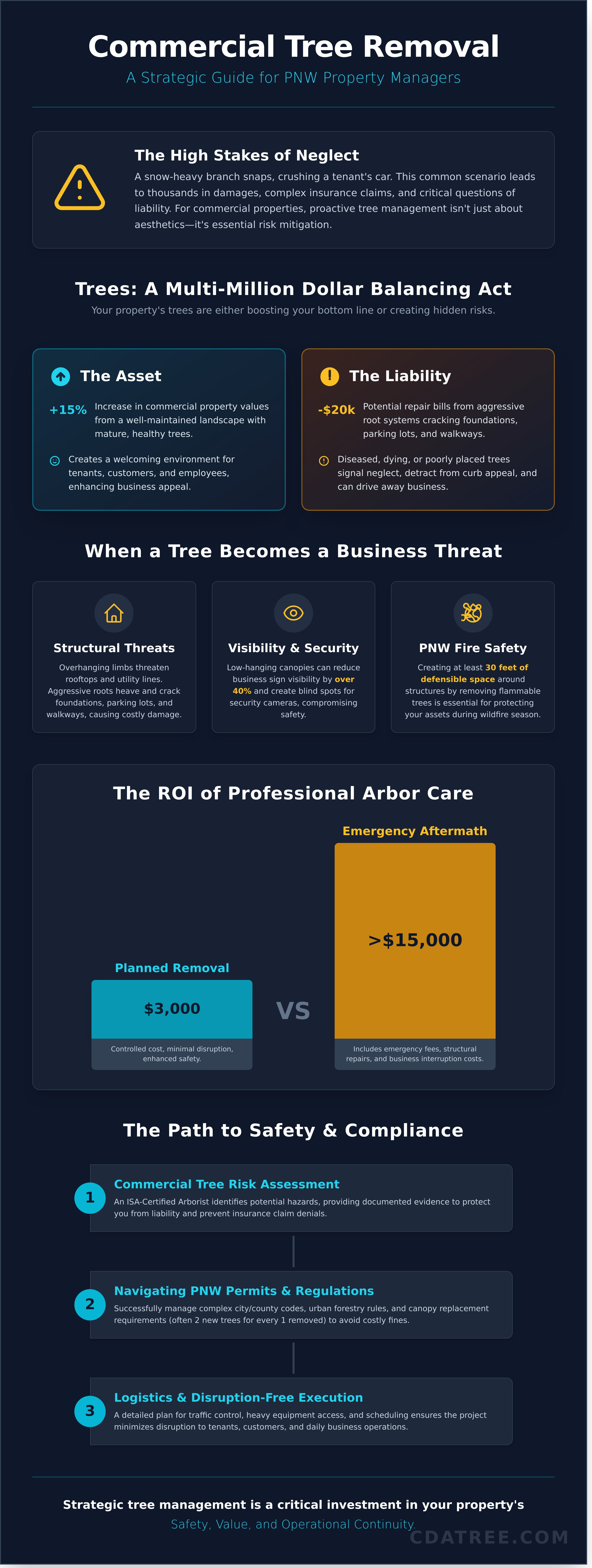
The health and placement of trees directly influence your property's financial performance. A well-maintained landscape with healthy, mature trees can increase commercial property values by as much as 15%, according to studies by the University of Washington. They create a welcoming environment for tenants, customers, and employees. Conversely, diseased, dying, or poorly placed trees detract from curb appeal and signal neglect, potentially driving away business. Proactive management ensures your green assets contribute positively to your bottom line instead of becoming a source of unforeseen costs.
A common challenge for growing businesses is realizing that valuable square footage is rendered unusable by existing trees. Strategic tree removal for commercial property is often the first critical step in a capital improvement project. Clearing a plot of overgrown or inconveniently located trees can unlock potential for a much-needed parking lot expansion, a new building wing, or improved vehicle access routes. It transforms a passive, green liability into an active, revenue-generating space.
When Tree Removal Becomes a Business Necessity
Identifying when a tree transitions from an asset to a risk is a key responsibility. The decision to remove a tree is often driven by clear, tangible threats to your operation and infrastructure. These situations demand immediate and professional assessment:
Structural Threats: Aggressive root systems can heave and crack parking lots, walkways, and building foundations, leading to repair bills that easily exceed $20,000. Overhanging limbs pose a direct threat to rooftops and utility lines, with a single fallen branch during a storm capable of causing thousands in damage and operational downtime.
Visibility and Security: Low-hanging canopies can obscure critical business signage, reducing visibility from the road by over 40% and impacting customer traffic. They can also create blind spots for security cameras, compromising the safety of your property and potentially increasing your liability.
Fire Safety in the PNW: For commercial zones in the Pacific Northwest, fire safety is a non-negotiable priority. Following guidelines from programs like Firewise USA®, creating at least 30 feet of defensible space around structures by removing flammable trees and brush is essential for protecting your assets during wildfire season.
The ROI of Professional Arbor Care
Investing in professional tree care services offers a significant return by mitigating future costs. A planned removal of a high-risk tree might cost $3,000, while an emergency removal after it has fallen on a building during a windstorm can escalate to over $15,000 when you include structural repairs and business interruption. The principles of Arboriculture, the professional cultivation and management of trees, are based on this proactive approach. By removing diseased trees or invasive species, you also cut long-term maintenance budgets by eliminating the need for constant pruning, treatment, and debris cleanup.
Ultimately, professional commercial arbor care is a long-term investment in the safety, value, and operational continuity of your property.
Navigating Permits and Regulations in the Pacific Northwest
Removing a tree from a commercial property in Washington or Idaho involves far more than just skilled labor. It's a legal process governed by a complex web of city and county regulations designed to protect our region's urban canopy. For property managers, a misstep here can lead to significant financial penalties and project delays. The regulatory landscape is built around the principles of 'Urban Forestry,' a city-led initiative to manage and maintain trees as a critical public asset. This often includes canopy replacement requirements, where a property owner must plant a specific number of new trees, often at a 2:1 or greater ratio, for every one removed.
Successfully managing the tree removal for commercial property requires a deep understanding of these local codes. An ISA-certified arborist is your most valuable asset in this process. Their professional assessment is not just a suggestion; it's often a mandatory part of the permit application. An arborist provides the documented evidence needed to classify a tree's condition, which is essential for proper Tree Risk Management and liability protection. Attempting to bypass this system can be costly. Unauthorized removal can result in fines exceeding $5,000 per tree in municipalities like Spokane, WA, not to mention forced mitigation costs and potential legal battles that can halt a project indefinitely.
Local Permit Requirements: What Business Owners Need to Know
A critical distinction exists between removing a 'hazard tree' and 'development-related' clearing. A hazard tree, professionally documented as an imminent risk to people or property, may qualify for an expedited permit. Development clearing, however, is scrutinized as part of a larger project plan. Based on 2024 processing data, property managers should expect a 4-6 week timeline for standard permit approvals in cities like Coeur d'Alene; we project this could extend to 6-8 weeks by 2026. At CDA Tree and Utility, we handle all regulatory paperwork to create a seamless process for you.
Environmental Compliance and Protected Species
The Pacific Northwest is home to specific trees and wildlife that are protected by law. Many Washington municipalities, for instance, have ordinances protecting native species like the Garry Oak. Additionally, cities often maintain a "Heritage Tree" registry, which protects individual trees of significant size or age. All tree removal for commercial property must also account for seasonal restrictions. Work is often prohibited during the primary nesting bird season, typically from February 15 to August 31, to comply with the federal Migratory Bird Treaty Act. Navigating these environmental regulations is our specialty. Our team ensures your project is fully compliant, protecting both your investment and our local ecosystem.
Mitigating Liability: The Commercial Tree Risk Assessment
As a commercial property manager, you operate under a legal principle known as a 'Duty of Care'. This means you are legally obligated to take reasonable steps to prevent foreseeable harm to tenants, customers, and the public on your property. When it comes to trees, ignorance is not a defense. A hazard is considered 'known' if you were aware of it or if a reasonable person should have been aware of it. A professional tree risk assessment is your single most powerful tool for fulfilling this duty and protecting your assets.
Regular, documented assessments are your best defense against insurance claim denials. While a storm that fells a healthy tree may be deemed an 'Act of God', the same storm toppling a visibly diseased or dead tree is often classified as negligence. An insurer can, and often will, deny a claim if there's evidence that the hazard was pre-existing and ignored. By maintaining a log of annual or biennial assessments from a certified arborist, you create a paper trail that proves you've acted responsibly. This documentation also provides a structured, professional response to tenant or neighbor concerns about overhanging limbs, proactively addressing potential disputes before they escalate.
Identifying High-Risk Liability Scenarios
A professional arborist is trained to spot liabilities that are easy to overlook. They focus on high-traffic, high-risk zones where tree failure could cause the most harm. Key areas of concern include:
Trees overhanging public spaces: This includes branches looming over parking stalls, public sidewalks, building entrances, and adjacent properties. A single falling limb can result in catastrophic damage or injury.
Deadwood and 'widow-makers': These are dead, detached, or broken limbs hanging precariously in a tree's canopy. They are especially dangerous in common areas like outdoor seating areas, playgrounds, or courtyards.
Root-related hazards: Tree roots can heave sidewalks, curbs, and asphalt, creating significant trip-and-fall risks. These issues can also lead to violations of the Americans with Disabilities Act (ADA) of 1990 if they obstruct accessible pathways.
Insurance and the 'Negligence' Factor
Insurance carriers make a sharp distinction between an unavoidable accident and a preventable one. In the event of a claim, they will investigate the tree's condition prior to its failure. If they find evidence of neglect, your coverage may be voided, leaving you personally liable for damages. This is why it's non-negotiable to hire a tree service that carries high-limit commercial liability insurance, typically a policy of $2 million or more. This protects you if an accident occurs during the course of their work. Ultimately, a professional assessment is the best evidence of responsible property management. It demonstrates proactive stewardship and a commitment to safety.
A documented assessment doesn't just manage risk; it helps you plan and budget for necessary maintenance or a full tree removal for commercial property. This proactive approach is essential for navigating local ordinances, as it provides the justification required to comply with specific municipal codes. For instance, the City of Salem tree removal regulations outline clear conditions for when a permit is required on commercial land. Having a professional arborist's report that details a tree's health and risk level makes the entire permitting and removal process seamless and defensible.
Minimizing Business Disruption During Large-Scale Removal
For a property manager, the biggest concern with large-scale tree work isn't just the tree itself; it's the potential for operational chaos. Lost parking, blocked access, and noise can directly impact tenant satisfaction and revenue. A successful tree removal for commercial property hinges on a project management approach that prioritizes business continuity. It’s not just about felling a tree; it’s about executing a complex task with surgical precision to protect your assets and daily operations.
Our decades of experience in the Pacific Northwest have refined a five-step process designed specifically to eliminate downtime and ensure a seamless project from start to finish. This isn't a vague promise. It's a structured, reliable system.
Step 1: Pre-Project Logistics Meeting. We meet with your team to map out the entire operational day. We identify high-traffic windows, like the 11:30 AM to 1:30 PM lunch rush at a retail center, and pinpoint critical access points for deliveries and staff.
Step 2: Proactive Tenant Communication. We provide clear, concise notices and maps for you to distribute to tenants at least 72 hours in advance. This details work schedules, temporary parking changes, and safe access routes, preventing confusion and frustration.
Step 3: Implement Strict Safety Perimeters. Our certified ground crews establish high-visibility safety zones that extend 1.5 times the height of the tree being removed. A dedicated ground-man actively manages the perimeter, ensuring no pedestrian or vehicle traffic can enter the work zone.
Step 4: Execute with Advanced Equipment. Using equipment like a 90-ton crane allows us to lift large tree sections up and over buildings and sensitive landscaping. This method can reduce on-site time by up to 40% compared to traditional rigging.
Step 5: Complete Comprehensive Site Cleanup. The project isn't finished until your property is customer-ready. This includes chipping all debris on-site, raking, leaf blowing walkways, and using magnetic rollers to pick up any stray metal fasteners.
Logistics and Safety Protocols for Active Businesses
Executing a major project at an active business requires meticulous planning. For a medical facility, we can schedule the noisiest work, like chipping, outside of patient hours. For office parks, we often begin work at 5 AM to complete the most disruptive phases before the 9 AM arrival of employees. We establish clear, ADA-compliant pedestrian detours with highly visible signage to guide customers and staff safely around the work area without confusion.
Advanced Equipment: Efficiency Equals Less Downtime
The right tools are essential for efficient tree removal for commercial property. An aerial lift with a 75-foot reach can access difficult trees in tight courtyards or over rows of parked cars, minimizing the need to block off large sections of your lot. A high-capacity chipper capable of processing 20-inch diameter logs turns immense piles of brush into manageable mulch in minutes, drastically reducing the time and space needed for debris hauling. Our commitment to a seamless process starts with the right plan. Schedule a logistics consultation to see how we protect your property's workflow.
CDA Tree and Utility: Your PNW Commercial Partner Since 1997
Choosing a partner for managing your property’s trees is a decision rooted in trust and proven capability. Since 1997, CDA Tree and Utility has been the trusted arborist for businesses, HOAs, and municipalities across the Pacific Northwest. With over 25 years of hands-on experience, we’ve built our reputation on understanding the unique demands of our region, from the powerful windstorms that sweep through the Inland Northwest to the specific growth patterns of our native Douglas Firs and Ponderosa Pines. We don't just remove trees; we provide peace of mind and protect the value of your assets.
Our founder, Joshua Williamson, stands behind every project with his personal guarantee: every job will be completed professionally, on time, and with an uncompromising commitment to safety. This isn't a corporate slogan; it's the foundation of our business. We know that as a property manager, you need a reliable partner who respects your schedule, your budget, and your tenants. We show up when we say we will, perform the work with precision, and ensure the safety of everyone on site. It’s that simple.
We offer a complete, end-to-end solution for the challenges you face. Our comprehensive approach to tree removal for commercial property ensures that no detail is overlooked. The process is seamless from start to finish:
Initial Hazard Assessment: We begin by methodically inspecting your property to identify high-risk trees, potential structural weaknesses, and utility line conflicts before they become costly emergencies.
Strategic Removal & Pruning: Our certified arborists use advanced equipment and industry-best techniques for safe and efficient tree removal, whether it’s a single hazardous tree near a building or a large-scale lot clearing project.
Stump Grinding: We eliminate tripping hazards and prepare the ground for future landscaping by grinding stumps well below the surface, leaving a clean, usable space.
Thorough Debris Cleanup: Your property will be left in pristine condition. We handle all hauling of logs, branches, and debris, ensuring your commercial space remains clean and professional.
The Pacific Northwest is no stranger to severe weather. Sudden windstorms and heavy snow loads can turn a healthy-looking tree into an immediate liability. Our emergency response team is on standby 24/7 to address storm damage swiftly, minimizing your property's downtime and securing the site to prevent further incidents. We have the heavy equipment and experienced crews necessary to handle complex and dangerous emergency situations safely and efficiently.
Why Regional Expertise is Critical for Commercial Success
Our deep understanding of the Pacific Northwest's unique soil, wind patterns, and native species is a critical advantage. We know how saturated winter soil affects the stability of shallow-rooted cedars and have a proven track record navigating the permit processes of local municipalities from Coeur d'Alene to Spokane. This local knowledge allows us to deliver on our commitment to ‘Safe, efficient workmanship’ at competitive pricing, ensuring your project is compliant and completed correctly the first time.
Next Steps: Securing Your Commercial Property
Protecting your investment begins with a proactive plan. The first step is to schedule a comprehensive hazard tree assessment with our team. During this initial, no-obligation consultation, one of our expert arborists will walk your property with you, identify potential risks, and discuss your specific goals and budget. We provide clear, transparent recommendations so you can make informed decisions. Contact Joshua Williamson for a professional commercial quote and partner with a team dedicated to your property's safety and success.
Partner with a PNW Leader for Your Commercial Tree Needs
Managing the trees on your property isn't just about curb appeal; it's a critical component of your risk management strategy. From navigating complex Pacific Northwest municipal codes to executing a removal with minimal disruption to your business, the process demands professional expertise. Protecting your assets and ensuring public safety is the ultimate goal.
That's why choosing the right partner for tree removal for commercial property is so important. Since 1997, CDA Tree and Utility has been the trusted expert for businesses across the region. Our team is fully licensed, commercially insured, and operates under the direct oversight of ISA-Certified Arborists. We bring over 25 years of localized experience to make the entire process seamless from start to finish.
Don't let tree-related risks become liabilities. Take the proactive step to secure your investment and ensure peace of mind. Request a Seamless Commercial Tree Removal Quote today, and let us handle the complexity so you can focus on running your business.
Frequently Asked Questions About Commercial Tree Removal
Do I need a permit for tree removal on my commercial property in the PNW?
Yes, a permit is often required in the Pacific Northwest, but the specific rules vary significantly by city and county. Many municipalities mandate a permit for removing any tree with a trunk diameter over 12 inches or for certain protected species. With decades of experience in the PNW, our team expertly navigates these local regulations. We handle the entire permit application process for you, ensuring full compliance and a seamless project.
Am I liable if a tree on my property falls onto a neighbor's building?
Yes, as the property owner, you are almost always liable for damage caused by your trees. Your liability is highest if negligence can be proven, meaning you knew or should have known the tree was a hazard and failed to act. We strongly recommend annual inspections by a certified arborist to document tree health. This proactive step is your best defense against liability claims and demonstrates responsible property stewardship.
Can I remove a tree to expand my parking lot or commercial building?
You can absolutely remove trees for development, but it requires careful planning with your local municipality. This common type of tree removal for commercial property often has strict requirements. Many cities now mandate a tree replacement plan, which means you must plant a specific number of new trees on-site to compensate for those removed. This process maintains the area's overall green canopy and property values.
How much does commercial tree removal typically cost compared to residential?
Commercial tree removal generally costs 20% to 50% more than a comparable residential job. The higher cost reflects the increased complexity and risk. Commercial sites often feature larger trees, require specialized equipment like industrial cranes, and demand extensive planning for public safety, traffic control, and working around active businesses. These factors require a higher level of resources and certified expertise.
What insurance coverage should a commercial tree service company have?
A professional tree service must carry two essential insurance policies to protect your property. First is a General Liability policy of at least $2,000,000 to cover any potential property damage. Second, and just as critical, is a current Workers' Compensation policy for all employees. Always request a certificate of insurance before work begins; it’s a non-negotiable part of hiring a safe and reliable contractor.
How long does the commercial tree removal process usually take?
The timeline depends entirely on the project's scope and complexity. Safely removing a single large tree near a building typically takes our crew one full 8-hour day, including cleanup and stump grinding. A larger project, such as clearing several trees for a new construction pad, could take anywhere from 3 to 5 business days. We provide a precise, reliable timeline for every project so you can plan accordingly.
What happens if a tree is on the property line between two businesses?
A tree located directly on a property line is legally considered a "boundary tree," making both business owners shared stewards. This means the responsibility, decision-making, and cost for its care or removal should be split 50/50. Before any work is scheduled, it is crucial to get a simple written agreement signed by both property owners. This document prevents future legal disputes and clarifies responsibilities.
How do I know if a tree on my property is considered a 'hazard tree'?
You can identify a potential hazard tree by looking for clear warning signs. Keep an eye out for large dead or hanging branches, deep cracks or cavities in the trunk, significant fungal growth (like mushrooms) at the base, or a sudden lean greater than 15 degrees from vertical. If you spot any of these indicators, it's time for a professional arborist assessment to determine the precise level of risk.
Comments