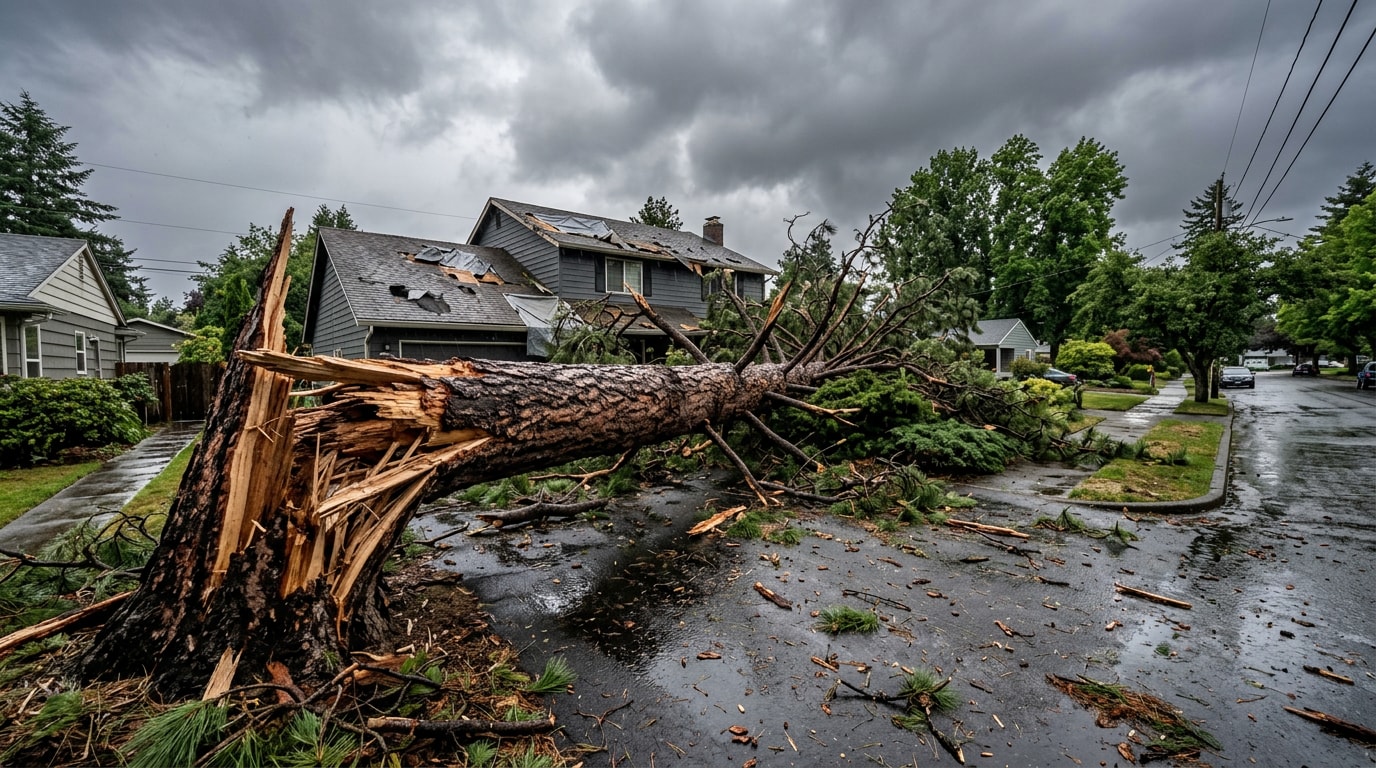
Downed tree removal in Spokane Valley, WA usually starts with a call made in the dark, right after a crack, a thud, and a power flicker. Wind and ice don't give much warning before a ponderosa pine drops across a driveway or punches through a roofline. This guide walks through what the emergency response actually looks like, how insurance and permits factor in, and what the job tends to cost.
When Storms Drop a Tree in Spokane Valley
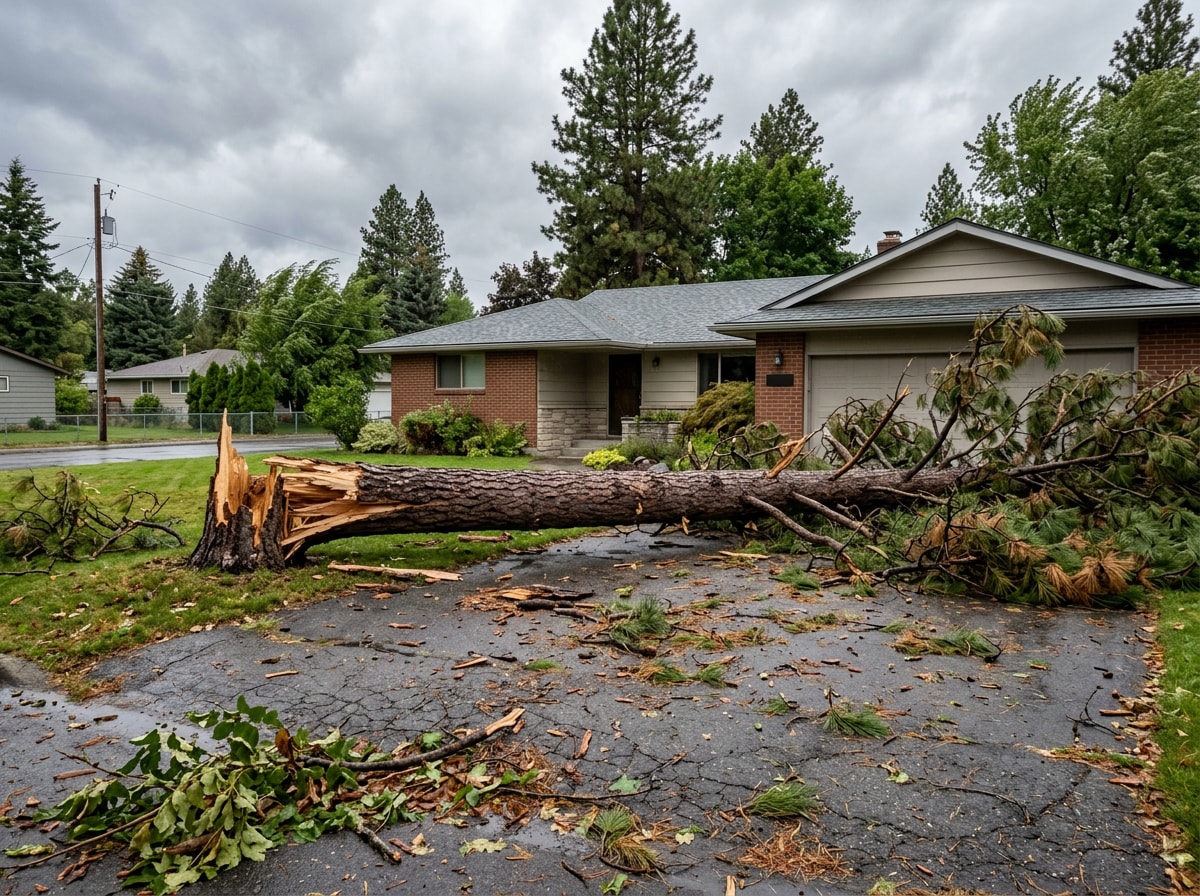
Calls about a tree resting on a house or blocking a driveway get priority dispatch, and for good reason. The situations that come up again and again include:
- A tree fallen directly on a roof, garage, or car
- A trunk or large limb blocking a driveway or the only road out
- Storm-damaged wood still attached but visibly cracked
- A tree leaning hard after heavy snow load or sustained wind
Our crews tend to see two spikes in downed-tree calls each year: the freeze-thaw and heavy snow-load stretch in January and February, and the wind events that roll through in October and November. That pattern lines up with what the National Weather Service office covering the Inland Northwest describes as a region where thunderstorms can develop by midday and carry threats ranging from tornadoes to flooding and lightning , with downburst winds capable of slamming into the ground and spreading out with enough force to cause extensive damage . That's documented in the National Weather Service's wind and hail bulletin for Spokane, and it's exactly why fallen-tree emergencies aren't a rare event here.
Emergency Tree Removal: What the Crew Actually Does
Once a crew gets dispatched, the work generally breaks into three categories depending on where the tree landed, what's still hanging overhead, and what equipment the site calls for.
Fallen Tree Removal
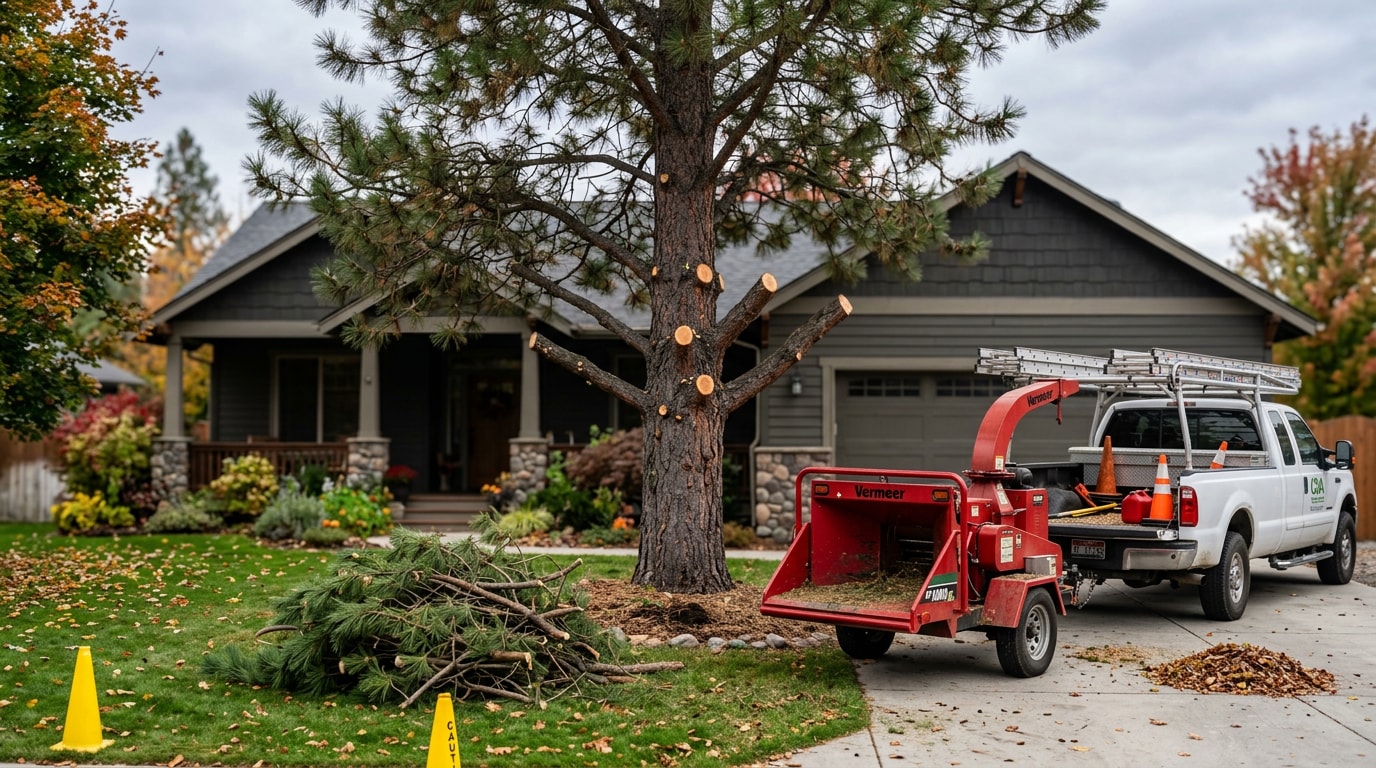
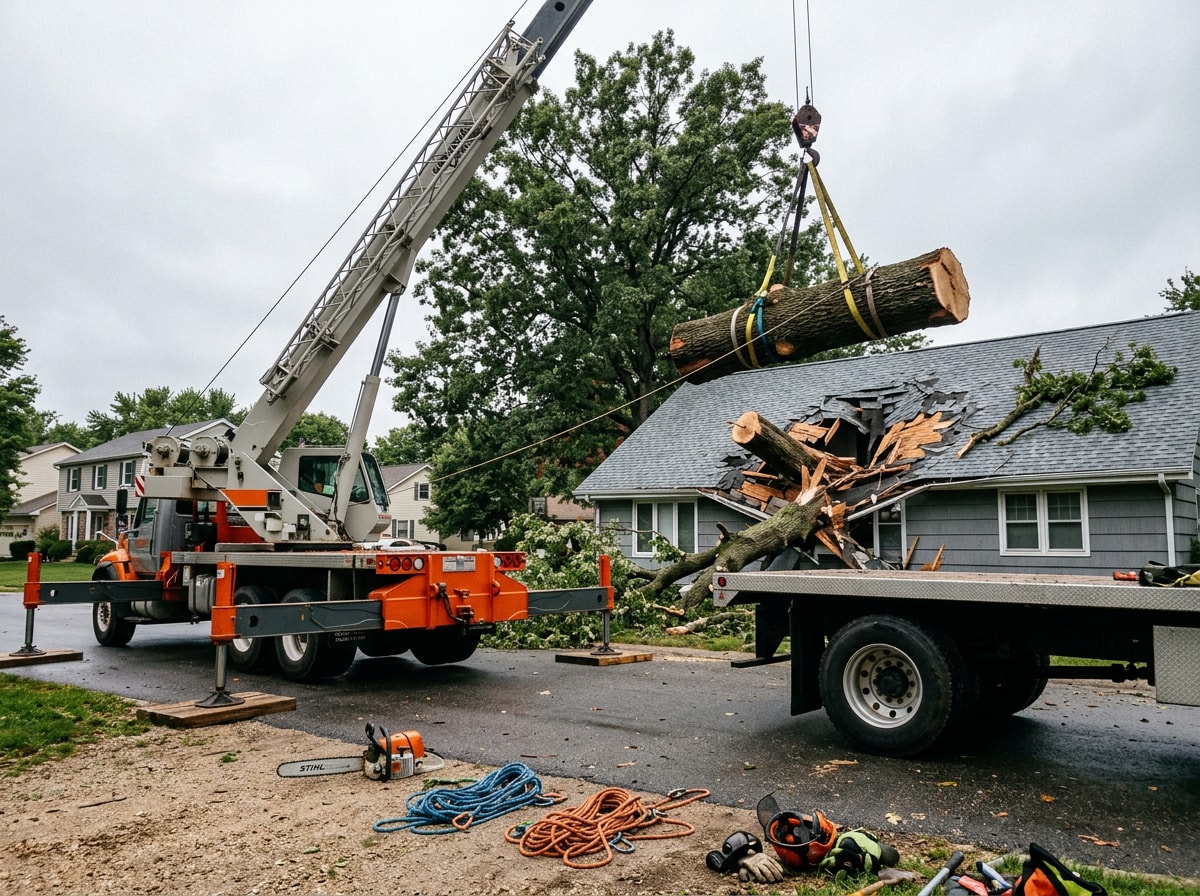
When a tree has already landed on a house, car, or driveway, the priority is lifting the wood off whatever it hit without causing more damage. Crews cut the trunk into manageable sections rather than dragging or dropping weight that could crack a roofline further or shatter glass already under pressure. Our emergency tree removal crews bring rigging and cutting equipment sized to the job, not a one-size-fits-all setup.
Hazardous Limb Takedown
Sometimes the whole tree doesn't come down. A heavy branch snaps and hangs up in the canopy above, and that's arguably more dangerous than a tree already on the ground, since nobody can predict exactly when it'll let go. A trained climber gets above the limb and makes a controlled cut before it drops on a person, pet, or parked car. This is the kind of job that falls under hazard tree removal rather than a standard takedown, because the approach and rigging are different.
Matching Equipment to the Job
Not every downed-tree call uses the same tools. Tree size, proximity to the house or power lines, and whether ground access even exists all factor into what gets brought to the site. A bucket truck works well for steady, repeated access to mid-height limbs. Rigging with ropes suits tighter yards where a controlled, piece-by-piece lower beats a straight drop. For a mature pine too heavy or too close to a structure to risk a free fall, a crane lifts the trunk straight up and away before it's cut loose. You can see examples of past takedowns, including crane work, in our completed projects.
What Homeowners Insurance Covers After a Tree Falls
Paperwork after a fallen tree can feel almost as stressful as the damage itself. Before anything gets moved or cut, take clear photos. Adjusters need to see exactly how the tree landed and what it hit.
If a tree hits your home or other insured structure, such as a detached garage, your standard homeowners insurance policy covers the damage to the structure, as well as any damage to the contents, and this is true for trees felled by wind, lightning, or hail.
You're generally insured no matter who owned the tree. Most insurers also expect homeowners to prevent further damage, which means getting a professional out quickly to remove the tree and tarp or board up any resulting holes.
Keep every receipt and document the timeline. Storm damage coverage still varies by policy, so confirming details with an agent beats assuming. If you need the tree off the structure before the adjuster even arrives, a free estimate is the fastest way to get that process moving.
Permits and HOA Rules for Tree Removal in Spokane Valley
Spokane Valley incorporated in 2003 and runs its own permitting process, separate from the City of Spokane next door. That distinction matters more than most homeowners realize when a tree needs to come down.
Most removals on private property don't require any paperwork at all. But a permit can come into play when work happens in the public right-of-way or on infrastructure the city has an interest in. Right-of-way, or "public way," means all property in which the City has any form of ownership or title, including easements, and which is held for public roadway or utility purposes.
Unless exempt under city code, a right-of-way permit is required of any person or company who performs work within existing city right-of-way or on city-owned infrastructure. Routine backyard removals almost never trigger this; trees close to a street, drainage area, or steep slope sometimes do. You can review current requirements on the city's right-of-way permit page.
There's also an HOA layer to consider. Neighborhoods in Greenacres, Opportunity, and along the Barker Road corridor often require proof of insurance and written approval before anyone touches a tree on a common area or shared easement. Checking with the HOA first can save a headache even when the city itself doesn't require a permit. For service details specific to this area, see our Spokane Valley page.
How Much Does Downed Tree Removal Cost in Spokane Valley?
Costs swing based on tree size, how easy the site is to access, and how many trees need to come down. Market estimates for the area commonly land in these ranges:
| Service | Typical Average | Typical Range |
|---|---|---|
| Standard tree removal | ~$551 | $212 to $872 |
| Emergency tree removal | ~$823 | Higher due to after-hours work and added safety planning |
| Stump removal add-on | ~$171 | $199 to $317 |
These are general market figures, not fixed quotes. A 90-foot pine leaning over a power line costs more to remove than a smaller tree in an open yard, and stump removal usually adds to the final bill. If storm debris is piling up beyond the tree itself, our breakdown of tree debris disposal options in Spokane Valley covers hauling costs and pickup timing in more detail. Once storm cleanup becomes a multi-tree job rather than a single removal, it shifts into storm tree cleanup territory, which is priced differently than a single downed tree.
Getting a free estimate for the specific tree and site conditions is the only way to know the real number. You can also start from our homepage to see the full range of services we run across the Spokane and Coeur d'Alene area.
FAQ
Do I need a permit to remove a tree in Spokane Valley?
Most removals on a homeowner's own property don't need a permit. Work in the public right-of-way or on city-owned infrastructure is where a permit typically applies, so check with the city's permit center if the tree sits near a street, easement, or drainage area.
Does homeowners insurance cover tree removal after a storm?
Usually, yes, if the tree damaged a covered structure like a house, shed, or fence. Coverage applies to trees felled by wind, lightning, or hail, regardless of whose property the tree started on. Removal of a tree that caused no damage is often excluded, so check your specific policy.
What should I do first if a tree falls on my house?
Get everyone, including pets, out of the affected room right away. If the tree struck power lines, call the power company immediately and stay well clear of the wires, then call a tree service to secure the area and safely remove the tree.
If a neighbor's tree falls on my property, who is responsible for removal?
Responsibility generally follows whose property the tree lands on, so if it falls onto your yard, it typically becomes your cleanup and your insurance claim, even though the tree originated next door. Coverage can still depend on what caused the tree to fall, so it's worth discussing specifics with an insurance agent.
How fast can a crew get to an emergency downed-tree call?
Response times depend on storm volume and how many crews are already out. A tree on a roof, blocking the only driveway, or resting on power lines gets priority scheduling over routine trimming or removal work.
Does tree removal cost more in an emergency?
Yes. Emergency work typically costs more than a scheduled removal because it involves after-hours dispatch, additional safety planning around unstable wood, and sometimes specialized equipment like a crane on short notice.