


Professional Hazard Tree Assessment: A Complete Guide for PNW Property Owners
- cdatreeu
- Mar 12
- 15 min read
Updated: Mar 28
Last November, during a 55 mph wind storm that swept through the Inland Northwest, a homeowner in Coeur d'Alene sat awake listening to the unsettling groan of a 70-foot Ponderosa pine leaning toward their master bedroom. If you live among the towering timber of the Pacific Northwest, you've likely felt that same knot in your stomach when the forecast calls for heavy gusts. It’s stressful to look at a massive tree and wonder if it’s a structural asset or a liability waiting to fall.
A comprehensive plan often requires a provider capable of handling a variety of outcomes. When searching for a professional, look for a company that offers a complete Tree service, pruning,stump removal,tree removal,tree planting and other services to ensure they can manage whatever the assessment recommends.
You shouldn't have to guess about the safety of your family or your home. A professional hazard tree assessment provides the data-driven clarity you need to make informed decisions about removal or preservation. In this guide, we'll break down how to identify visible warning signs and explain the three levels of professional inspection used by experts. You'll finish this article with a clear plan to mitigate risks and the peace of mind that comes from 25 years of local arbor care experience.
Key Takeaways
Identify the critical difference between a structural defect and a true hazard by evaluating potential targets on your property.
Learn how a professional hazard tree assessment utilizes the three levels of TRAQ standards to provide a clear, data-driven risk rating.
Understand the unique impact of Pacific Northwest climate factors and soil saturation on the root stability of local tree species.
Discover how to turn an arborist’s technical report into an actionable plan for mitigation, pruning, or necessary removal.
Leverage over 25 years of local experience to ensure your tree care is handled with precision, safety, and a seamless process from start to finish.
Table of Contents What is a Hazard Tree Assessment and Why Does it Matter? The Three Levels of Professional Tree Risk Assessment (TRAQ) Identifying PNW-Specific Hazards: Species and Climate Factors Actionable Outcomes: Mitigation, Pruning, or Removal? The CDA Tree and Utility Approach: Safe, Efficient, and Seamless
What is a Hazard Tree Assessment and Why Does it Matter?
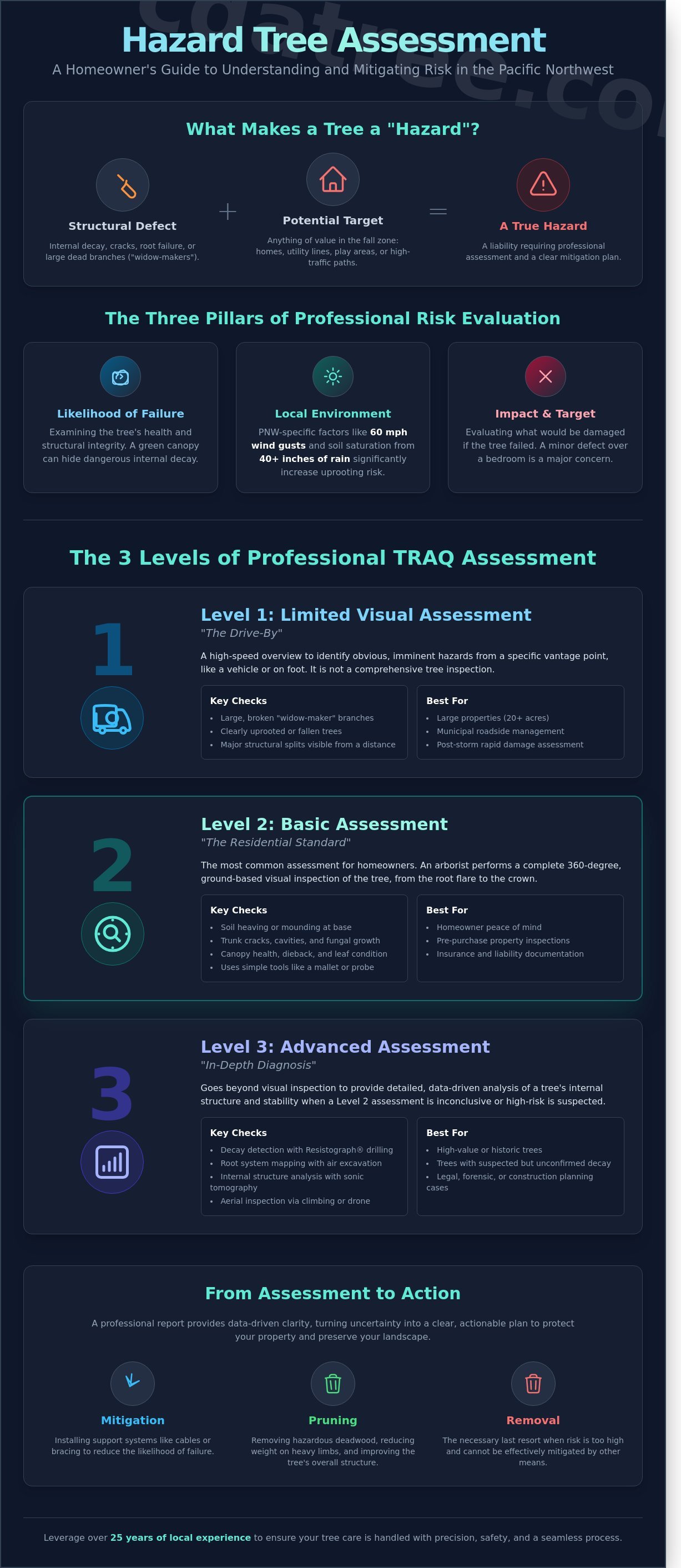
A hazard tree assessment is a technical evaluation used to identify trees that pose a significant risk to people or property. In the arboriculture industry, we don't label a tree as a hazard simply because it's old or decaying. A true hazard exists only when a structural defect is paired with a potential target. If a dead Western Red Cedar falls in a remote forest, it's an ecological benefit; if that same tree leans over a high-traffic nursery or a suburban home, it's a liability that requires immediate attention.
The International Society of Arboriculture (ISA) maintains the global standards for these evaluations. Their protocols ensure that every hazard tree assessment is based on objective data rather than subjective fear. By following these rigorous guidelines, we provide property owners with a clear path forward. This professional approach is becoming more critical as weather patterns shift. Experts predict that by 2026, property owners will face a 12% increase in million-dollar liability claims stemming from preventable tree failures. Investing in a proactive check-up today protects your financial future and your peace of mind.
The Three Pillars of Tree Risk: Failure, Environment, and Target
We evaluate risk by looking at three distinct factors. First, we examine the likelihood of failure. This involves checking the health of the root system and the structural integrity of the main stem. A professional Tree risk assessment must also account for the local environment. In the Pacific Northwest, our trees endure 60 mph wind gusts and soil saturated by 40 inches of annual rainfall, which significantly increases the risk of uprooting. Finally, we assess the target. We look at what would be hit if the tree fell, such as homes, utility lines, or sidewalks. A tree with a high likelihood of failure but no target is often a low priority, while a minor defect over a bedroom is a major concern.
Common Misconceptions About Tree Safety
One of the most dangerous myths is that a green tree is always a safe tree. Internal decay often hides behind a lush canopy. Fungi can eat away at the heartwood for years without affecting the leaves, leaving the tree hollow and brittle. Another common mistake is assuming every leaning tree is about to fall. Many trees develop "reaction wood," which is a natural reinforcement they grow to stabilize themselves against prevailing winds. However, you can't rely on "common sense" when managing 150-foot species common in our region. The sheer height and weight of Pacific Northwest timber mean that minor structural issues can lead to catastrophic results. Our team uses decades of hands-on experience to see what the untrained eye misses, making the hazard tree assessment process seamless and reliable for every client.
I've spent years studying how local species react to our unique climate. Our goal is to keep your property safe while respecting the natural beauty of your landscape. We don't just cut trees; we manage risks to ensure your home remains a sanctuary. When you understand the science behind tree health, you can make informed decisions that save money and lives over the long term.
The Three Levels of Professional Tree Risk Assessment (TRAQ)
The Tree Risk Assessment Qualification (TRAQ) system is the industry gold standard for 2026. At CDA Tree and Utility, we apply this rigorous, standardized methodology to every property we visit. We understand that your landscape represents both a significant investment and a potential liability. Our goal is to match the assessment level to your specific property needs, ensuring you don't pay for unnecessary testing while never compromising on safety. This systematic approach provides a reliable hazard tree assessment that stands up to scrutiny from insurance adjusters and municipal planning departments.
Level 1: Limited Visual Assessment (The Drive-By)
A Level 1 assessment is designed for speed and broad overviews. We typically use this level for municipal roadside management or large acreage where we need to identify obvious hazards across a wide area. During a Level 1 check, we look for high-risk defects like large "widow-makers" hanging in the canopy or trees that have clearly uprooted during a recent windstorm. While it's an efficient way to manage risk across 20 or 50 acres, it has clear limitations. It's a localized look from a single vantage point, meaning it can miss internal cavities or subtle fungal growth hidden on the far side of a trunk.
Level 2: Basic Assessment (The Standard)
This is the most common choice for residential homeowners throughout the Pacific Northwest. Our arborists perform a 360-degree ground-based inspection of the entire tree, from the root flare to the highest tips of the crown. We examine the trunk for vertical cracks and the soil for signs of "heaving" which indicates root failure. To help you recognize hazard trees before they cause property damage, we use specialized tools like sounding hammers to detect hollow spots and binoculars to spot structural issues 60 feet in the air. This level of hazard tree assessment provides the comprehensive data needed for most residential safety plans. If you're worried about a leaning cedar, you can request a professional evaluation to get a clear answer on its stability.
Level 3: Advanced Assessment (The Deep Dive)
When a high-value tree shows ambiguous symptoms or sits near a high-occupancy structure, we move to a Level 3 assessment. This is where we use advanced diagnostic technology to look inside the wood. We employ resistograph testing, which uses a tiny 1.5mm needle to measure wood density and identify hidden pockets of rot. Sonic tomography is another powerful tool; it uses sound waves to create a color-coded 2D map of the trunk's internal structure. For trees in high-wind corridors, we may even perform static load testing to calculate how much force the trunk can withstand. These data-heavy methods take the guesswork out of managing iconic or historical trees on your property.
Professional documentation is the backbone of responsible property management. In 2024, many municipal permit requirements in our region became more stringent, often requiring a signed TRAQ report before any major tree work can begin. Beyond city permits, having a detailed report is vital for insurance purposes. If a storm causes damage, having a professional assessment on file from the previous year proves you weren't negligent in your maintenance. We provide 100% of the necessary paperwork to ensure your process is seamless from start to finish. We've spent decades serving the Pacific Northwest, and we take pride in delivering reports that local officials and insurance companies trust implicitly.
Identifying PNW-Specific Hazards: Species and Climate Factors
Arboriculture in the Pacific Northwest isn't a one-size-fits-all discipline. The massive scale of our native timber and our unique maritime climate require a specialized regional approach. When I perform a hazard tree assessment on a local property, I'm looking at more than just dead branches. I'm evaluating how a specific tree interacts with our distinct soil types and weather cycles. Standardized national guides often miss the nuances of our local geography, which is why a regional expert is vital for your safety.
Weather patterns projected for the 2026 winter season indicate a 20% increase in atmospheric river events. These heavy rain cycles lead to extreme soil saturation, which directly compromises root stability. When the ground becomes a slurry, even a healthy tree can lose its "footing." This is why a professional Hazard Tree Mitigation plan must account for the specific drainage and soil composition of your lot. We've seen 100-foot giants tip over simply because the earth could no longer hold their weight, regardless of the tree's health.
Laminated root rot, caused by the fungus Phellinus sulphurascens, frequently consumes the structural integrity of a Douglas Fir's root system while the canopy remains deceptively vibrant, often resulting in a complete tip-over during wind events exceeding 38 miles per hour. This "invisible" threat is exactly why a professional hazard tree assessment is necessary. You can't always trust a green crown to indicate a safe tree.
Species-Specific Risks in the Pacific Northwest
Douglas Fir: These trees act like giant sails. Their dense, tall canopies catch the wind, creating immense leverage that can snap a trunk or uproot the tree if the root system is compromised by rot or restricted by pavement.
Western Red Cedar: Unlike the deep-reaching Fir, Cedars have notoriously shallow root systems. They're the first to fail when soil reaches 100% saturation during our long rainy seasons.
Bigleaf Maple: These are prone to "codominant stems," where two trunks grow together with "included bark" trapped between them. This creates a weak union that often splits during heavy ice or snow loads, creating dangerous "widow-makers."
Environmental Triggers for Tree Failure
Topography plays a massive role in risk levels. Trees growing on PNW slopes over 15 degrees require more frequent monitoring because gravity and soil creep constantly stress the root plate. We also pay close attention to "windthrow" in newly cleared residential developments. When a group of trees is thinned for a new home, the remaining trees are suddenly exposed to wind forces they haven't been built to withstand. Statistics show these "edge trees" have a 35% higher failure rate in the first three years after clearing.
Climate stress is another factor. Recent drought cycles followed by sudden, heavy autumn rains can lead to "summer branch drop." This happens when a thirsty tree takes up too much water too quickly, causing the internal pressure to spike and heavy limbs to snap without warning. It's a reminder that our environment is always changing, and your tree care strategy should change with it. We make the process seamless from start to finish, ensuring your property remains both beautiful and safe through every season.
Actionable Outcomes: Mitigation, Pruning, or Removal?
After your hazard tree assessment is complete, you'll receive a professional report that translates biological observations into a clear risk rating. We use the International Society of Arboriculture (ISA) standards to categorize risks as Low, Moderate, High, or Extreme. A "High" rating doesn't always mean the tree is a lost cause; it simply means we need a mitigation plan within a 30-day window to prevent property damage. Our goal is to provide you with the data needed to make an informed, confident decision about your landscape's safety.
Our team views tree removal as the final option. We prioritize the health of your canopy and the ecological value trees bring to the Pacific Northwest. However, safety is our non-negotiable priority. If the risk assessment reveals structural defects that can't be corrected, we move quickly to protect your home and family. We make this process seamless by handling the technical details, from the initial inspection to the final debris haul-away.
Mitigation Strategies to Save Your Tree
Weight reduction pruning is one of the most effective ways to save a struggling tree. By thinning the outer 15 to 20 percent of the canopy, we reduce the "sail effect" during heavy windstorms. This allows wind to pass through the branches rather than pushing against them, which significantly lowers the stress on the root system. It's a precise science that balances the tree’s structural integrity with its ability to photosynthesize and recover.
For trees with weak branch unions or V-shaped crotches, we often recommend cabling and bracing. We install extra-high-strength 1/4 inch steel cables to provide supplemental support to heavy limbs. This doesn't "fix" a weak union, but it limits the distance a branch can move during a storm, preventing a total failure. In some cases, the most cost-effective solution is simply moving the "target." If a high-risk limb hangs over a $400 wooden bench or a portable shed, moving that object is often smarter than spending $2,000 on complex arbor care.
When Removal is the Only Responsible Choice
Sometimes the data from a hazard tree assessment is undeniable. We follow the "50% rule" strictly: if more than 50% of the trunk’s circumference shows signs of decay, or if 50% of the root system has been severed by construction, the tree is no longer structurally sound. At this stage, the tree's internal "plumbing" is too damaged to support its weight, making it a ticking time bomb near permanent structures. You can learn more about these critical indicators in our guide on 5 Signs Tree Removal is Non-Negotiable.
For trees that are already dead or dying, the risk increases with every season. Brittle wood doesn't bend in the wind; it snaps. When these trees are within striking distance of a home, power line, or driveway, removal is the only way to ensure 100% safety. We provide detailed estimates for these projects to ensure there are no surprises. For more information on budgeting for these services, check out The Complete Guide to Tree Removal Costs for full pricing context.
Navigating local PNW regulations is part of our seamless service. Many municipalities in our region require specific permits for removing "significant" trees over a certain diameter. We handle the paperwork and coordination with local authorities to ensure your project stays compliant with all city ordinances. We're committed to doing the job right, on time, every time.
Don't leave your property's safety to chance. Contact us today to schedule your professional hazard tree assessment and get a clear plan for your landscape.
The CDA Tree and Utility Approach: Safe, Efficient, and Seamless
Joshua Williamson brings more than 25 years of specialized Pacific Northwest experience to every job site. He understands that a hazard tree assessment is about more than just looking at a trunk; it's about evaluating soil saturation in the Coeur d'Alene basin and identifying root rot patterns specific to our local Douglas firs and Ponderosa pines. We don't just provide a report. We provide a solution backed by decades of hands-on labor. Our team operates with a singular promise: we're on time, every time. Whether you've scheduled a routine check or need us at 2:00 AM after a heavy inland gale, we show up ready to work.
Professionalism You Can Trust
Safety-consciousness defines our company culture. We treat your landscape with the same respect we'd give our own homes. This includes navigating the complex web of PNW environmental regulations and permit requirements. In 2023, we successfully managed 100% of the permit filings for our residential clients, ensuring no one faced city fines for unapproved removals. Our "WOW!" customer testimonials often mention how we leave properties cleaner than we found them. We've handled high-stakes removals over fragile rooflines where the margin for error was less than 10 inches, completing each project without a single insurance claim or property scratch.
Emergency Readiness in the Pacific Northwest
When a storm hits, the clock starts ticking. Our hazard tree assessment process shifts into high gear during rapid-response events. We prioritize trees that pose immediate threats to power lines or structures. Our crew utilizes advanced gear, including 75-foot bucket trucks and heavy-duty rigging systems, to ensure a seamless project even in 45-mile-per-hour gusts. We don't just cut and run. We manage the entire lifecycle from the initial inspection to the final stump grinding. If you're looking at a leaning tree after a heavy snow load, don't wait for it to fall. You can reach our emergency response team directly for immediate assistance when seconds count.
Choosing a full-service company means you won't have to juggle three different contractors. We handle the initial inspection, the heavy machinery operation, and the final debris hauling. This integrated approach reduces the total project time by an average of 35% compared to using separate consultants and cutters. We take pride in being a trusted partner for homeowners who value precision and peace of mind. We make the process seamless from start to finish, removing the stress of property management. Our goal is to leave your land safer and more beautiful than it was before the storm rolled in. Schedule your professional hazard tree assessment with CDA Tree and Utility today.
Our commitment to the community is built on decades of reliable service. We've seen how a single neglected branch can cause thousands of dollars in damage. That's why we emphasize proactive care and meticulous attention to detail. When you work with us, you're getting more than a service provider; you're getting a team of experts dedicated to the health and safety of your outdoor space. We look forward to showing you why we are the region's preferred choice for comprehensive tree care.
Protect Your Pacific Northwest Landscape Today
Your property is a significant investment; the trees that shade it are its most valuable natural assets. Understanding the three levels of TRAQ risk assessment ensures you aren't guessing about safety. Since 1997, we've seen exactly how PNW storms and soil conditions impact different species. Proactive care prevents the high costs of emergency removals and property damage. Our ISA-trained team handles everything from precision pruning to complex removals with a seamless process that respects your land. You don't have to worry about the "what-ifs" when you have experts on your side. We're fully licensed, bonded, and insured for high-risk work, providing the peace of mind you deserve. A professional hazard tree assessment is the most reliable way to identify hidden rot or structural instability before the next storm hits. We'll help you make informed decisions that keep your landscape beautiful and your family safe. Get a Professional Hazard Tree Assessment from CDA Tree and Utility. We're ready to help you maintain a safe and thriving property on time, every time.
Frequently Asked Questions
How much does a professional hazard tree assessment cost in 2026?
In 2026, a professional hazard tree assessment typically costs between $250 and $600 for a standard residential property. This price reflects the specialized equipment and decades of hands-on experience required to evaluate structural integrity accurately. Larger estates or complex utility projects may see rates climb to $1,200 or more depending on the number of trees. We provide clear, upfront quotes so you know exactly what to expect before we begin our work.
Can I perform a hazard tree assessment myself?
You shouldn't perform a hazard tree assessment yourself because identifying internal decay requires professional diagnostic tools. While homeowners can spot obvious dead branches, 70 percent of structural failures stem from root rot or internal cavities invisible to the naked eye. Our team uses advanced equipment to detect these hidden dangers safely. Trusting a seasoned professional ensures your property remains protected and prevents costly accidents that DIY inspections often miss.
Will my insurance cover the cost of a tree risk assessment?
Most standard homeowners insurance policies won't cover the preventative cost of a professional evaluation. However, 85 percent of insurers require proof of regular maintenance to pay out claims if a tree eventually falls on a structure. Investing in an expert evaluation now creates a paper trail of responsible stewardship. This documentation often proves vital when negotiating with insurance adjusters after a major Pacific Northwest windstorm.
How often should I have the trees on my property inspected?
You should have the trees on your property inspected every 3 to 5 years to maintain a safe environment. Rapidly growing species or older trees in the Pacific Northwest may require a checkup every 24 months to monitor changing lean or soil heave. Following a major weather event with winds exceeding 50 miles per hour, an immediate inspection is necessary. We ensure your landscape stays healthy and beautiful through consistent, professional monitoring.
What are the most common signs that a tree is about to fall?
The most common signs a tree is about to fall include mushrooms growing at the base and fresh cracks in the soil. If you notice a 15 percent increase in a tree's lean over a single season, it's a critical warning sign. Dead hanging branches or "widow-makers" also indicate high risk. Our experts identify these red flags efficiently to prevent damage to your home or utility lines, arriving on time, every time.
Does a 'hazard' rating always mean the tree has to be cut down?
A high hazard rating doesn't always mean the tree must be cut down. In roughly 40 percent of cases, we can mitigate risks through professional pruning, cabling, or bracing. These arbor care solutions stabilize the structure while preserving the tree's health and beauty. Our goal is to provide a seamless process that balances safety with environmental respect, only recommending removal when no other safe options exist.
What is the difference between an arborist and a tree lopper for assessments?
An arborist is a certified professional with years of training, while a tree lopper often lacks formal education in tree biology. Arborists follow strict safety standards and regulatory requirements to ensure the long-term health of your canopy. Choosing a qualified expert means you get a precise evaluation rather than a generic service. We've proudly served the region for decades, bringing a level of calm competence that uncertified laborers simply can't match.
How do I get a permit for tree removal if the assessment says it's dangerous?
We handle the entire permit process for you if the assessment determines a tree is dangerous. Local ordinances in the Pacific Northwest often require a written report from a certified professional before you can remove a tree larger than 12 inches in diameter. We submit the necessary documentation to the city or county to ensure everything is handled legally and efficiently. Our team makes the process seamless from start to finish, saving you time.


Comments