
Crepe myrtle trimming in Spokane, WA runs on a different clock than it does in the South, where these trees line nearly every street. Spokane's crepe myrtles sit near the cold edge of the species' hardiness range, so timing and technique matter more here than almost anywhere else they're grown. This guide covers when to cut, how to cut correctly, which tools to use, and the point where a stressed tree needs a trained eye instead of your loppers.
When to Trim Crepe Myrtles in Spokane: Dormant-Season Timing
Crepe myrtles are typically rated for USDA Plant Hardiness Zones 7 through 10, and may survive winters in Zones 5 and 6 . Spokane itself straddles two zones: according to the 2023 USDA Hardiness Zone Map Spokane, Washington is in Zones 6b (-5°F to 0°F) and 7a (0°F to 5°F) . That's actually a step up from the previous map: this is a change from the 2012 USDA Hardiness Zone Map which has Spokane in Zones 6a (-10°F to -5°F) and 6b (-5°F to 0°F) . Winters have trended milder on paper, but a hard freeze can still catch a crepe myrtle mid-growth.
Because Spokane sits colder than the zone 7–9 range most pruning charts assume, local trees need a later cut than Southern guides suggest. Extension-backed advice for this climate band is blunt: if you're growing crepe myrtle in Zones 5 or 6, you may want to wait until March to prune or after the last risk of frost, since pruning in the fall will likely leave your crepe myrtle susceptible to frost damage .
Dormant pruning never costs you flowers. Crepe myrtles bloom on new growth produced after the cut, so a late-winter trim simply shapes the wood that will carry summer color. A practical local routine: inspect the tree in January, prune in March once the hardest cold has passed, and hold off if a freeze is forecast within the next two weeks.
Avoid "Crepe Murder": Why Topping Hurts Spokane's Crepe Myrtles
Topping a crepe myrtle (hacking main branches back to stubs) has earned its own nickname in horticulture circles. The practice of chopping off the tops of crape myrtles, known as 'topping,' is, unfortunately, very commonplace, and has been aptly named 'Crape Murder' by gardeners due to the murderous effect on the plant's appearance .
It looks tidy for one season, then the damage shows. Severe pruning removes large portions of the tree's developed scaffold branches and replaces that growth with weak shoots that aren't strong enough to support the blooms, prevents the formation of the tree's unique exfoliating bark, and leaves cuts that don't heal well and often let disease and rot in . Thin, whippy regrowth can't hold a full bloom cluster, so branches flop or snap in summer storms.
Professional pruning standards back a conservative approach for a reason. Under ANSI A300 guidelines, crews are told they cannot remove more than 25% of the foliage and growth on a single tree limb, and no pruning more than 25% of a tree in a single year, unless it's for safety clearance . That 25% ceiling is a useful rule of thumb even for a DIY trim.
Step-by-Step: How to Trim a Crepe Myrtle the Right Way
Once timing is right, work in the same order professionals use: inspect first, then prune by priority. Going through dead wood, suckers, and structural branches in sequence keeps the canopy's natural vase shape intact instead of guessing as you go.
Start by Inspecting the Tree
Walk a full circle around the tree before any blade comes out. Look at the overall shape from a distance, note where branches cross, and flag any wood that looks thin or discolored. Deciding what needs to go before you start cutting keeps the work purposeful instead of reactive.
Step 1: Remove the Three D's
Take out dead, damaged, and diseased wood first. It offers no benefit to the tree and can spread problems to healthy branches. Dead wood is gray and brittle with no green beneath the bark; damaged wood shows cracks or old storm injury; diseased wood often carries discoloration or cankers.
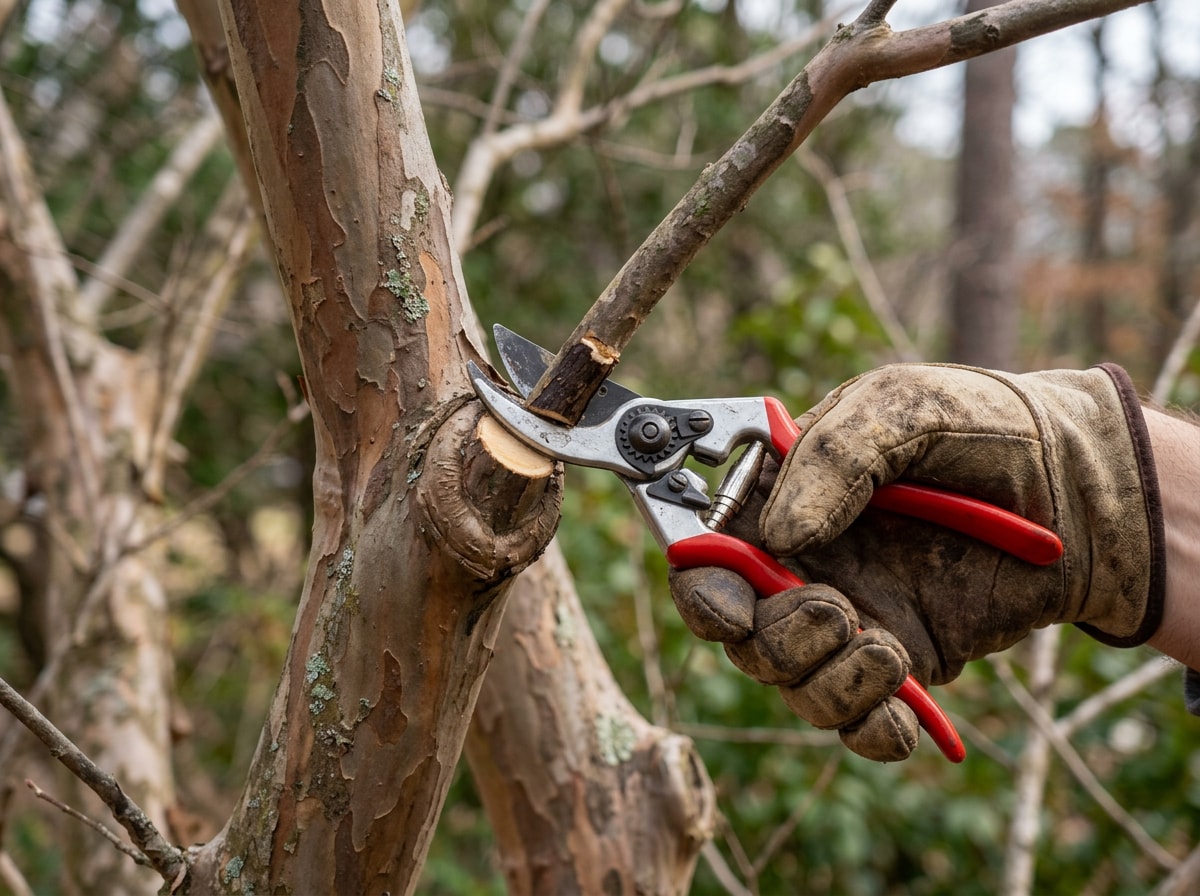
Make each cut just outside the branch collar, the slightly swollen ring where a branch meets its parent limb. Cutting flush against the trunk removes the tree's natural defense tissue and heals far more slowly. Poor pruning can cause damage that lasts for the life of the tree, and small cuts do less damage than large ones , so favor earlier, smaller cuts over waiting for a problem to grow.
Step 2: Remove Suckers and Water Sprouts
Crepe myrtle suckers sprout from the roots or trunk base, while water sprouts shoot straight up from established branches, usually after stress or past over-pruning. Both pull energy away from the main canopy. Remove any future growth from the ground to retain the desired tree shape rather than snapping or pulling it, which tears bark and invites disease.
Take water sprouts off where they meet the branch, using the same branch-collar technique as Step 1.
Step 3: Resolve Crossing and Inward-Growing Branches
Step back and judge the canopy as a whole. A mature crepe myrtle should form an open, vase-shaped canopy with branches spreading outward rather than crowding the center. Cut out anything that crosses, rubs, or grows inward, addressing branches crossing or rubbing against each other and shoots growing into the center of the canopy at their point of origin.
Thinning interior branches improves airflow, which helps leaves dry faster after rain and cuts down on fungal issues. Stay under that 25% canopy limit for the season. For trees with real structural problems, a professional tree pruning service can assess what's actually safe to cut.
Tools for the Trim
Matching the tool to the branch size matters as much as timing. The wrong tool crushes fibers instead of making a clean cut, and crushed wood heals slower and invites decay.
| Tool | Branch Diameter | Best For |
|---|---|---|
| Bypass hand pruners | Up to ¾ inch | Twigs, suckers, deadheading spent blooms |
| Bypass loppers | ¾ inch – 2 inches | Water sprouts, small crossing branches |
| Folding or pole pruning saw | 2 inches and up | Structural wood, dead limbs, hard-to-reach cuts |
Wipe blades with rubbing alcohol between cuts, especially when moving from diseased wood to healthy branches, to avoid carrying pathogens from tree to tree. The International Society of Arboriculture publishes consumer guidance on proper pruning cuts and tree health that's worth a read before a big job. For buying or renting the right gear locally, our tree trimming tool guide breaks down what Spokane homeowners actually need.
Signs Your Crepe Myrtle Needs Expert Tree Care
Even with good timing and the right tools, some problems go beyond a DIY pruning session.
- Sparse or absent blooming for two or more seasons
- Sooty black mold coating leaves or branches
- White, waxy scale insects clustered on bark
- Branch-tip dieback spreading toward the trunk
- Thin, weak shoots regrowing from old topping cuts
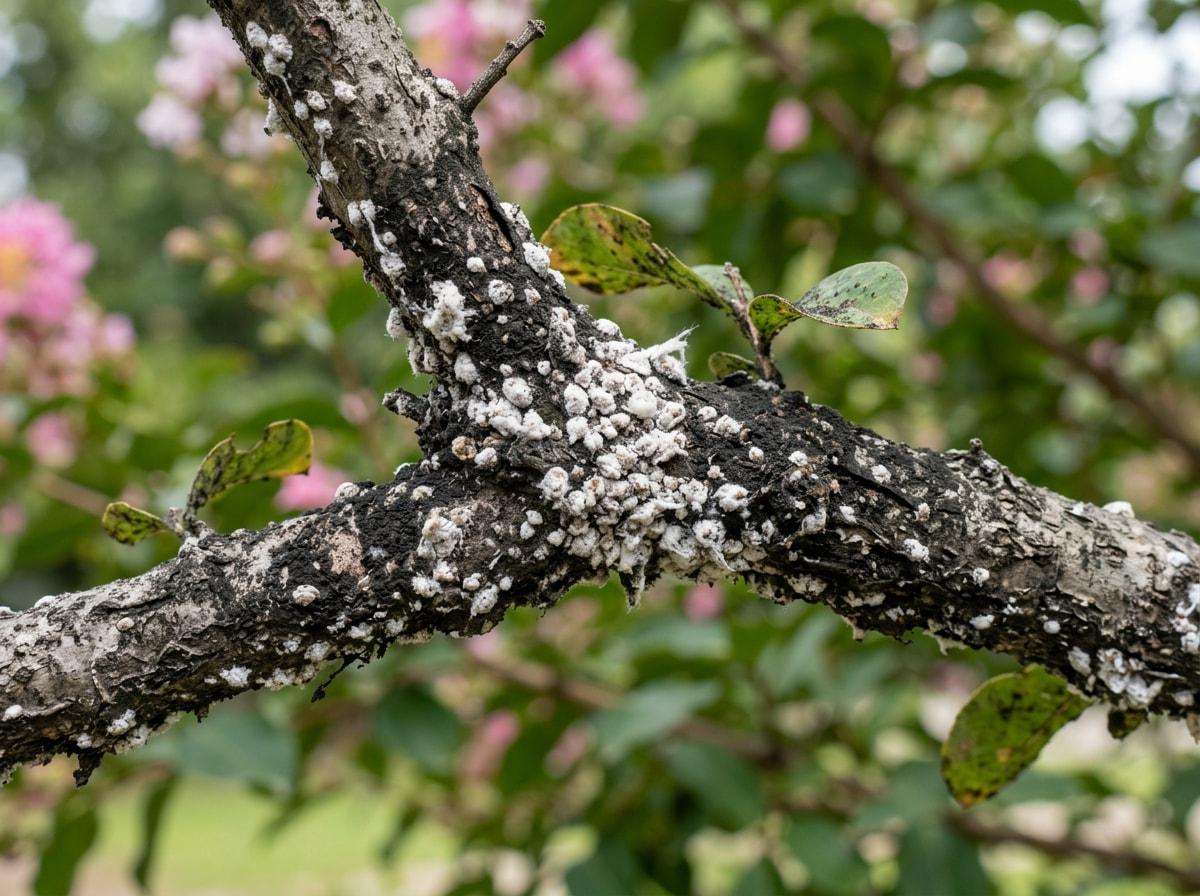
The white, waxy insects are usually crape myrtle bark scale. One field technique to identify crapemyrtle bark scales is to crush suspected female shelters with a fingernail, which should produce a pink streak , and sooty mold is strongly associated with CMBS, which produces copious amounts of honeydew that feeds the mold . Seeing several of these signs together usually means the tree needs more than routine trimming.
For pest pressure like this, or any tree that seems to be declining without an obvious cause, a tree health consultation can catch the problem before it spreads to nearby plants.
Regional Considerations: Cold-Hardy Cultivars for the Inland Northwest
Crepe myrtles carry two different cold thresholds, which explains a lot of confusion about whether they'll survive here. Above-ground branches are considered winter hardy to zone 7, while the roots are usually, though not always, hardy to zone 5 . In practice, a hard Spokane winter can kill branches back to the ground even on a healthy tree, and the regrowth the following spring can look like dieback when it's really normal cold damage, not a dying plant.
Washington growers have already worked out which varieties handle this best. Dwarf Bellini Crape Myrtles are hardy to Zone 5 even, with a shorter shrubby habit perfect for small sunny locations , and Lagerstroemia indica x fauriei hybrids like 'Pecos' (pink) and 'Zuni' (lavender purple) were among the first hardy hybrids seen in our area . If you're planting new stock, these cultivars shrug off freeze-thaw cycles better than varieties bred purely for Southern heat.
Because dormant season runs longer here and spring arrives later than in warmer regions, late timing matters more. Cutting too early risks exposing fresh wounds to another freeze, while waiting too long delays the growth needed for a full summer bloom. Our crews track these patterns across the Spokane, WA service area every season, and a quick walk-through before you cut can save a tree a full year of recovery.
If your crepe myrtle has multiple issues at once, or you're simply not sure where to start, get a free estimate and we'll walk the property with you before anyone picks up a saw. You can also browse recent work on our projects page or visit the homepage for our full range of tree care services.
FAQ
When is the best time to trim crepe myrtles in Spokane, WA?
Late winter dormancy, typically in March once the hardest cold has broken. If you're growing crepe myrtle in Zones 5 or 6, wait until March to prune or after the last risk of frost , since cutting earlier can expose fresh wounds to another freeze.
How much does crepe myrtle trimming cost in Spokane?
Nationally, Angi's 2026 cost data puts crepe myrtle trimming between $80 and $400 , with tree size, trunk count, and access driving most of the spread. For Spokane-specific pricing by tree size and job type, see our average cost to trim a tree in Spokane, WA guide.
Can I cut my crepe myrtle back hard, or will that kill it?
It usually won't kill the tree outright, but it will weaken it over time and ruin its natural form. Severe pruning removes large portions of the tree's developed scaffold branches and replaces that growth with weak shoots that aren't strong enough to support the blooms . Stick to selective thinning instead of topping.
My crepe myrtle was topped years ago. Can it still be saved?
Yes, in most cases. Choose the strongest two or three sprouts from each stub and remove all of the other sprouts each dormant season. Repeating this over two or three winters gradually rebuilds a natural branch structure instead of the dense cluster topping creates.
Should I trim my crepe myrtle myself, or hire a professional?
Light maintenance (deadheading, snipping suckers, removing small twigs) is manageable with basic pruning tools. Structural thinning on a mature tree, storm damage, or branches near power lines is safer left to a trained crew. If you're unsure which category applies, request a quote from our team for an honest assessment before you commit to a DIY job.
Do crepe myrtles survive winters in Spokane?
Most years, yes, especially cold-hardy cultivars. A severe winter can still kill top growth to the ground even though the root system typically survives, since above-ground branches are considered winter hardy to zone 7, while the roots are usually, though not always, hardy to zone 5 . New shoots from the root crown the following spring are a recovery sign, not a reason to remove the plant.